
Ecommerce Microservices: A Complete Guide to Architecture, Benefits, and Implementation

Enterprise ecommerce platforms rarely become difficult to change simply because the codebase has grown too large. The friction often appears when different parts of the business need to move at different speeds. One team wants to launch a promotion while another is protecting checkout before a traffic peak. Catalog updates, regional integrations, and customer-facing experiments have their own priorities, yet a shared release process forces everyone to coordinate around the same platform. A routine change in one area becomes a concern for teams that have nothing to do with it.
This is where microservices enter the conversation. Giving a capability its own service boundary can let teams release, scale, and operate it without pulling the rest of the commerce platform into every change. But splitting a system into services doesn’t automatically make it easier to manage. The dependencies still exist, and poorly chosen boundaries can turn familiar coordination problems into a much less familiar set of distributed ones.
That distinction matters in the enterprise systems we at Expert Soft work with. Sometimes the need starts with architecture, sometimes with scale, ownership, release independence, or integration pressure. This guide reflects that broader experience: it looks at where service boundaries help, where they create new operational demands, and what teams should understand before deciding how far to take a microservices approach in production.
Quick Tips for Busy People
If you need the short version of the main ideas of the article, keep these points in view.
- Start with the pressure, not the pattern: A service boundary earns its place when change, load, or integration volatility is materially different from the rest of the platform.
- Keep the core where it works: A modular monolith, a selectively extracted service, and a managed component are different answers to the same question of how much independence a capability needs.
- Make benefits conditional: Targeted scale, safer change, fault isolation, and clearer ownership appear only when the boundary and operating model are credible.
- Give ownership a business shape: A team can operate a service effectively when it owns one understandable capability rather than a technical layer or a shared utility bucket.
- Make data and interfaces deliberate: Clear source-of-truth rules and sufficient API or event contracts prevent independent services from creating hidden coordination work.
- Build safe delivery with the boundary: Contract-aware testing, observability, and a realistic rollback path make a small extraction safe enough to learn from.
- Control distributed complexity early: Dependencies, consistency, resilience, caching, security, and incident visibility need named controls before the estate grows.
- Use the roadmap to test a real hypothesis: Begin with one constrained capability, measure whether independence improves it, and stop if the evidence does not support broader decomposition.
- Let front-end and back-end boundaries complement each other: A domain can evolve more freely when its customer experience and supporting capability share clear ownership without being forced into a one-to-one design.
- Give fast-changing AI behavior a controlled place to evolve: A separate service can isolate provider, cost, latency, and review concerns while the commerce core stays accountable for stable commerce behavior.
The rest of the article turns those principles into a microservices development decision framework for ecommerce enterprise platforms.
Microservices in Ecommerce Architecture: What They Change
In an ecommerce platform, microservices help redistribute responsibility across domain teams, data, integrations, and the release process. Instead of one deployable application holding most commerce behavior, a service owns a bounded capability and exposes a contract to the rest of the system. In practice, that affects data, integrations, deployment responsibility, failure boundaries, and the conversations teams need to have before a change goes live.
Not every capability needs that level of independence. A service boundary becomes useful when a part of the platform has its own operating profile: it changes at a different pace, needs to scale separately, or creates enough risk that teams need to isolate its impact from the rest of the commerce flow. That is why areas such as search, pricing, catalog processing, or external integrations often become natural candidates, while more stable behavior may remain inside the core.
Once a capability becomes independent, the architecture also needs a clear way for it to participate in the wider commerce flow. Some interactions require an immediate response through an API, others are better handled asynchronously through events. In an order journey, for example, payment, fulfillment, notifications, and analytics may all depend on the same business event without needing to execute in the same transaction or release cycle.
At that point, the architectural question becomes broader than microservices alone. A microservices architecture for ecommerce is an operating design question: teams are deciding how different commerce capabilities should be composed, operated, and evolved together while keeping their boundaries clear. A microservice may be one part of that model, but so can a modular core, a SaaS capability, or another independently managed component. That is where the conversation naturally moves from microservices to composable architecture.
Microservices vs composable approach
Composable commerce is an approach to assembling an ecommerce platform from capabilities that can be selected, replaced, and evolved without treating one vendor suite as the only option. Microservices, headless commerce, and SaaS modules can all contribute to that approach, but they operate at different layers:
- Microservices split back-end responsibilities;
- headless commerce separates experience delivery from commerce capabilities;
- Composable commerce describes how those capabilities are combined and governed.
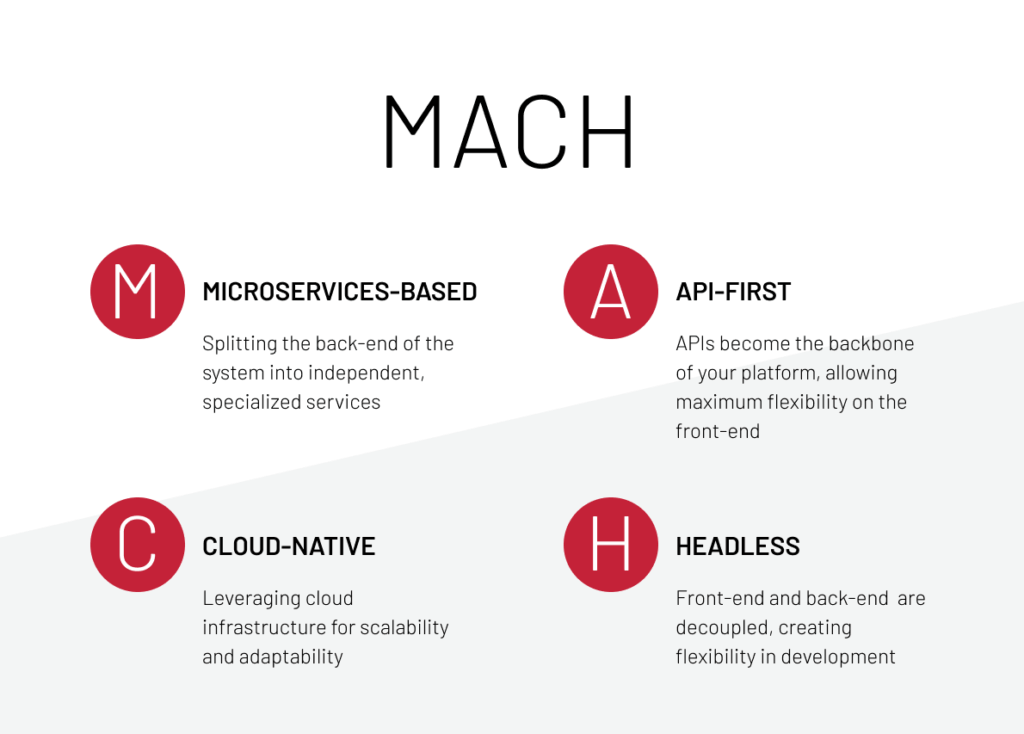
The MACH approach is the vocabulary often used when those building blocks appear together: Microservices-based, API-first, Cloud-native SaaS, and Headless. It is helpful as a map, not as a recipe. A headless storefront may still rely on a modular monolith, and a microservice estate may still be tightly coupled through shared data and release coordination.
That broader set of options changes the practical question. A team does not have to choose between a legacy platform and a fully distributed future. It can decide which constraints belong in the core, which capability may deserve an independent boundary, and where a managed component provides enough value. The next section makes those three choices concrete.
Ecommerce Microservices Architecture Options
In this article, as well as in real enterprise environments, the choice often is not between a monolith that has failed and a fully decomposed platform that has arrived. Mature enterprise ecommerce systems often sit between those poles for good reasons.
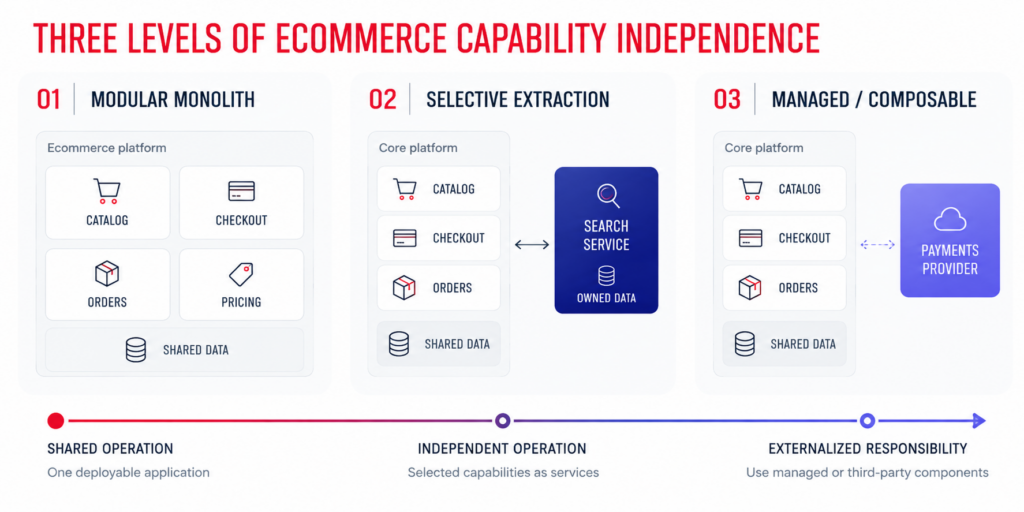
These are not three variants of microservices architecture. There are three common ways enterprise ecommerce teams decide how much independence a capability actually needs. One option keeps the capability inside a modular core, another extracts it into an independently operated service, and the third shifts more responsibility to managed or composable components. The choice depends on the constraint the team is trying to remove and on how much operational complexity it is prepared to own.
A modular monolith is the option that stops short of service extraction. It is a deliberate choice for capabilities that need to change and transact together. It keeps the core as one operating unit when a single team, shared data, and strong consistency are more valuable than independent deployment. Local calls, one deployment unit, and simpler debugging can be exactly what a stable core needs.
Selective extraction is where microservices enter the picture more directly. The core remains intact, while one capability is separated because its load, integrations, or change cadence has become disproportionate. Search indexing, high-volume product data delivery, a regional integration, or an AI feature may warrant a boundary before order management or pricing does. The aim is to remove a specific coordination or load constraint, not to scatter a platform into smaller codebases.
Selective evolution does not always mean extracting a back-end microservice. The same principle applies whenever one part of the platform needs more independence than the rest. In an Expert Soft project for a Big Three credit-rating company, the main constraints were slow data retrieval and an aging interface, but replacing the whole platform would have solved more than the actual problem required.
The team introduced a React-enabled front end with microfrontends so product-specific areas could evolve independently, while the data layer was modernized separately through near-real-time synchronization for search. The architecture changed along the boundaries where pressure actually existed: experience delivery, team-level ownership, and data freshness. The rest of the platform did not need to move simply because those areas did.
Managed and composable platforms answer a different question: where should the business stop owning implementation detail? They fit when a capability is not a source of differentiation and a product or SaaS component can meet it through stable contracts. That can reduce build responsibility, but it does not remove responsibility for data, contracts, and customer-facing outcomes.
If your commerce core is stable but a fast-changing capability is not, this whitepaper offers a way to assess selective isolation before committing to broad decomposition.
Download the white paperOnce the alternatives are visible, the decision becomes less ideological. The next question is whether the ecommerce platform has the kind of pressure that makes a service boundary worth its operating cost.
When Microservices Fit Ecommerce: Benefits and Opportunities
When Microservices Fit Ecommerce: Benefits and Opportunities
Microservices fit when a capability needs a distinct operating model: it changes independently, needs targeted scale, has a clear owner, and can communicate through understandable data and interface contracts.
When a capability has a genuine need for its own operating model, extracting it into a microservice can do more than separate one part of the architecture from another. This is where the microservices benefits become tangible, creating opportunities to improve change, scale, reliability, and ongoing development:
-

Targeted scaling
lets a team add capacity to the workload under pressure without scaling the whole commerce platform.
-

Safer change
narrows the release surface when one capability can be tested and deployed independently.
-

Fault isolation
can keep a non-critical dependency from becoming a platform-wide outage when failure behavior is designed explicitly.
-

Clearer ownership
gives one team responsibility for a capability's roadmap, reliability, and operational decisions.
-

Integration flexibility
contains partner-specific variation behind a boundary instead of spreading it through shared commerce code.
-

Focused performance work
lets a team tune data access, caching, and processing for one user journey rather than compromise for every workload.
The value of that separation becomes clearer under real retrieval pressure. A global credit-rating company needed its analytical portal to support search and filtering over a rapidly growing data set, while the source database already held more than 60 million records and continued to grow by millions each day.
Expert Soft moved the retrieval flow into a separate serving layer built around Kafka, MongoDB, and Redis, while Postgres remained the source of record. That separation did more than improve data delivery. It gave the high-volume search and filtering workload its own performance profile, so it could be tuned and scaled without forcing the transactional source database to absorb the same pressure. It also made the retrieval path easier to evolve independently as access patterns changed, while keeping data ownership clear and limiting the impact of future changes on the rest of the platform.
In practice, the microservice boundary strengthened the platform in several of the ways described above: targeted scaling became possible around the retrieval workload, performance optimization could focus on one user journey, and ownership of the serving layer became clearer without weakening the source-of-record model.
The benefits are conditional. Without clean boundaries and accountable teams, independent deployment can simply create more release paths to coordinate.
Core Principles of Ecommerce Microservices Architecture
Once a platform has identified a capability worth isolating, the attractive part is usually the first service. The demanding part begins after it exists. A new boundary introduces questions the former codebase could postpone: who changes it, who writes its data, what other teams may rely on, and how a partially failed workflow recovers.
The following microservices implementation best practices connect rather than compete. Ownership makes a boundary meaningful: it guides the data and interface decisions that make incremental delivery safe. The next principles turn that idea into practical design choices.
Start with commerce domains and accountable ownership
Begin with a business capability that a team can both change and operate. A service called ‘common utilities’ is a warning sign. A product-data enrichment flow, inventory-availability view, or promotion calculation has a more testable reason to exist.
The Single Responsibility Principle is useful here: each service should own one coherent business responsibility, not accumulate unrelated work because it happens to use similar technology. Teams can identify that responsibility through a business capability or a bounded domain context. A search service that also handles authorization and payments becomes difficult to scale, maintain, and operate safely.
Set service boundaries around changing capabilities
Technical layers alone do not make strong boundaries. A separate database service, API service, and business-logic service may still need to change together for every product decision.
Look instead for changes that repeatedly arrive together within one capability and independently from others. A regional fulfillment adapter that changes with carrier rules may deserve a boundary. A stable function that is always released with checkout may not. This is how teams avoid creating a distributed version of the same coupling they were trying to reduce.
Make data ownership and consistency explicit
Each service needs an understood authority to write its data, even when other services read a projection or receive an event. “Shared database for convenience” often becomes shared schema ownership, then shared release risk.
Consistency is a business decision as much as a technical one. A cart total, stock indication, promotion, and order confirmation do not all need the same freshness rules. Name what must be immediately consistent, what may be eventually consistent, how conflicts are handled, and which event or version marks the change.
The data-delivery system discussed earlier used the same principle in a different place. In that project, the source held a broad analytical model, while the portal needed complete index documents ready for search and filtering. Its enriched messages carried the context needed to build a complete serving document, so the receiving flow did not repeatedly return to the source database.
That made high-volume processing more predictable because the contract supplied the information the downstream service actually needed. The lesson is not that Kafka is a universal answer. It is that a receiving service needs a sufficient, owned data contract.
Design APIs and events around real commerce operations
Interfaces should represent actions that matter to commerce, such as reserving inventory, publishing a price, accepting an order, or updating a product attribute, rather than expose an internal data model and ask every consumer to reconstruct meaning.
A gateway can give storefronts and external consumers one stable entrance to those capabilities, while individual services evolve behind it. In some cases, a backend-for-frontend is useful when a storefront, mobile app, and operator tool need different views of the same domain. The point is not to place another layer in front of every service. It is to keep client-facing contracts understandable while service locations, implementations, and release cadence change.
API contracts still need versioning and compatibility discipline. Events need named ownership, schema-evolution rules, idempotent consumption where duplicates are possible, and observable failed handling. In commerce, a small interface change can cross order, payment, inventory, catalog, customer, and partner boundaries.
Enable incremental delivery testing and safe change
The safest extraction is usually staged. Route a limited traffic slice, run the new path beside the existing one where comparison is possible, and make rollback realistic before a peak period makes theory expensive. Contract-aware tests, service-level telemetry, and incident runbooks should arrive with the boundary, not after it causes its first production ambiguity.
The same principle applies beyond the extraction itself. Safe change depends on how independently the new service can be tested, released, observed, and rolled back without forcing unrelated parts of the platform to move with it. Release isolation, automation, contract-aware testing, and risk-based validation make staged delivery practical and help teams compare the new path with the existing one before committing fully.
Over time, the same delivery discipline can also contribute to reducing deployment time, because smaller, better-isolated changes require less coordination and carry a narrower release surface.
See how to separate read-heavy workloads and scale data access without rewriting the systems that still work.
A new service makes one capability easier to change, but it also makes calls, data, and failures travel across a boundary. The next question is operational: how do teams keep those dependencies understandable as the platform grows?
Managing Microservices Complexity in Ecommerce
Microservices don’t remove complexity. They move it from internal code paths into contracts, network calls, data synchronization, deployment coordination, and operational visibility. That is not an argument against them. It is a reason to make the controls visible before the estate becomes too large to reason about.
A compact complexity-to-control map is more useful than a catalog of failures:
-

Dependency sprawl needs contracts and ownership.
Keep service responsibilities narrow, document critical dependencies, and make API and event compatibility a deliberate release concern. The common microservices challenges begin when services are nominally independent but still rely on fragile synchronous chains.
-

Distributed data needs explicit consistency rules.
Define the source of truth for each business fact, make replication and reconciliation visible, and tell consumers what freshness they can expect. A boundary is healthier when it does not disguise uncertainty about who owns the data.
-

Latency and cascading failure need resilient interaction patterns.
Bound timeouts, make retries selective and observable, use idempotent handlers where repetition is possible, and provide a useful fallback when a non-critical dependency cannot respond. These are design choices, not emergency patches after the first incident.
-

Performance pressure needs cache discipline.
Decide what can be cached, how it is invalidated, what the acceptable staleness is, and how the system behaves when the cache misses or fails. Caching in microservices can protect a commerce journey, but only when it has a named owner and an observable policy.
-

Security across services needs shared controls with local accountability.
Central identity, policy, and secret-management practices can reduce inconsistency, while each service owner remains responsible for the data it exposes, the permissions it enforces, and the dependencies it trusts.
-

Delivery visibility needs observability and incident practices.
A team should be able to trace a customer action across services, correlate logs and metrics, see failed events, and exercise a recovery path before a high-volume period makes the gap expensive.
To see how these controls work in practice, consider a modernization project for a trusted credit-assessment company. The client had several platforms with different login methods, which made authentication and access management harder to keep consistent across the environment. Expert Soft introduced a centralized Launchpad to identify the platform and required login method, enabled single sign-on for users entitled to multiple platforms, and migrated authentication to Amazon Cognito with managed MFA, adaptive authentication, and federated identity controls.
This is a practical example of shared security controls with local accountability. Authentication was moved onto a common foundation instead of being handled independently by each product, while platform-specific permissions and data access remained with the systems that owned them. The result was a more consistent security model without forcing all authorization logic into one centralized layer.
Microservices Implementation Roadmap
By this point, you have seen the fit signals, the boundaries, and the operating cost of ecommerce microservices implementation. So, the next logical question is “Where to start?”
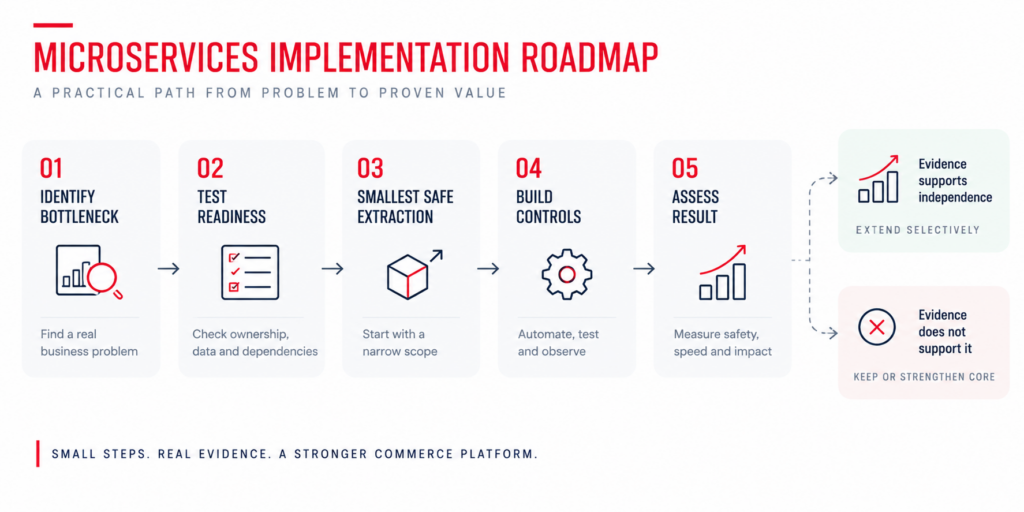
The roadmap below is not a fixed migration recipe. It is a way to turn assessment into a safe first experiment: begin with the pressure you can see, make the scope small enough to learn from, and build the controls that let the team decide whether to continue.
-
Identify the bottleneck
Start with the repeated symptom and the business capability behind it: a discovery path, partner integration, data-serving flow, or release constraint.
-
Test readiness
Check whether one team can own the capability and whether its data, dependencies, and operational risks are understandable enough to manage separately.
-
Choose the smallest safe extraction
Make coupling explicit, keep the first scope narrow, and preserve a clear fallback to the core where it is needed.
-
Build the controls
Add delivery automation, contract checks, observability, security controls, and incident paths before the new boundary becomes business-critical.
-
Assess the result
Measure change safety, delivery speed, stability, user impact, and operating cost; use the evidence to decide whether to extend the pattern.
The assessment is useful even when it leads to restraint. For teams evaluating microservices for ecommerce, strengthening the modular monolith is a sound decision when the platform does not yet have a credible first boundary or the organization cannot support one. If one capability remains repeatedly constrained, selective extraction can be the right endpoint without a wider rewrite.
Expert Soft can help identify where microservice boundaries make sense and implement them without disrupting the stable core.
Contact UsThe back-end boundaries discussed so far determine how capabilities change, share data, and recover from failure. But customers experience those capabilities through journeys such as discovery, product comparison, account management, and checkout.
When different teams need to evolve parts of those journeys without waiting for one shared storefront release, the same question of domain ownership reaches the front-end. That is where microfrontends become relevant.
Microfrontends for Ecommerce: When They Complement Microservices
Microfrontends matter here not as a separate front-end topic, but as the customer-facing complement to the boundary decisions already discussed. A microservice can give a domain control over the back-end capability that supports a journey, while a microfrontend can give that same domain room to change the interface through which customers use it.
The benefit is not a prescribed one-to-one pairing. It is clearer room for a domain to change across the experience and the back end, provided shared language, integration discipline, design-system governance, and release coordination prevent coupling from simply moving to the browser.
A financial analytics platform we worked on shows how this front-end independence can work in practice. The interface had several product areas that needed to evolve at different speeds, so treating the whole front end as one release unit created unnecessary coordination. Expert Soft moved each microfrontend into its own repository and used Amazon S3 with a JSON import map to introduce updated components independently.
That setup gave teams more control over the parts of the experience they owned: they could release and debug them separately without breaking the platform into visibly disconnected products.
In ecommerce, the same logic can complement microservices when a domain needs independence on both sides of the boundary. A product-discovery team, for example, may own both the customer-facing journey and the back-end capability behind it.
The value is not in forcing a one-to-one mapping between microfrontends and microservices, but in aligning ownership, contracts, and release freedom around a domain that genuinely needs to move independently.
How Microservices Support AI Adoption in Ecommerce
AI belongs in this discussion because it is increasingly becoming part of the same commerce platforms that teams are trying to keep stable. A review summary, product-discovery aid, or content-enrichment flow may need a very different release rhythm and operating profile from the core that manages orders and pricing. Its behavior can shift with provider performance, model quality, retrieval logic, or cost controls, while the commerce core still needs to remain predictable. That difference is what makes a separate service boundary worth considering.
A well-bounded service gives AI-specific logic its own operating space while the commerce platform keeps responsibility for core commerce behavior and rendering. Teams can adjust prompts, retrieval, provider routing, refresh policies, review checks, and fallbacks without turning every AI change into a change to the core.
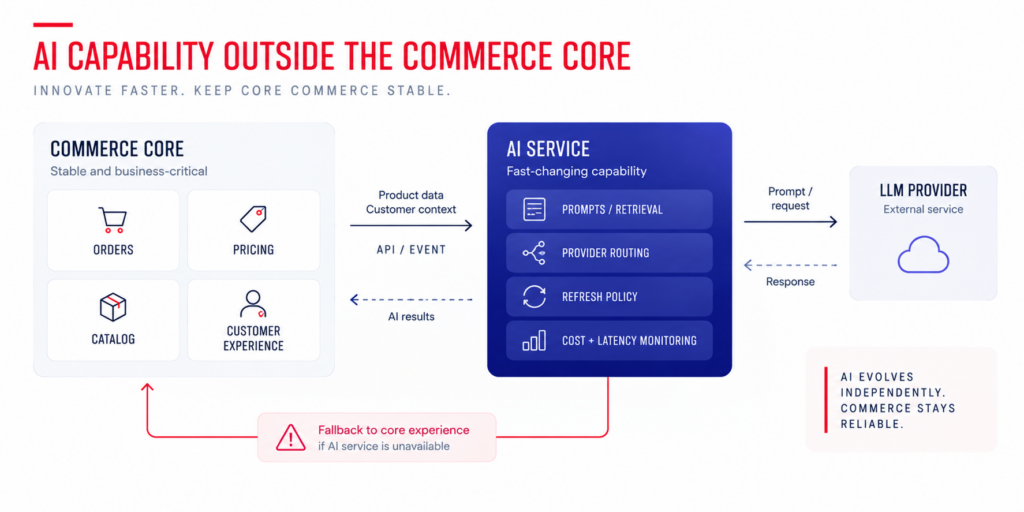
It also makes the operational questions easier to define: who owns the flow, what data crosses the boundary, what happens when the service is unavailable, and how cost and latency are monitored. In that sense, an AI microservice is useful not because AI must always be separated, but because it gives fast-changing model behavior a controlled place to evolve.
We used that pattern in work for a top-15 global health and beauty retailer, where the team introduced AI-review summary functionality without pushing LLM-facing processing into SAP Commerce Cloud. A separate AI microservice handled the generation flow and returned prepared content for SAP Commerce to render. That separation lets the storefront gain new AI functionality while keeping provider interaction and generation logic outside the shared commerce core.
The same boundary also made it possible to control how the feature operated in production. Refreshes were triggered by meaningful review-count changes rather than every review update, reducing unnecessary provider calls and token use. The rollout also exposed a cache-visibility issue for the target customer group, which reinforced an important point: an AI service may be separate from the core, but it still has to work with the platform’s caching, access, and release behavior.
The AI case is useful because it makes the boundary decision visible in a concrete setting. The model-facing logic had different cost, release, and operational needs from the commerce core, so giving it a separate operating space solved a real mismatch rather than creating separation for its own sake.
The same test applies beyond AI: before extracting any capability, teams need to understand whether its pressure, ownership, data, and operating needs are distinct enough to justify another independently run part of the platform.
What to Assess Before Moving to Microservices
A service boundary is easy to draw on a diagram. The harder part is proving that the capability behind it can actually stand on its own in production. Before making that call, teams need to look at the pressure they are trying to remove, the data and dependencies that will cross the boundary, and the operational responsibility that comes with creating another deployable unit.
The questions below help structure that discussion:
- Where do change, load, or integration bottlenecks actually appear?
- Which business capability has a coherent owner and a different change cadence from the core?
- What data does that capability own, and what freshness or consistency does the business truly require?
- Which APIs, events, partners, and downstream consumers would become part of the boundary?
- Can the team support automated delivery, contract testing, observability, security, and incident response for another deployable unit?
- What should improve if the change succeeds: stability, speed of change, targeted scale, or cost of ownership?
Treat these questions as a decision lens, not a migration sequence. Together they test whether a proposed boundary has a real business reason, a viable operating model, and an outcome worth measuring.
That assessment tells a team whether a boundary makes sense under today’s platform conditions. But those conditions are not static and can change following the current microservices trends.
Ecommerce Microservices Trends
This is where the broader landscape matters. Once the architecture basics are clear, the next useful question is not “what technology is popular now?” but “what is changing around service ownership and operation, and how does that affect the decisions teams make today?”
Across Expert Soft client projects, we see that shift clearly. Teams are less interested in decomposing platforms for its own sake and more focused on making selective independence sustainable. The trends below show how the environment around microservices is changing and what teams increasingly need in place if they want service boundaries to remain useful rather than become another source of coordination overhead.
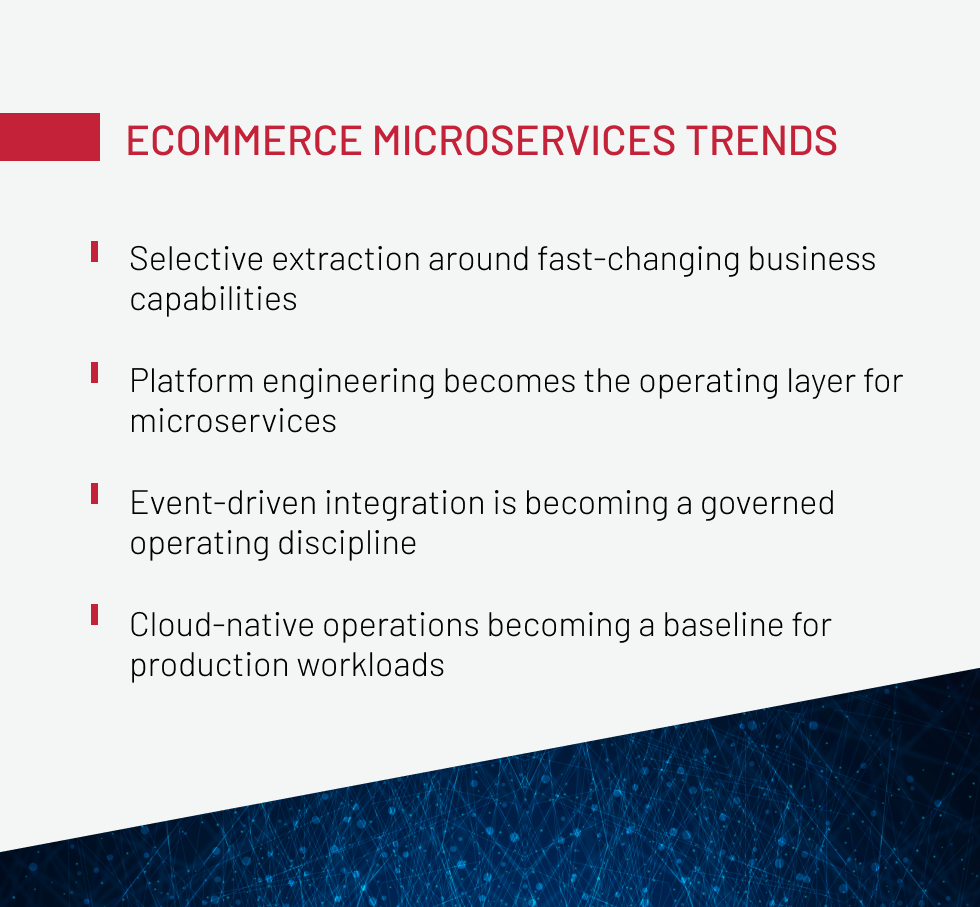
Selective extraction around fast-changing business capabilities
Selective extraction is becoming a practical way to introduce microservices without turning modernization into a platform-wide rewrite. Even in large, tightly connected ecommerce systems, teams can keep a stable shared core in place while moving individual capabilities into separate services when they need more room to change, scale, or operate independently.
The review-summary case above illustrates this well. The retailer still runs a large shared codebase on SAP Commerce Cloud, but the AI workflow had a very different operating profile from the commerce core. Rather than pulling the whole platform apart, the team gave that workflow its own service boundary, with separate refresh logic and cost controls. The core remained where it was already doing its job; the faster-moving capability gained space to evolve on its own terms.
We see the same direction across complex client platforms: microservices are often introduced selectively, around the parts of the system where change or load pressure actually justifies an independent boundary. The result is less about “moving to microservices” as a single transformation and more about reshaping the platform one meaningful boundary at a time.
Platform engineering becomes the operating layer for microservices
Microservices give teams more independence, but that independence creates a new problem as the service estate grows. Every service still needs a deployment path, access controls, observability, runtime configuration, security checks, and a reliable way to recover from failure. If each team builds those foundations independently, the architecture may become distributed faster than the operating model can keep up.
This is where platform engineering is gaining ground. Instead of asking every service team to solve the same infrastructure and delivery problems from scratch, platform teams provide shared tooling, self-service workflows, and standard paths for common operational tasks. The service teams still own their applications, but they operate them on a more consistent foundation.
DORA’s 2025 research reflects how established this approach has become: 90% of organizations reported using an internal developer platform, and 76% had dedicated platform teams. For ecommerce teams expanding a microservices estate, the implication is practical. More service independence increasingly goes together with more standardization underneath it, otherwise, the coordination burden microservices were meant to reduce simply reappears at the infrastructure and operations level.
Event-driven integration is becoming a governed operating discipline
Event-driven integration has long been useful in ecommerce because different parts of the flow do not need to move at the same speed. What is changing now is the level of discipline around that model.
As event-driven systems grow, the harder problem is no longer publishing an event, but making sure teams know who owns it, how its schema can evolve, what happens when processing fails, whether replay is safe, and how downstream consumers are affected. Without that discipline, asynchronous integration can hide dependencies rather than remove them.
That is why event contracts, schema governance, idempotency, replay strategy, failed-message handling, and end-to-end observability are increasingly treated as part of the operating model, not implementation details. For ecommerce teams, this makes event-driven integration a controlled way to separate workflows with different timing and reliability needs, without turning the platform into a network of invisible dependencies.
Cloud-native operations becoming a baseline for production workloads
As ecommerce teams move more capabilities into independently operated services, the infrastructure underneath them matters just as much as the service boundary itself. Each workload still needs a repeatable way to deploy, scale, observe, secure, and recover. Cloud-native practices are increasingly becoming the common foundation for doing that without rebuilding the operating model around every new service.
CNCF’s 2025 Annual Cloud Native Survey reflects how established that foundation has become: 82% of container users run Kubernetes in production, while 59% of organizations say much or nearly all of their development and deployment is cloud native.
For ecommerce teams, the takeaway is not that every microservice needs Kubernetes. It is that service independence increasingly depends on a standardized operational layer underneath it: shared deployment patterns, policy controls, telemetry, and recovery practices that let teams add services without multiplying operational inconsistency.
Final word
Microservices are useful when they make a specific ecommerce platform easier to change and operate. The point becomes clearer when the conversation starts with the platform people actually have, not the architecture diagram they wish they had. A stable core may carry years of commercial logic, integrations, and customer expectations. Replacing it because microservices are fashionable creates a second problem before the first one has been understood.
The stronger starting point is a constraint that keeps returning: a discovery experience that needs its own scale, a partner integration that changes too often, a data-serving path that cannot keep up, or an AI workflow whose cost and release rhythm do not belong inside the core. Those are the moments when a boundary can earn its operating cost.
Across Expert Soft projects, the most useful architecture work has rarely begun with a declaration to decompose. It has begun with a practical question: which team is blocked, which capability is under pressure, and what would become safer if that capability had an accountable boundary? The answer may be a modular monolith with better seams. It may be one selective extraction.
That is the measure worth keeping. A microservice is a good move when it gives the platform more control over change, stability, and cost than it adds in distributed complexity.
FAQ
-
When do microservices fit an ecommerce platform?
Microservices fit an ecommerce platform when ecommerce capabilities have different change rates, load patterns, integration demands, and accountable teams. They are most useful when a bounded capability can be independently operated without creating more coordination and data-consistency risk than the existing platform has.
-
What benefits can microservices bring to ecommerce architecture?
Microservices can enable targeted scaling, smaller deployment blast radii, fault isolation, and clearer ownership. Those benefits depend on deliberate service boundaries, data authority, compatible interfaces, and operational controls. Without them, distributed complexity can outweigh the flexibility gained.
-
How do microservices differ from headless and composable commerce?
Microservices decompose back-end capabilities into independently operated services. Headless commerce separates the front-end from commerce capabilities. Composable commerce assembles replaceable capabilities into a wider platform. These approaches can coexist, but each addresses a different architecture and operating constraint.
-
What are the main challenges of running ecommerce microservices?
The main challenges are dependency sprawl, distributed data consistency, network latency, security across services, versioning, and limited operational visibility. Teams manage them through explicit ownership, contracts, observability, testing, resilient interaction patterns, and disciplined cache and incident practices.
-
Can ecommerce teams adopt microservices incrementally instead of replacing the entire platform?
Yes, ecommerce teams can adopt microservices incrementally by isolating one constrained capability while keeping the stable core in place. A credible first extraction has an accountable team, understandable data and integration boundaries, delivery controls, and a measurable reason to exist, such as a distinct load profile or repeated change pressure. That approach lets the organization test whether independent ownership improves the platform before it commits to a wider decomposition.
Kate Savastsichuk helps enterprise teams turn modernization goals into operating changes that customers and delivery teams can sustain. Her perspective connects platform evolution with customer experience, organizational workflows, and the control needed to change a business-critical ecommerce system safely.
New articles

See more

See more

See more

See more

See more