

Introducing AI Features into a Top-15 Global Retail Platform
Introducing AI-powered product experience features into a live SAP Commerce Cloud platform, so shoppers could get clearer review guidance and more relevant product discovery without adding uncontrolled load to the commerce core.
Quick Insights



Client
The client is a top-15 global retailer in health and beauty, working in a category where product choice, trust in reviews, and relevant discovery directly affect customer satisfaction and engagement.
Client Need
The client wanted to strengthen the customer experience with AI features that could make product pages more useful for shoppers and support stronger engagement. In a large retail ecommerce environment, that goal could not be treated as a simple AI add-on.
The implementation had to respect the existing SAP Commerce Cloud platform, avoid unnecessary load on the commerce core, and control the cost of LLM usage.
“It was not enough to simply add an AI system. In enterprise ecommerce, it almost never works that way. AI features had to be introduced in a controlled way, without overloading the platform, and with respect for how the commerce ecosystem already worked.” – Daniel, AI Product Owner at a top-15 global retailer in health and beauty.
Solution
Expert Soft approached the work as AI development services for ecommerce inside an existing SAP Commerce Cloud landscape. The client began with customer-facing product experience features, and the Expert Soft team worked on two separate AI lines: review summaries and AI-driven product discovery for similar items.
The team analyzed each business request through the constraints of SAP Commerce Cloud. The core platform needed to keep responsibility for commerce behavior and page rendering, while supporting AI services handled model-facing logic and product selection. This boundary helped the client introduce AI without turning the commerce application into the place where every AI decision and refresh policy had to live.
AI Review Summaries
The review summary feature gives shoppers a shorter way to understand product feedback on the PDP. Instead of making them scan every review immediately, the page can show a concise summary of the main themes above the standard review list.
The feature had to do more than generate a useful summary once. In a large retail catalog, reviews keep changing, while product pages still have to load reliably for live shoppers. That made the architecture question practical: the AI layer needed enough product and review context to prepare meaningful content, while SAP Commerce Cloud had to stay focused on serving the page. This led to a separated flow where the summary was prepared by a supporting AI layer and then passed back to the commerce platform for rendering.
The architecture kept the LLM-facing work outside SAP Commerce Cloud:
- Review data for the product being viewed is collected from the connected review sources before it enters the AI summary flow.
- The review data is passed to a separate AI microservice responsible for model-facing processing.
- The microservice uses an LLM to generate a concise summary of the main themes in the reviews.
- SAP Commerce receives the prepared summary instead of calling the model directly.
- The PDP renders the summary above the standard review list for shoppers.
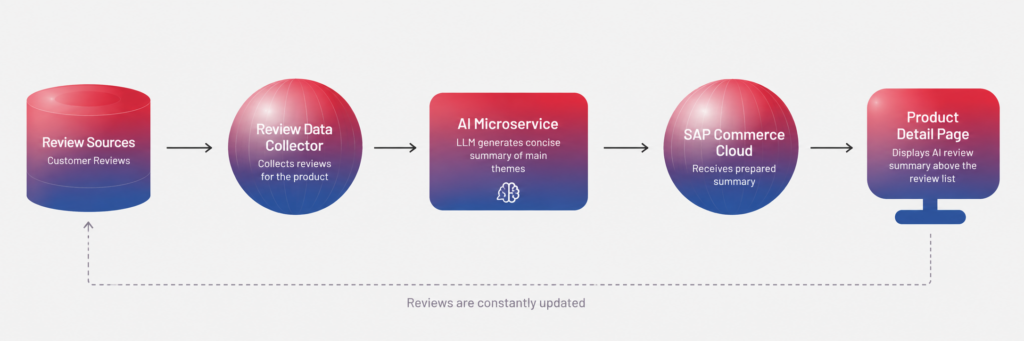
This division of responsibility mattered because the core platform stayed focused on rendering and commerce behavior. The AI microservice handled the model-facing task, which made the feature easier to control and reduced the need to place direct model orchestration inside the core platform.
Cost-Control Logic for AI Refreshes
Launching the summary was only the first part of the task. As new reviews appeared, the content had to stay fresh, but regenerating a summary after every update would have created extra review-provider calls, token consumption, and operational load. Expert Soft therefore built the refresh logic around review-count thresholds, so the AI flow was triggered when the change in feedback was meaningful rather than every time the review data changed.
SAP Commerce runs a scheduled job that exports a product feed as JSON with the fields needed for AI. The feed is uploaded to an Azure hot folder, and that upload triggers an Azure Function. The function reads the feed, calls external review providers for each product, counts the current reviews, and stores those counts in its own database.
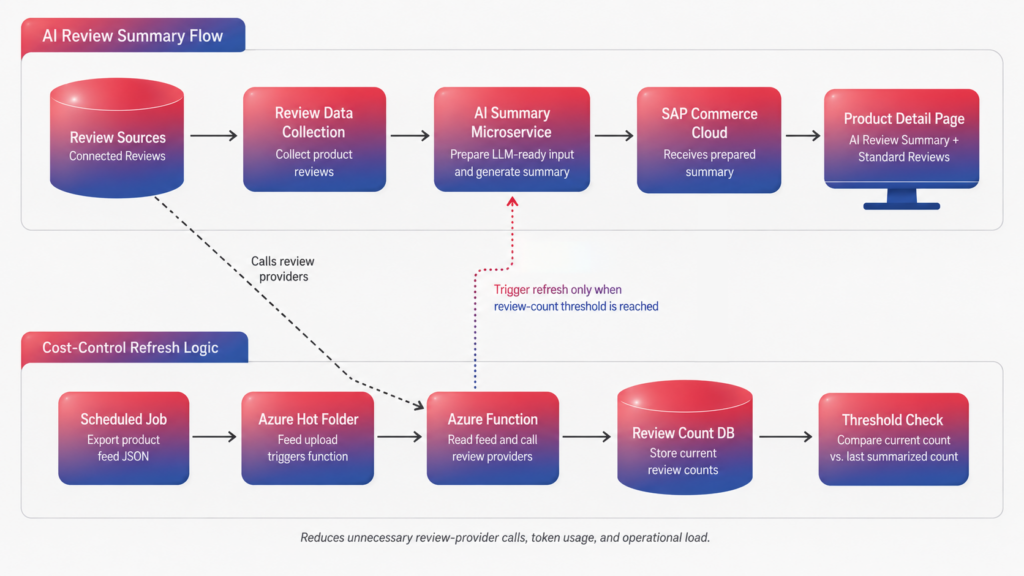
The stored count is compared with the count used for the last AI summary. A new generation request is made only when a configured threshold of new reviews is reached. This ties summary regeneration to a meaningful review-count delta, keeps the refresh policy tunable outside the SAP Commerce core, and reduces unnecessary LLM and API usage.
AI Similar Products
The similar-products capability was implemented as a separate AI feature to help shoppers discover relevant alternatives or related products while viewing a PDP.
Similarity criteria can include attributes such as volume, price, notes, and other product characteristics. These criteria are configured outside SAP Commerce Cloud, while the AI microservice is responsible for selecting the products. The core platform receives the selected result set and renders it on the page.
This kept product discovery logic outside the commerce core. SAP Commerce Cloud did not need to own the full AI selection process, but it remained the place where the customer-facing component appeared in the product experience.
Future Expansion Across Brands and Locations
Because the platform serves different brands and locations, the new AI components had to be reusable without becoming uncontrolled. The initial production test was limited to one brand and one specific location, with visibility managed through a dedicated customer group.
During this test phase, SAP Commerce out-of-the-box component rendering cache initially hid the AI blocks. Components rendered for anonymous users were cached and reused for logged-in test users, so the target customer group could not see the new components as intended.
The caching behavior was adjusted so the AI components were initially available only to a dedicated business user group in SAP Commerce for production testing. After successful validation, the restrictions were removed and the functionality was opened to all customers. The same implementation pattern could then be reused across other locations and brands, providing a controlled path from limited testing to broader rollout.
Outcomes




Technologies
SAP Commerce Cloud, microservices, Azure Function
Conclusion
Expert Soft helped strengthen the SAP Commerce Cloud retail platform with AI features that respected the system around them. Review summaries, similar-product selection, threshold-based refresh logic, and controlled rollout all followed the same principle: AI could add value to the product experience only if cost, load, visibility, and architectural boundaries stayed under control.