
AI Readiness Assessment: 8 Questions to Ask Before Moving AI Pilot to Core Ecommerce Operations

AI pilots are usually good at demonstrating that a model can produce a useful result. The gap appears when that result has to operate inside a live commerce system, where changing data, exceptions, peak load, and ordinary handoffs can affect its value or its impact on customers and frontline teams. Closing that gap requires more than a well-performing model: any workflow that influences a shopper or operator needs a clearly defined responsibility and a safe way to operate when conditions change.
Gartner predicts that more than 40% of agentic AI projects will be canceled by the end of 2027, citing escalating costs, unclear value, or inadequate risk controls. That forecast reinforces a broader point: strong pilot performance does not guarantee predictable behavior in production, especially when an AI workflow lacks clear boundaries. It makes the move into core commerce more deliberate: teams need to know whether one workflow can deliver a useful result at the right time, from data they can explain, with a safe fallback and an owner when it affects operations.
Once a pilot produces a useful result, the next question is whether that result can take on a dependable role in live commerce. In our enterprise commerce work at Expert Soft, that transition changes the standard: a workflow must keep producing a useful outcome through data changes, peak load, exceptions, and ordinary handoffs. The article provides a practical AI readiness assessment for that decision.
Quick Tips for Busy People
If there are core points that you need to know from the article, they’re below:
- Operational purpose comes first: a useful output needs a defined commerce decision, timing window, and consequence before it can become a core workflow.
- Data readiness is contextual: the workflow needs traceable, current business meaning for its use case, rather than a universal platform rebuild.
- Controlled processing protects both cost and trust: refresh only when a meaningful change justifies work, then retain a path to reconcile missed or delayed events.
- Stable commerce boundaries matter: keep AI-specific logic, observability, and policy changes from destabilizing the transaction and rendering responsibilities the core already owns.
- A team needs evidence to scale: measure quality at failure points, latency, spend, escalations, and drift signals, then assign people to act on those signals.
With that context in place, let’s move from the headline criteria to the decisions, controls, and operating boundaries behind each one.
What Is an AI Readiness Assessment?
An AI readiness assessment is a structured review of whether a specific AI workflow can operate responsibly in a live commerce environment. It asks whether that workflow can move from a useful experiment into a controlled part of ecommerce operations, with dependable inputs, defined controls, and a recovery model that the team can operate.
That makes it narrower than an AI maturity assessment. Maturity looks at an organization’s general capacity to work with AI. Readiness asks whether a particular workflow, such as review summarization, catalog enrichment, search assistance, or operator guidance, can safely take on a defined responsibility now. The distinction matters because a mature organization can still have one workflow with unclear data ownership or no safe response to failure.
An AI readiness assessment makes that judgment practical rather than abstract. It gives commerce, data, and AI teams a common way to decide what a workflow may do now, which limits still protect customers and operators, and what evidence is needed before the next expansion.
Taken together, the distinction between maturity and readiness changes the question a team has to answer. The issue is not whether the organization is broadly prepared for AI, but whether one workflow has enough evidence to take on a defined commerce responsibility. The questions below structure that decision.
8 Questions for an AI Readiness Assessment
The questions below examine the conditions that determine whether an AI workflow can move beyond a pilot: a clear business purpose, usable data, controlled processing, safe customer-facing behavior, and accountable operation. They work best as a structured conversation between the people who own the commerce outcome and the people who run the platform. A “partly” answer is valuable when it reveals a bounded gap, a responsible owner, and a practical next step.
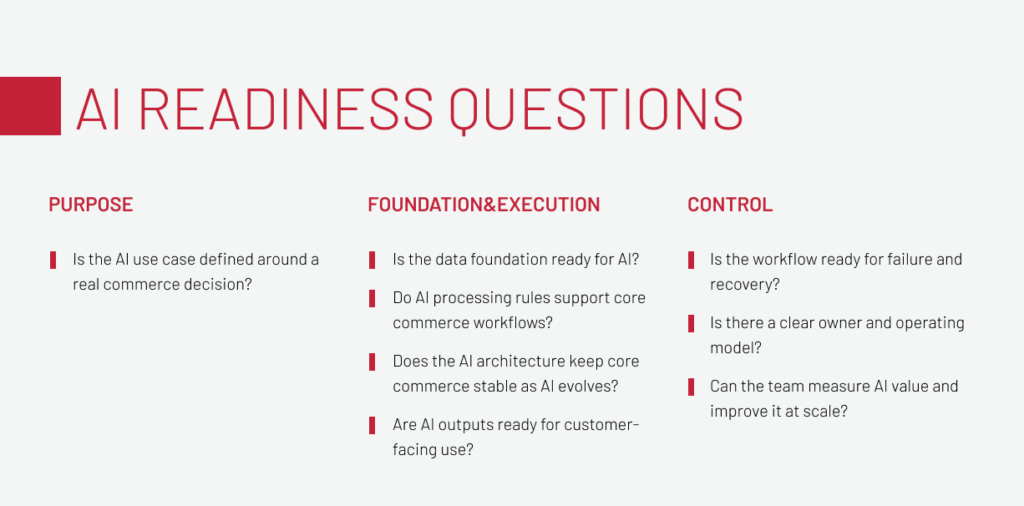
Is the AI use case defined around a business use case?
An AI use case is ready for core responsibility when it supports a specific commerce workflow and can be measured against a current baseline. Start with the business outcome, not the model capability: what task should improve, who uses the result, and what action becomes faster, more accurate, or more effective because of it?
The assessment should define the baseline and the target. Depending on the use case, that may mean conversion rate, time to complete a task, or the time between a customer signal and an operational response. It should also identify the affected workflow, the acceptable timing window, and the consequence if the result arrives late, wrong, or not at all.
Value alone is not enough. A useful design test is whether the workflow has a meaningful trigger, a business-defined timing window, and the smallest safe update unit. Those choices distinguish an attractive demonstration from a defensible operational purpose. A pilot that runs whenever data changes may look responsive while doing work that has no material effect on the commerce decision.
-

Readiness answer:
the team can name the business use case, the affected workflow, the acceptable timing window, and the smallest piece of work that needs an AI result.
Is the data foundation ready for AI?
The question is not whether all enterprise data is perfect. It is whether this workflow receives current, contextual, traceable, consumer-ready data with the business meaning its output needs. A shopper-facing search or product experience feature cannot compensate for unclear product attributes, stale availability, or joins that no one can explain after a result is challenged.
Medallion architecture offers a practical pattern for working with fragmented commerce data. A bronze layer preserves source lineage, silver creates cleaned canonical entities, and gold publishes controlled views that are ready for an AI use case. This is a way to create governed relevance-sensitive views without turning a full platform rebuild into a prerequisite.
See how a governed data layer can help teams prepare enterprise data for multiple AI use cases without treating a full platform rebuild as the starting point.
Talk to Our TeamSolutions built on this layered approach can give teams a practical starting point. For example, an AI Search Readiness Kit uses a read-only layer to surface incomplete attributes, inconsistent variants, and weak signals before they affect an AI search or assistant. That lets a team examine where normalization and quality work are needed without changing source systems or the production search engine.
-
Readiness answer:
the workflow has a traceable source-to-output path, fit-for-purpose data contracts, and known freshness and recovery expectations for the business context.
Do AI processing rules support core commerce workflows?
Processing readiness concerns when the system should work and how much it should change. A model can answer a request in seconds and still be a poor fit for the workflow if every low-value event triggers expensive processing, or if the flow redraws a whole customer-facing result when one local change would do.
Let’s look at an example. For a global retail platform, the immediate task was to make AI-generated review summaries useful without refreshing them every time a new review arrived. The team set a refresh policy around meaningful changes in review volume and limited the initial rollout to one brand and location, so model calls were tied to a defined customer-facing need rather than background activity. That kept processing scope and cost visible while the team tested whether the trigger produced a noticeably better summary.
The pattern above also shapes AI implementation costs: when refresh rules respond to meaningful change, the team avoids turning routine data movement into model calls with little customer or operational value. The cost question is therefore not just how often the model runs, but whether each run serves a defined need.
-
Readiness answer:
processing starts for a business-meaningful condition, runs within a defined timing window, and changes only the safe unit that actually needs renewal.
Does the AI architecture keep core commerce stable as AI evolves?
Core commerce should retain the responsibilities it already handles well, including commerce behavior, transactional integrity, and customer-facing rendering. The AI boundary should give model-facing interactions and their operational rules an explicit home. It should also absorb variable latency, fallbacks, traceability, and AI-specific observability. That boundary is an architectural decision, not a requirement to create a microservice for every capability.
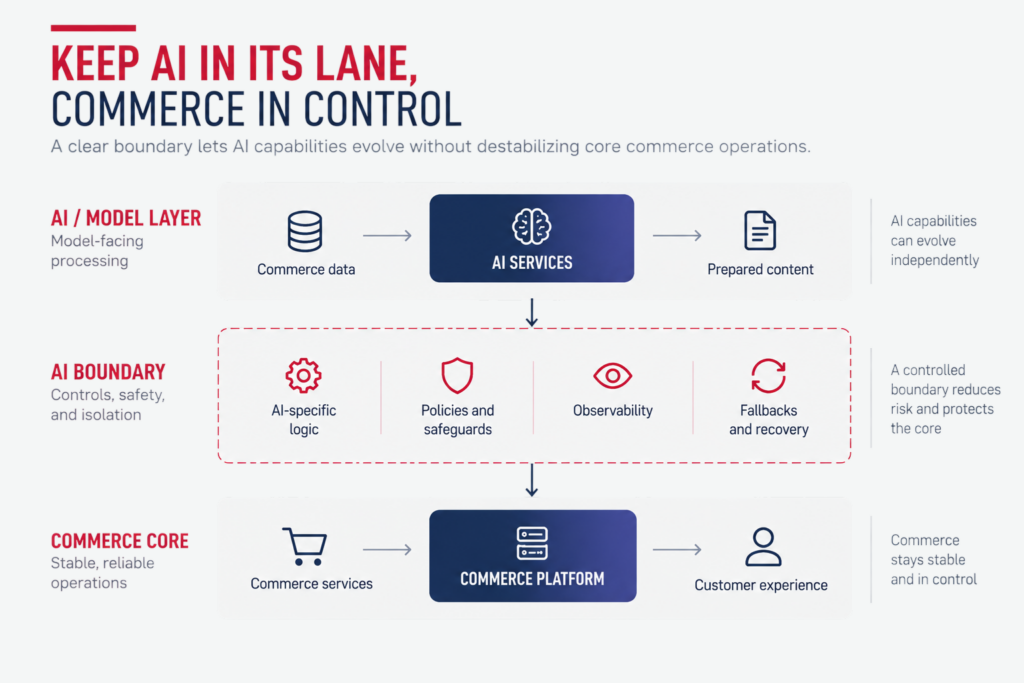
The review-summary implementation mentioned in the previous section used a separate AI microservice layer between the model-facing workflow and SAP Commerce Cloud. The microservice handled the review data and model calls, then returned prepared content for SAP Commerce to render in the storefront. This kept the commerce core responsible for its usual transactional and presentation work, while refresh behavior and model-specific changes could evolve in the separate layer.
Download a whitepaper to see how teams can keep AI logic independently controllable while preserving the stability and responsibilities of the commerce core.
The right boundary follows the workflow’s integration depth, control needs, and operating conditions. It should make change safer without turning separation into architecture for its own sake.
-
Readiness answer:
the team has documented which responsibilities stay in the commerce core, which sit with the AI boundary, and how fallback and traceability work across that boundary.
Are AI outputs ready for customer-facing use?
A customer-facing result needs controls at the point where a weak output can cause harm. For example, for an operator-facing suggestion, it may mean routing uncertain output to a person before it changes a catalog record or customer interaction.
For customer-facing content, it may also mean clearly marking AI-generated material where regional regulations or transparency requirements call for disclosure. The required review, labeling, and escalation path should be defined by the market, content type, and level of commerce risk.
Once a team has decided where an output can affect a user, it needs two complementary controls. Validation determines whether a specific output can proceed, while monitoring reveals whether quality is shifting, exceptions are recurring, or the workflow is drifting away from its data. The assessment should establish the quality gate, human routing, and escalation path at the point where commerce risk appears.
-
Readiness answer:
each customer- or operator-facing output has a relevant quality gate, an escalation path for low confidence, and an owner who can change the control when evidence shows it is insufficient.
Is the workflow ready for failure and recovery?
Core responsibility means that a delayed or failed AI step has a known operational outcome. The team should know whether the shopper sees a fallback, whether an operator sees an exception, which work can be retried, and how the system checks that the target state still reflects the source. “The job started” is not evidence that the outcome reached the right place.
Recovery and reconciliation belong in the workflow from the start. An event may provide speed, but a scheduled check, status comparison, or visible exception state gives the team a way to detect a missed or incomplete update. That second path makes failure recoverable without assuming the primary path will always succeed.
-
Readiness answer:
fallback behavior, retry rules, reconciliation, and an operator-visible exception state have been defined and exercised for the workflow’s realistic failure modes.
Is the AI operating model clear for core commerce?
An AI operating model becomes concrete when the team knows who can change the workflow’s behavior and who owns the decision when it goes wrong. Those responsibilities often span the commerce core, an automation or AI layer, and an operating layer. Leaving them as a shared assumption produces slow decisions when a quality gate trips or a provider behavior changes.
The operating boundary should carry post-launch responsibilities alongside technical components. Post-launch responsibilities need named ownership, from changing a validation threshold to responding when a provider behavior changes or an incident affects the workflow. The team does not need a new committee for every model adjustment. It does need a decision path that works before a shopper-facing issue turns into a cross-team investigation.
-
Readiness answer:
named owners can approve changes, monitor health and cost, respond to incidents, and authorize recovery without relying on informal handoffs.
Can the team measure AI value and improve it at scale?
McKinsey’s 2026 global survey reports that nearly nine in ten respondents use AI regularly in at least one business function, while 44% report enterprise-scale adoption. Adoption is not the same as dependable value. The same survey reports that about one in five organizations face AI-related operating costs that constrain usage, which is a useful reminder to measure the live workflow rather than celebrate usage volume.
Expert Soft can help you integrate it with the right controls, data flows, and operational boundaries.
Let’s talkThe survey’s cost signal points to the assessment question behind those numbers: can the team decide in advance what evidence it will need to judge a live workflow? That means defining the signals that matter at likely failure points, such as quality movement, latency, spend, or exceptions, and deciding who will review them. Observability and traceability then make those signals actionable by showing why a result appeared and where the workflow needs adjustment.
-
Readiness answer:
the team has identified the few readiness signals it will need to validate once the workflow is live, together with the owner who will review them.
Taken together, these questions test whether a promising AI result has the operating conditions to carry real commerce responsibility. The next step is to turn the answers into a decision about what can move forward and what must be addressed first.
AI Readiness Assessment Roadmap
After answering the questions above, teams still have to turn a mixed set of findings into a decision. That can be uncomfortable because a pilot often has visible momentum and a partial answer in several areas. The matrix below helps separate a bounded gap that can be closed from a condition that makes core responsibility premature.
Use it alongside the earlier questions. The assessment shows what can move forward, where remediation is needed, and which conditions still keep the workflow outside core operations.
Read the matrix as a decision aid rather than a verdict. A partly ready workflow should leave with a specific gap, an owner, and a condition for reassessment. If a workflow is not ready, the result clarifies whether its scope, controls, or operating model need more work before it takes on core commerce responsibility.
Final word
A useful pilot shows that AI can produce an output. A workflow that can take on ongoing commerce responsibility needs more than a promising result: it needs a defined decision, fit-for-purpose data, controlled processing, safe boundaries, recovery, accountable ownership, and a way to learn from live evidence.
Readiness is not a score that turns a complex decision into a simple yes-or-no answer. It is a way to determine whether a particular use case can be trusted with a defined role: whether its data carries the right business meaning, its processing rules connect work to a real trigger, its boundary protects the commerce core, and its outputs and failures have safe controls.
Instead of treating AI readiness as a single approval, teams can identify the exact gap that needs work, assign an owner, and return to the decision with better evidence. That is how a useful AI capability becomes something the commerce organization can operate with confidence.
Alex Bolshakova helps enterprise commerce teams shape platform strategies that remain stable as business processes, data flows, and customer expectations evolve. Her perspective focuses on the operating decisions that determine whether an AI capability can take on a reliable role in ecommerce.
New articles

See more

See more

See more

See more

See more