LLM Observability in Production: How to Diagnose AI Quality Changes

The AI demo answered the questions your team wanted to test, and the results looked good enough to move beyond the pilot. But once the solution goes into production, it has to handle a wider range of requests, messier data, and real workflows that the demo couldn’t fully cover. So it’s natural to expect that some answers won’t be as good as they were during the demo.
That is normal for a system operating in a changing business. The problem is being unable to explain the movement.
If an answer weakens, the useful question is where the system lost what it needed to respond well. The team must connect the symptom to a specific part of the answer path and make the correction testable. Each layer calls for a different correction, especially when AI moves from pilot to core operations.
LLM observability connects a visible quality shift to the evidence behind it. In this article, we look at the signals worth watching, the request trail needed to locate a cause, and the checks that show whether a correction holds. Together, those elements make a production AI system easier to improve instead of leaving the team to guess at each new problem.
Quick Tips for Busy People
When you need the operating view first, keep these distinctions in mind.
- A quality signal is a starting point: A rising override or rephrase rate tells you where to investigate, but it does not identify the faulty layer. Review a sample of those requests before deciding whether the issue sits in the answer or the user’s task.
- Capture the answer path while it exists: Source versions, access scope, routing decisions, and validation results are hard to reconstruct from today’s configuration. Keep a request-level record so the team can inspect the conditions that produced an answer.
- Fix the layer that failed: A stale source, a wrong route, and an invisible page component can produce similar complaints and need different changes. Match the correction to the evidence rather than trying another prompt by default.
- Retest the original conditions: The affected request and nearby cases show whether a correction resolves a pattern or only one phrasing. Include the role, source version, and page state that exposed the problem.
- Connect the signals in a review framework: For each problem, identify the evidence that exposed it, the trace needed to test a cause, and the check that would show a fix holds. This keeps the investigation focused on a decision, not on a collection of dashboards.
A dashboard may show that something moved. The harder and more useful question is what the system did for the affected request.
The Scope of LLM Observability in Production
In a production AI application, LLM observability is the ability to relate changes in answer quality, execution, user behavior, and cost to the evidence and decisions behind individual responses. It includes monitoring trends, tracing requests, validating and reviewing outcomes. These functions answer different questions.
LLM monitoring tells you that something has changed, but it cannot explain a particular answer. A trace lets you follow that answer back through the system as it runs. Validation serves a different purpose: it can catch an unsupported response before a user sees it. Together, these views help a team move from noticing a quality problem to investigating its cause.
The distinction matters because quality, speed, and cost can move in different directions. A route that returns faster may have skipped a check the answer needed. If another path takes longer because it consults the relevant source, the extra time may be justified. Likewise, a lower bill means little if people must verify the answer manually.
Consider a product Q&A assistant that starts responding faster and using fewer tokens after a routing change. Monitoring shows better performance, but traces reveal that questions about bundle offers now go through a lighter model path that skips the promotion rules check. The change reduces response time and cost, but also leads to incorrect answers about offers that affect basket value.
The point is to see the relationships, then decide whether to change data, execution, evaluation, or policy.
Traceable answers depend on more than a model log. The whitepaper shows the design choices behind that visibility.
Explore the whitepaperOnce those paths are visible, the first practical task is to notice that quality has changed without treating every signal as a verdict.
Signals of Quality Change in a Live AI System
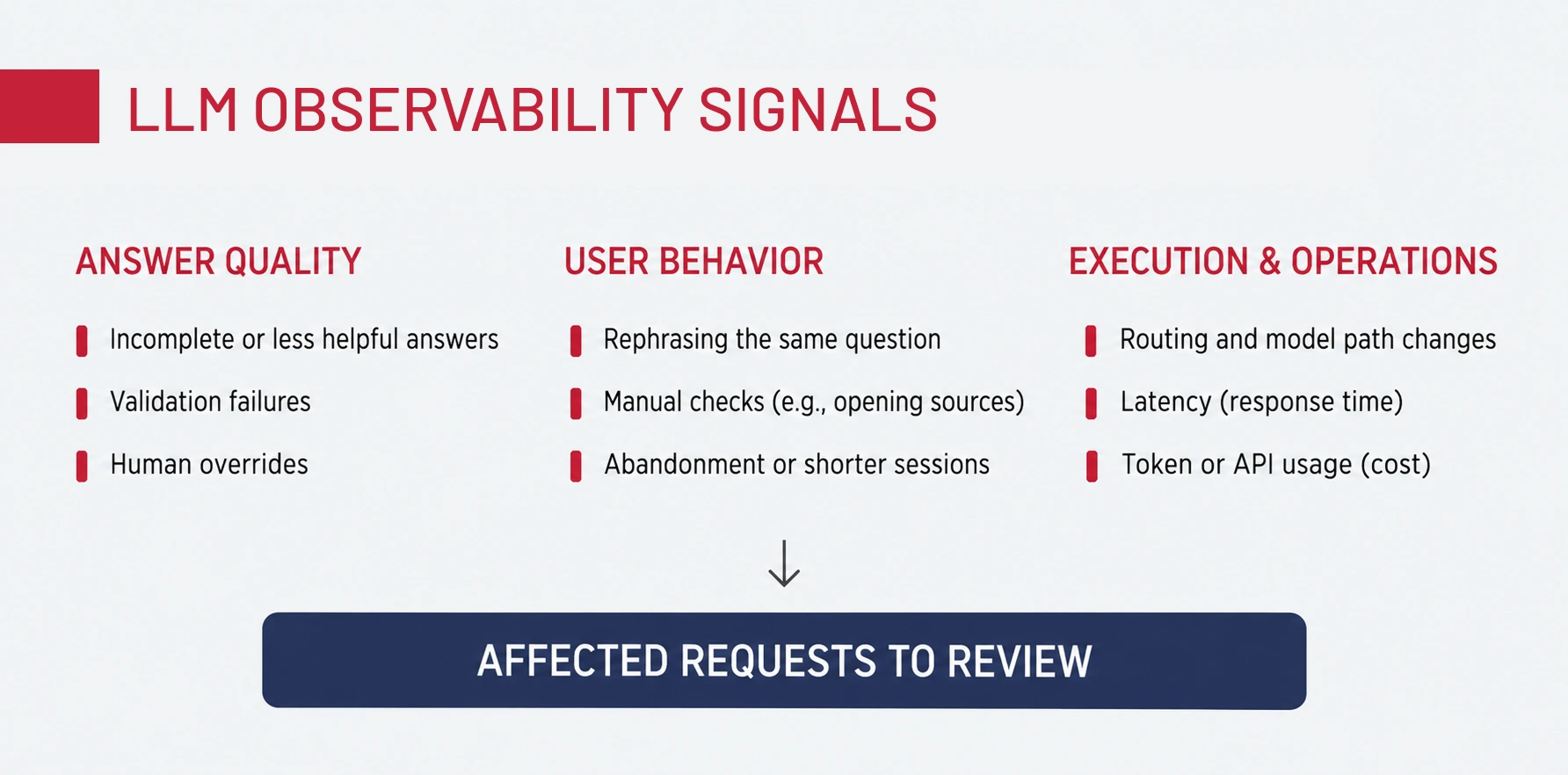
A healthy application can still return a weak answer. Error rate and availability therefore belong beside answer and user signals, not in their place. Read signals as groups: what happened in the response, how the user reacted, and what operating path produced it. A trend should lead to a sample of affected requests that a reviewer can inspect.
Answer quality and user behavior
Begin with the task the answer was supposed to support. A fluent response may omit an eligibility condition or cite a product record that lacks the relevant variant relationship.
For example, a shopper asks whether a discounted jacket is eligible for store pickup. The answer names a price but misses the condition that the selected size is available only for delivery. The shopper asks again about the size, which could look like a poor response or a normal follow-up until a reviewer checks the product record and the original question.
The useful finding is the omitted pickup condition. The repeat question tells the team which exchange to review, but it does not establish the cause on its own.
To tell a missing condition from an ordinary follow-up, look for patterns in the answers and in what shoppers do next:
- Unsupported or incomplete answers: Sample responses against the source and task context, especially where the answer could affect an operational decision.
- Validation failures and human overrides: Track why a response was blocked or changed, and whether the reason clusters around a source, request type, or release. For example, after a catalog import for a new market, the validation step may start blocking most answers that mention product sizes because that market’s size charts use a different unit system.
- Rephrasing, manual checks, and abandonment: Compare these behaviors with reviewed examples before treating them as a quality score.
Taken together, these signals tell the team which answers to sample and review, but they do not diagnose the cause on their own.
-

What to check next
Review the affected requests against the source record, the shopper's question, and any subsequent reformulation. Flag answers that omit a decision-critical condition.
Execution and operating conditions
Now, look at what the application did to produce the response. A changed route can alter both answer quality and spend. A refresh policy may leave content stale longer while reducing API use, or it may increase load without improving what the user sees.
In one Expert Soft retail implementation, review-summary updates were tied to meaningful changes in review count, making refresh frequency an operating choice rather than a fixed schedule. The policy connected freshness to LLM calls, external-provider requests, and platform load. The takeaway is to judge a usage spike against the freshness and page behavior that the refresh policy was meant to deliver.
The relevant signal depends on that operating decision. To see whether that trade-off is still working, compare the request path, response time, and API use rather than reading any one figure alone:
- Route and retrieval: Watch which model, tool, or source path handled the request and whether escalation or clarification occurred when expected.
- Latency and failures: Segment slow or interrupted requests by path rather than averaging away a problem in one task group.
- Token and API use: Read cost alongside freshness and review outcomes. A cheaper path is not automatically the better answer path.
This review is also the most reliable way to explain AI cost: spend makes sense only next to the freshness and answer quality it buys.
-
What to check next
Compare the affected requests with the previous route, refresh schedule, and operating conditions. Inspect any change before treating the quality trend as a model problem.
Expert Soft can implement AI around your existing commerce system, with traceable answers and controls your team can use.
Talk to Our TeamThe signal categories narrow the search. To identify a cause, the team still needs the conditions of a weak answer.
LLM Tracing for Root Cause Analysis
Suppose a merchandising user gets a plausible explanation of a promotion, but it omits the condition that determines eligibility. Re-running the question next week may produce a better answer because the source changed. But that does not explain the original incident.
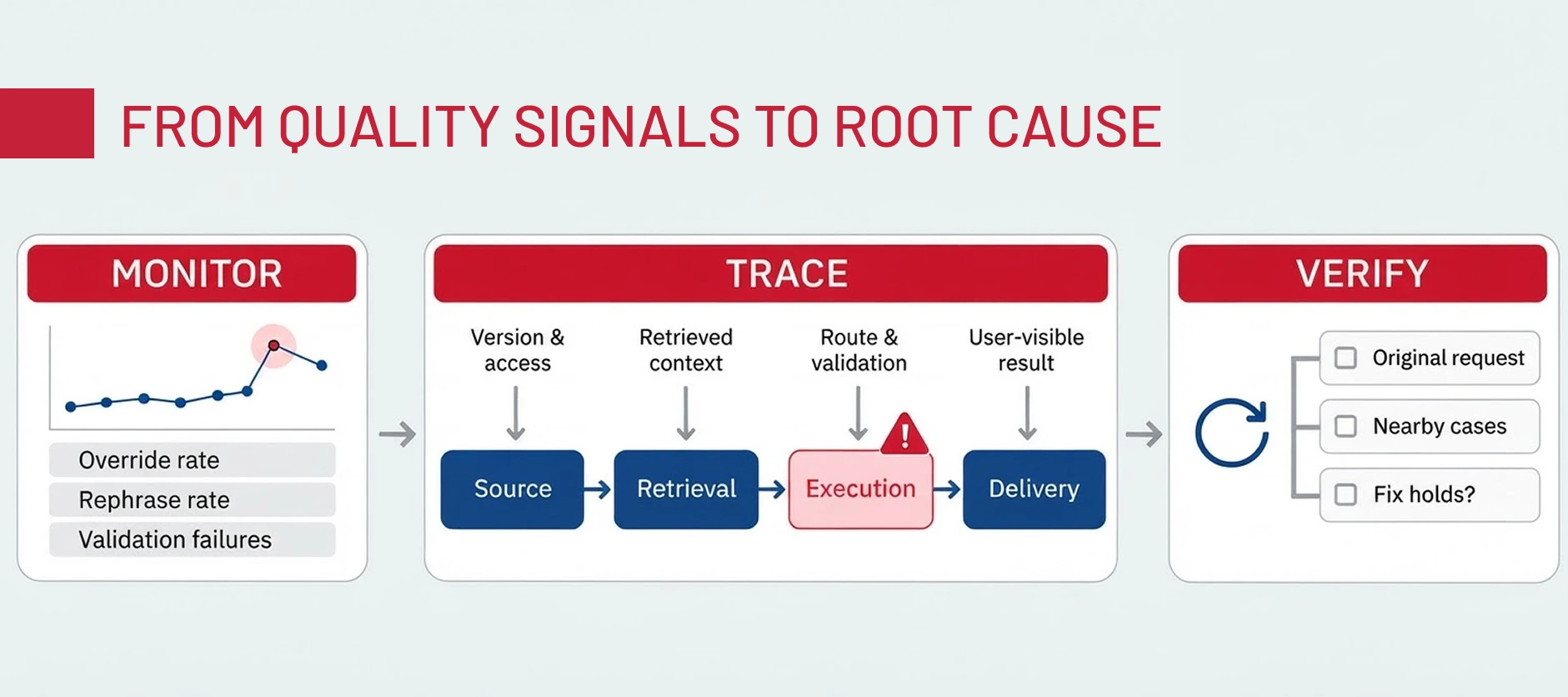
LLM tracing is useful when it preserves the request as it happened and connects the response to its source, access, retrieval, and execution history.
Reconstructing one weak answer means checking which part of its path could have changed the outcome. The table below organizes that investigation: each row names the evidence to recover, what it can explain, and where to verify it.
| Evidence to recover | What it can explain | Where to check |
|---|---|---|
| Original request and task context | Whether the answer addressed the user’s actual role, question, and conditions | Request record, relevant conversation history, task or role metadata |
| Source, version, and access scope | Whether approved guidance was stale, unavailable to this user, or outside the effective version | Source IDs, timestamps, version history, permission decision |
| Retrieval and assembled context | Whether the right rule, product relationship, or exception was found and preserved | Retrieved items, ranks, filters, prepared data view, context passed forward |
| Execution route and validation | Whether the request took the intended model or tool path and whether a check ran | Step trace, tool calls, route decision, validation result |
| Response and delivery | Whether the generated answer and the user-visible result were the same | Recorded output, application event, rendered component or delivery log |
The table’s source-version and retrieval rows show where a needed condition dropped out. If a prepared catalog view omitted a variant relationship, the model could not recover it from a nearby product description. If the relationship was available but filtered out, retrieval or access needs attention.
The way product data is prepared across layers determines which view retrieval can use. Check the version tied to the original request; today’s catalog cannot prove what the assistant saw then.
A trace also has limits. It can show that a rule was used, but it cannot decide whether that rule was authorized or still valid. Preserve missing evidence as an open finding rather than promoting a likely explanation to a confirmed cause.
If answers pass through several services, the team needs a record of each handoff. The whitepaper shows how to design that control.
Open the whitepaperWith the request path in hand, the next decision is which layer to correct and how to tell whether the correction holds.
Common LLM Production Failure Patterns and Fixes
A weak answer is a symptom, not a diagnosis. The same complaint can come from stale content, incomplete product structure, a wrong workflow route, unsupported synthesis, or a page that never displayed the generated result. Use the trace to distinguish these patterns before changing prompts or adding another model check:
-

Stale or incomplete source
The trace points to an old version or a prepared view missing a required condition. Correct the source or its preparation path, then repeat the original request and related conditions against the updated version. For example, the return window for sale items changes from 30 to 14 days, but the assistant keeps saying 30 because the policy article in the knowledge base was never republished.
-

Retrieval or access mismatch
The needed evidence exists, but the retrieved context omits it, or the permission decision excludes it. Review indexing, filters, relationships, and authorized access. Test the original role and nearby roles with different entitlements. For example, a B2B buyer receives the public list price instead of the contract price because the retrieval filter excluded the account-specific price list for that role.
-

Wrong execution route
The request reaches a model or tool path intended for another task, or it misses a necessary clarification or escalation. Adjust the route and retest the triggering request alongside borderline cases.
-

Unsupported response
The evidence was present, but the answer overstates or misreads it. Revise generation or validation behavior, then compare groundedness and task completion on the original case and a small set of related examples. For example, the product record says "dermatologically tested," and the answer turns it into "suitable for sensitive skin:" a claim the source does not support, and one that carries regulatory risk in health and beauty.
-
Delivery or operating fault
The AI result exists, but caching, rendering, refresh, or other application behavior changes what the intended user receives. Compare the trace with the user-visible page or event, correct that layer, and test under the same audience and rollout conditions.
The handoff from the commerce application to the AI microservice gives the team a specific check: compare the service that received the request with the service intended for that task, then trace the result back to commerce.
The last pattern appeared during an Expert Soft project for a top-15 global health and beauty retailer. The client wanted review summaries and similar-product discovery on product pages within an existing SAP Commerce Cloud platform. The implementation separated model-facing processing from commerce page rendering and introduced the new components in a limited production test for one brand and location. A dedicated customer group was meant to see them.
During that test, the AI blocks did not appear for the intended logged-in users. The issue was in SAP Commerce’s component rendering cache: output prepared for anonymous users was being reused for test users. The team adjusted the caching behavior so the components were visible to the correct audience. After successful validation, the restrictions were removed, and the functionality was opened to all customers.
A model-quality dashboard could have shown a healthy generation path while the feature still looked broken to a shopper. Comparing the generated result with the rendered page under the test group’s conditions pointed to the delivery layer.
After any correction, rerun the affected request or page state, then test nearby cases. A rule change may need business authorization before an engineer encodes it. Approval authority for an AI rule change should be explicit in the incident record, along with the accepted change and the follow-up test result. Without that last step, the team has a plausible fix, not a closed issue.
A Practical LLM Observability Review Framework
Up to this point, each section has looked at one part of the diagnosis: the signal that changed, the path behind an answer, and the test of a correction. When a new complaint arrives, you need to bring those pieces together quickly. The framework below gives you a way to start with the visible problem, check what evidence exists, and identify the first gap your tools must close.
| Problem type and signal | Trace evidence | Cause check | Fix verification | Required tool capability |
|---|---|---|---|---|
| Retrieval/data: unsupported or stale answers cluster around a source or category | Source ID and version, retrieved items, filters, prepared data view | Was the relevant condition present, current, and available to this user? | Repeat original and nearby queries against the corrected source/view | Versioned source references, retrieval inspection, access history |
| Execution/routing: one request group has changed latency, cost, or escalation | Step path, model/tool choice, clarification and validation events | Did the task take its intended path under its risk and cost rules? | Replay affected and boundary cases, compare route and reviewed answer | Request-level tracing, route segmentation, alerts, safe replay |
| Answer grounding: review finds claims beyond the evidence | Prompt context, retrieved support, generated answer, validation result | Was the evidence missing, or did generation misuse evidence it had? | Review groundedness and task completion on an affected sample | Answer-to-evidence view, evaluation records, human review workflow |
| Delivery/operating behavior: users report missing or inconsistent AI output | Generated result, page event, cache or refresh state, user group | Did the result reach the intended audience under the rollout condition? | Check the rendered experience for the original and adjacent groups | Cross-service correlation, delivery events, controlled access to traces |
Let’s put it into practice. Suppose customers ask whether a sale item can be picked up today, but the assistant gives yesterday’s availability. The signal is a cluster of stale answers.
Follow the retrieval/data row: find the product view and version used for those requests, then inspect what the retriever passed to the model. If the view was old, refresh the source and rerun the same questions, including a nearby item whose availability changed. If the view was current but the retriever selected an older record, fix that path instead.
The first tool gap to close is whichever record prevents the team from making that distinction.
That result tells the team what its tooling must preserve for the next incident. If request traces live in one platform and catalog versions in another, make sure a reviewer can connect the two records without reconstructing the path by hand.
Final Word
Production AI quality will change as the application meets new users, data, and operating conditions. A team does not need to promise that every answer will remain perfect. It needs to know when quality moves, reconstruct the conditions behind an affected answer, and make a correction at the layer that actually failed.
Before expanding an AI feature, test whether the team can reconstruct a weak answer from the original request to the result the user saw. That means knowing what data and rules were available, which route ran, and where the outcome changed.
If the evidence stops at a dashboard metric or the model’s final text, make the missing part of the request path visible before declaring a cause. The team can then choose a correction and test it on related cases.
Beyond the pilot, LLM observability keeps quality signals tied to the data, execution, and delivered result behind them. That evidence supports deliberate improvement as traffic, source data, and business rules change.
New articles

See more

See more

See more

See more

See more