AI Governance Responsibilities in Ecommerce: Roles, Decisions, and Accountability

As AI capabilities continue to advance faster than we can fully explore them, the possibilities for integrating AI into enterprise systems seem almost limitless. An AI feature can support a business goal, use catalog data, interact with an external model, and ultimately influence what shoppers see.
When these elements span multiple teams, the boundaries between decisions, actions, and outcomes become blurred, making it necessary to clearly define responsibilities. But simply asking “who is responsible for AI?” is too broad to provide a useful answer. Someone must decide what the feature is allowed to do. Someone else may approve its use, check its risks, build the controls, or respond when its behavior changes. The person accountable for the outcome may have no direct control over every component.
That gap is already visible to technology leaders. In a IBM Institute for Business Value survey, two-thirds of surveyed CIOs and CTOs said they were held accountable for AI systems they did not fully control. The concern is practical: leaders can be answerable for an AI outcome without the authority or visibility needed to correct it. Governance has to connect accountability to the people who can authorize a use, inspect its behavior, and change it when the evidence calls for it.
In this article, we’ll explore AI governance roles and responsibilities, following an AI use case from selection through implementation, release, and operation. We’ll look at who makes the consequential decisions at each stage and what they need to know.
Quick Tips for Busy People
Keep these distinctions in view as you assign work:
- Roles and responsibilities: Separate accountability from authority. Name who owns enterprise AI risk, who can authorize a specific use case, who builds its controls, and who reviews the evidence independently.
- Use case selection: Set the boundary before development: agree on the business outcome, permitted data, allowed AI actions, and the consequences of a wrong result.
- Implementation: Build those decisions into the system. Assign ownership across data and AI services, with review points, validation, and traces that let owners inspect what happened.
- Before release: Approve a defined rollout, not the feature in general. Record the tests, unresolved exceptions, fallback, and audience covered by the decision.
- After launch: When behavior changes or an issue recurs, distinguish immediate containment, a decision about the rule, a technical fix, and acceptance of the change.
Those are the decisions to keep in mind. Let’s start with the people who make them, then follow what changes as an AI use case moves toward production.
AI Governance Roles and Responsibilities: Who Owns What?
Clear AI governance responsibilities matter because the people who define an AI feature’s purpose, supply its data, build it, and approve its release do not hold the same authority. The handoffs between them determine whether an accountable owner can control the result.
Consider a product team adding AI recommendations: the commerce owner defines the desired outcome, the data owner confirms permitted attributes, engineers build the service boundary, and a privacy or security reviewer checks the data path. Each contributes to the decision; none alone authorizes exposure to every shopper.
Four terms help prevent that confusion.
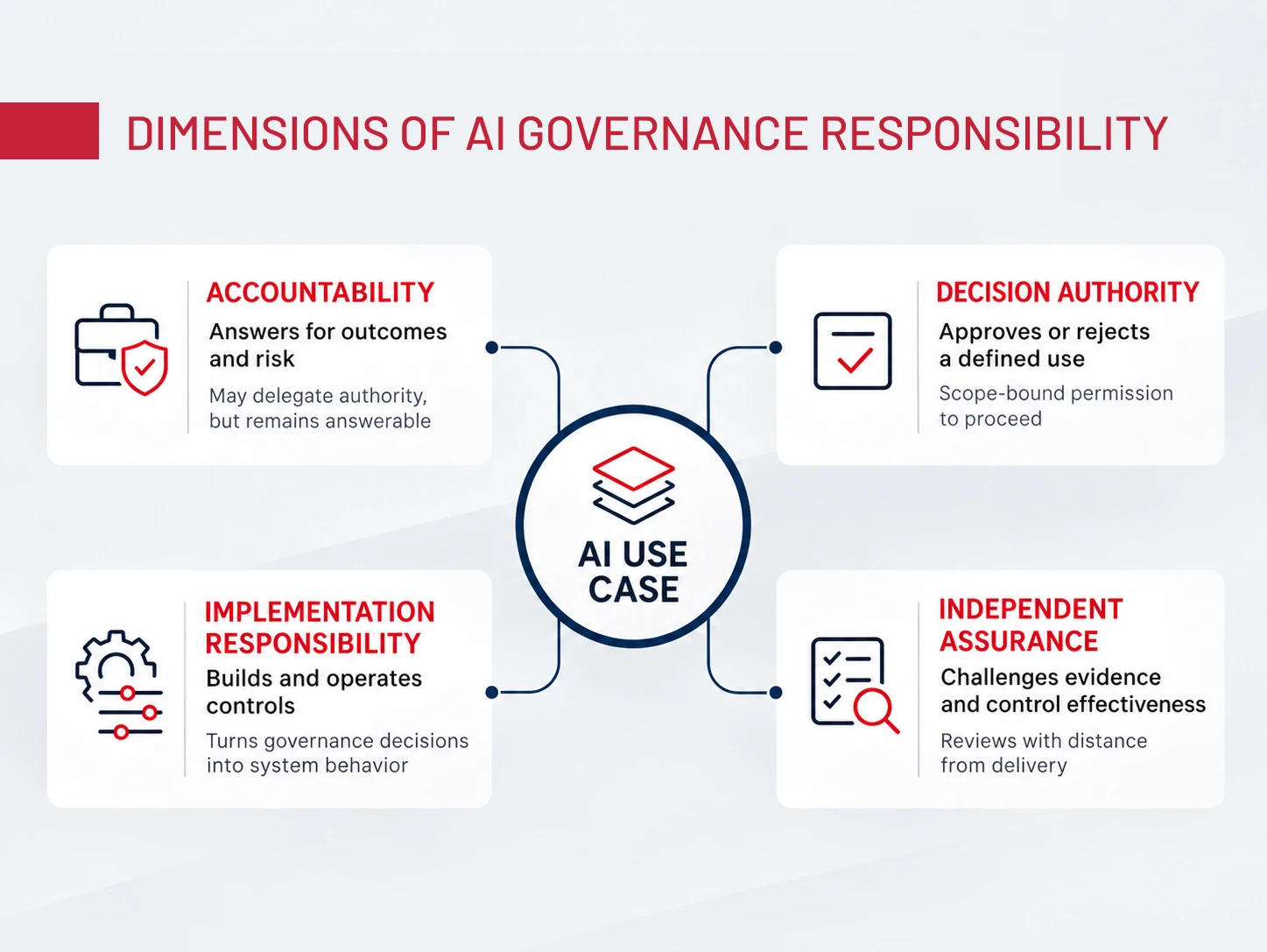
Accountability means answering for a risk or outcome, including the decision to delegate authority. Decision authority means permission to approve or reject a defined use within a stated scope. Implementation responsibility means building and operating the agreed controls. Independent review or assurance means testing whether the evidence and process support the decision, with enough distance from delivery to challenge it. These powers can sit in different roles even when a small organization gives one person several jobs.
From these distinctions, we can map four different powers across five connected responsibility areas:
-

Organization-wide rules and risk tolerance
Executive leadership sets the limits within which teams may adopt AI, with a governance lead or body coordinating policy where useful.
-

Business outcome and use case boundaries
The business owner defines the intended result, acceptable behavior, and consequence of error for one workflow.
-

Data, implementation, and technical control
Data and technical owners specify source permissions, interfaces, validations, and recovery behavior that make those limits enforceable.
-

Specialist review
Risk, legal, privacy, and security functions assess the issues their remit covers and identify conditions for approval.
-

Independent assurance and ongoing oversight
Reviewers outside the build path examine evidence, while operations watches actual behavior and escalates change.
The five areas describe different kinds of work, but they only become governance when decisions can move between them. NIST’s Govern Playbook calls for documented roles and communication lines for mapping, measuring, and managing AI risk. It places responsibility for risk decisions with executive leadership and describes independent evaluation as one possible safeguard. Its lifecycle actor descriptions span design, development, deployment, operation, and evaluation.
The matrix below translates those principles into an illustrative enterprise role map. It is a way to expose missing decisions, not a prescribed organization chart.
| Role | Primary remit | Decision or review authority | Stages involved | Evidence or handoff |
|---|---|---|---|---|
| Executive oversight | Enterprise risk tolerance and delegation | Accountable for portfolio risk decisions and delegated authority | All stages | Policy, risk limits, escalation route |
| Governance lead or body, where used | Coordinate rules and cross-functional decisions | Advise or approve only within delegated mandate | Selection, release, operation | Decision record and exception route |
| Business or use case owner | Purpose, outcome, and acceptable use | Own use case boundaries and seek required release approval | Selection through operation | Business criteria, scope, acceptance |
| Technical and data owners | Implement controls and maintain approved data paths | Execute technical decisions within approved scope | Implementation through operation | Source/version record, tests, trace |
| Specialist control functions | Assess legal, privacy, security, and other material risks | Review or set conditions within their remit | Selection, release, change | Risk findings and required conditions |
| Operations or service owner | Watch live behavior and restore safe service | Act on incidents within operating mandate | Release and operation | Monitoring, incident, recovery log |
| Independent assurance | Challenge evidence and control effectiveness | Provide independent evaluation, not delivery approval by default | Release and ongoing review | Evaluation findings and follow-up |
Job titles, sign-off power, and the design of independent assurance will vary with the organization and the risk of the use case. What should remain visible is the handoff: a reviewer can require a condition, an authorized owner can accept or reject remaining risk, and the implementation team can show what was actually built.
This matters because a new AI feature can enter the business before the people expected to govern it know it exists: 70% of surveyed technology executives said business teams were deploying technology faster than IT could track. A useful role map therefore names who brings a proposed use into review and who can authorize its scope.
Let’s put this role map to work. By following an AI use case from selection through implementation, release, and operation, we can see when each owner has a decision to make, what evidence they need, and where responsibility changes hands.
AI Governance During Use Case Selection
At use case selection, the first question is not which model to build. It is which business task AI should support, where its authority should end, and who will own the result.
The use case owner needs to settle that operating purpose with technical and control partners before engineers choose a model or interface. A practical readiness check starts with one named workflow: its owner, permitted data, quality gate, fallback, and escalation path.
The selection record should answer a small set of decisions:
-

Purpose and outcome
The business or use case owner names the affected task, the result worth improving, and the consequence of a late or wrong output. Product and operations teams help define a usable baseline.
-
Allowed actions
The business owner states whether AI may inform a person, prepare a change, or trigger one under conditions. Technical owners test whether the workflow can enforce that boundary, and specialist functions review higher-risk effects.
-

Data and permissions
Data owners identify approved sources, meaning, freshness, and access. Privacy and security reviewers assess use or egress where their remit applies.
-

Risk and recovery
The authorized risk owner sets the classification and review threshold. The use case owner and operations agree on success criteria, escalation, and what happens when AI cannot safely finish.
Those decisions need a sensible level of control for the action involved. A draft review summary can be held for checking. A system action that changes catalog content or a customer interaction needs an explicit permission and validation path. That distinction is central to controllable workflow design: preparation can be automated, but authority to act must be granted separately.
Consider a retailer using AI to speed up catalog onboarding. The same model could draft copy for a content manager to approve, or write directly to the live catalog across thousands of SKUs. In the first design, a false ingredient claim can be caught before publication. In the second, it may reach shoppers before anyone reviews it.
Model quality alone does not explain that difference. The business owner must decide how much authority the workflow receives at selection, and engineering must enforce that permission during implementation.
If those conditions are explicit, the team can move from deciding what AI is allowed to do to building the boundary that enforces it.
AI Governance Responsibilities During Implementation
Implementation tests whether the agreed responsibilities can be exercised. The business owner has defined the allowed action, but engineers must turn that limit into permissions, review points, and records the owner can inspect. If a disputed recommendation cannot be traced or stopped, the role map offers accountability on paper without control in the system.
Define what AI can do and when a human must decide
Start with the moment an output becomes an action. AI may prepare a recommendation for a person, trigger a bounded action under specified conditions, wait for validation by another system, or require human approval. Each path needs a named decision owner, a permitted scope, and a condition that stops or escalates execution. A confident response is not itself permission to act.
For example, an AI suggestion to amend a product record can be prepared automatically, while a catalog owner or an external data check determines whether the change may be committed.
For a practical guide to managing AI actions, review points, and escalation across enterprise workflows, explore the whitepaper.
The review point should match the cost of a bad change. The cost of a bad change depends on what the suggestion can alter: a draft for review is different from a change that reaches production, customers, or sensitive data. In AI software development, that difference determines which suggestions can be accepted automatically and which require a named review before they are applied.
Assign ownership across data, platforms, and the AI service
Even a well-defined approval rule can become hard to enforce when commerce, data, and model processing sit in different systems. A platform may provide access controls, logging, and orchestration primitives. It does not decide what a product attribute means, which source is authoritative, or when a shopper-facing result is acceptable.
When these systems cross team boundaries, a useful pattern is to separate model-facing processing from the commerce action that exposes a result to shoppers. The AI service can be changed or stopped independently, while the commerce platform controls which prepared results it publishes. The AI architecture choice determines how clearly that boundary can be maintained.
Here’s how this pattern can appear in practice. In one Expert Soft project for a global retail platform, we added AI features to improve product discovery and review content. Separating model-facing processing from customer-facing rendering helped keep AI behavior outside the commerce core while SAP Commerce stayed responsible for the page shown to shoppers. SAP Commerce retained core commerce behavior and rendering, while a separate AI service handled model-facing processing and product selection, then supplied prepared results for display.
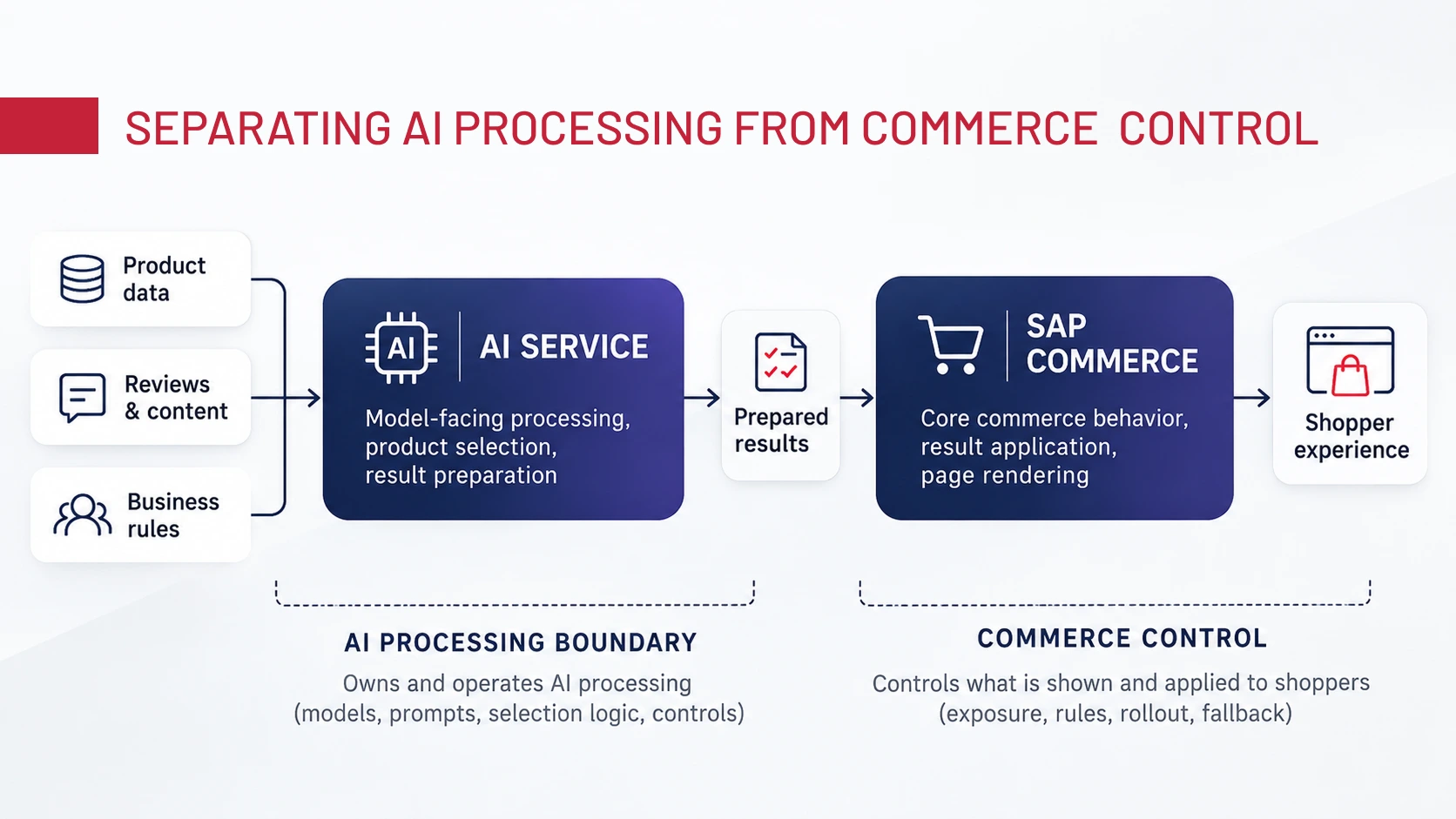
Its governance lesson is an interpretation: a service boundary makes it possible to assign control over model calls and selection logic separately from the system that publishes the result.
For teams designing that boundary, where AI logic runs affects who can maintain and stop it. The boundary is also weak if no one owns the meaning and freshness of incoming data.
Explore how to divide governance responsibilities between the platform and your team.
A practical governance test for the platform is whether the named owner can change the rule, see when it fired, and stop the action if its conditions no longer hold.
Make behavior testable and traceable
The person accountable for a result needs more than a success dashboard. If a recommendation is disputed, the team should be able to identify the source and version used, the route through the workflow, the validation outcome, any human handoff, and the fallback or failure state. Otherwise, a review can only debate the final text while the cause stays hidden.
To make that investigation possible, the team has to design for AI quality from the start: source ownership, routing, validation, and traceability must make a disputed result explainable. Those records answer different questions for the people responsible.
Validation shows whether an output crossed the approved boundary before it was used. A trace lets the technical owner reconstruct the source and route behind a disputed recommendation. Monitoring shows the operational owner whether exceptions are rising after a change.
Knowing which path produced a result is an important part here. For a health and beauty retailer operating 12 brands in 28 markets, Expert Soft integrated an external delivery promise service into checkout. When that service became unstable, a circuit breaker switched the platform to a controlled fallback based on data already in SAP Commerce, so customers could still place orders. Each delivery promise also carried a marker telling downstream systems which path had produced it.
While the project is not about AI, the lesson transfers directly: when a result can come from more than one route, a record of the route is what lets an owner explain a disputed outcome later.
Expert Soft can design and implement it with the controls, visibility, and operating processes needed to keep it accountable as it evolves.
Let's talkTogether, signals mentioned let the use case owner decide whether the workflow still operates within its authorized scope.
With those controls in place, the next question becomes a judgment about evidence and scope. A tested build still needs authorization to meet real users.
AI Governance Before Release
Release approval should say which behavior was tested, under what conditions, and for whom it is authorized. Engineering can show that the build runs, but release is a different decision.
The release owner needs evidence that the feature behaves as intended in the actual workflow, that specialist conditions were met, and that someone can handle exceptions. Only then can the delegated approver authorize exposure to a defined audience. If the evidence supports only a limited audience or set of actions, the permission should be limited too.
The release record should make that judgment possible: tests against use case criteria, unresolved exceptions, a workable fallback, and an owner authorized to expand the scope. A quality gate matters because a weak output can reach a shopper or operator if nothing intercepts it.
The retail platform case about AI implementation discussed earlier shows why scope matters. Its production testing began with one brand and one location, with visibility limited through a dedicated customer group. Broader use followed approval. That sequence supports a bounded release principle: evidence gathered under narrow exposure can justify a next decision without pretending it already covers every market or customer.
That bounded test exposed a rendering problem. At first, the AI blocks did not appear for logged-in test users because SAP Commerce’s cache reused page components built for anonymous visitors, so the test group saw the old page.
The team corrected the behavior by tying visibility to a dedicated customer group. The governance point is concrete: limited production exposure revealed a failure, gave the team room to fix it, and let the approver judge the corrected behavior before extending access.
Authorization is a starting condition for operation. Once the feature is live, its owners have to respond to results they did not anticipate and to changes in the systems around it.
AI Governance After Launch
An AI workflow can drift without a dramatic outage. A source version changes, a route begins sending more requests to review, or a recurring answer is challenged by operators. Monitoring should bring those signals to an operational owner who can contain an immediate issue. It should also give the use case owner enough evidence to decide whether the business rule or authorized scope needs to change. Understanding operating AI cost also matters when model routes or review volume change.
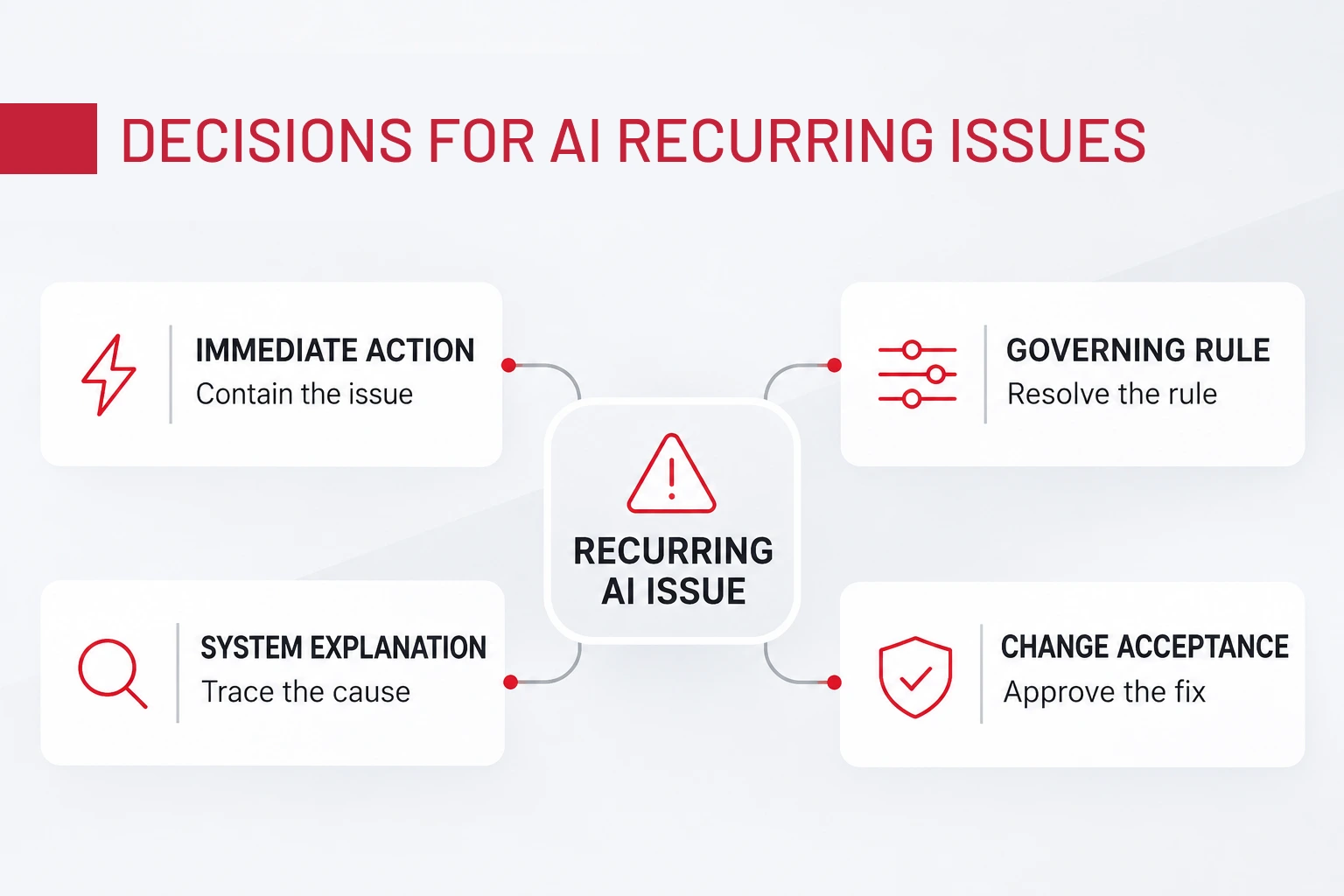
Four decisions need to be made when the same AI issue keeps returning:
-

Immediate action
The operator or service owner handles the current case, including a safe fallback or temporary restriction.
-

Governing rule
The owner of the business procedure or knowledge source resolves which rule applies when sources conflict or guidance is stale.
-

System explanation
The technical or AI service owner reconstructs the source, route, validation, and response behavior that produced the result.
-

Change acceptance
The authorized owner approves the correction after testing the original problem and related cases.
Consider those four decisions in a customer-service workflow. Suppose an assistant repeatedly tells shoppers that sale items can be returned within 30 days, while agents say those items are final. Agents can correct the answer for the current customer, but repeating that fix will not settle the rule.
The returns-policy owner needs to confirm whether the policy changed or the knowledge base is stale. The technical owner then traces whether the assistant used an old source or misread a current one. The authorized owner can close the issue only after the corrected answer has been tested against the original question and related cases.
The same person may hold several of these responsibilities, but the decisions are still distinct. A prompt adjustment cannot settle an ambiguous returns policy. A policy decision cannot explain why an older source remained available to the service. When the same disagreement keeps returning, a case-by-case fix is not enough. The responsible owner needs to resolve the rule, authorize the change, and confirm that the original problem is closed.
The operations team also needs authority to recover service when normal processing fails and a route to escalate changes that exceed its mandate. When a use case no longer meets its purpose or cannot be operated within acceptable limits, the accountable owner should decide whether to narrow, suspend, or retire it. That is the same governance chain working in reverse: evidence from operation changes the scope of permission.
Final Word
AI governance responsibilities become useful when they attach to decisions a team makes. An executive may set risk tolerance, a business owner may define the use case, specialists may challenge its conditions, and engineers may implement the controls. Release and operation then test whether those assignments carry through to evidence, escalation, and accepted change.
For any proposed AI use case, trace one consequential action from purpose to production. Name who may authorize it, what they are authorizing, who must review it, which record shows the system followed the limit, and who decides when it does not. If one of those answers is missing, the gap is specific enough to fix before the feature takes on more responsibility.
Frequently Asked Questions
-

Who owns AI governance decisions across an organization?
Executive leadership is accountable for organization-wide AI risk tolerance and delegation. Named owners decide the purpose, scope, release, and operation of individual use cases under that policy. Technical teams and specialist reviewers carry out different parts of the work, so no single operational role performs all governance.
-
Which functions should be represented on an AI governance committee?
Committee composition depends on the organization’s structure and the risks of its AI uses. Business and technical owners should be represented, with risk, legal, privacy, security, and independent assurance perspectives involved where relevant. A committee still needs explicit authority and handoffs to use case decision makers.
-
Who owns an individual AI use case?
A named business or use case owner should own the intended outcome and operating boundaries. Data and technical owners implement those boundaries, while specialist functions review applicable risks. Final permission to release or expand the use case depends on its risk and the organization’s delegated approval policy.
New articles

See more

See more

See more

See more

See more