
Understanding AI Implementation Costs: The Factors That Matter After Go-Live

Most conversations about cost for AI start with the visible numbers: model pricing, infrastructure, license fees, and the first implementation budget. Those numbers matter. They are also only part of the cost structure that behaves politely in a spreadsheet.
In enterprise ecommerce, the larger question is what happens after go-live. Once AI becomes part of daily ecommerce workflows, the cost picture changes. It starts to depend on invocation frequency, data movement, integration behavior, refresh governance, and whether the architecture can support the next AI use case.
This is why the question “how much does AI cost?” rarely has one clean answer. The cost of artificial intelligence depends on the implementation model, the surrounding platform, the operating process, and the control mechanisms around the AI layer.
One Expert Soft project shows this pattern well: we needed to add generative AI to summarize customer reviews on a product detail page. Despite the seemingly straightforward task, the core interest here is not in feature implementation itself, but in organizing the workflow in which operational expenses don’t grow in direct proportion to every new piece of review activity.
This article looks at the cost of implementing AI through that practical lens. We will use the review summary project as the running example, because it shows where enterprise AI costs appear before launch and what starts to matter after go-live. The focus is not only on model pricing, but on the decisions that keep AI useful without letting ordinary data changes turn into unnecessary operating costs.
Quick Tips for Busy People
For readers who need the short version first:
- Initial costs reflect both scope and sourcing choices: data preparation, integrations, testing, security, and the build-versus-buy model determine the upfront budget and the level of control retained after launch.
- Direct costs are visible, while indirect costs emerge in operation: engineering and vendor fees are easy to track, but maintenance becomes harder to estimate once the system depends on several teams and changing business processes.
- AI software price is shaped by the system around the model: even a straightforward AI capability can require substantial work when it must operate across complex enterprise platforms, data flows, and regulatory environments.
- Long-term economics depend on execution and reuse: meaningful invocation rules protect ROI, while reusable orchestration, data, and monitoring patterns reduce the cost of future AI expansion.
- Cost control works best as part of the architecture: Teams can keep spending manageable by connecting AI activity to business value and placing its governance where policies can be adjusted independently.
Now let’s look at where AI implementation costs actually come from, and why a feature that looks simple on the page can become a cost-management question in the architecture.
The Initial Cost for AI
Initial AI costs come from turning an idea into something the business can safely run in production. For enterprise ecommerce teams, this rarely means “connect an API and ship.” The work usually sits across architecture, data, platform integration, security, testing, deployment, and operational readiness.
The useful question is not only how much artificial intelligence costs at the start. The question is which parts of the first build will later make AI cheaper or more expensive to operate.
What is included in AI development costs?
Initial AI development cost usually includes several cost categories:
-

Discovery and solution design
This category reflects how much uncertainty the team must resolve around workflows, output expectations, success criteria, and platform constraints. A well-defined use case can keep this phase focused, while a broader or less mature scope requires more analysis.
-

Data preparation
Cost depends on the condition and accessibility of the source data. Clean, structured data may need limited preparation, while fragmented data can require normalization, filtering, access controls, and quality checks.
-

Model or API selection
The pricing profile changes with the required balance of capability, privacy, latency, governance, and operational control. A standard hosted model may fit one use case, while another may justify a more controlled option.
-

AI orchestration and service development
This cost reflects the logic needed around the model, including prompt preparation, request management, response handling, output storage, and business rules. Reusable orchestration can also reduce repeated work across future use cases.
-

Testing and validation
The budget depends on how much technical behavior, output quality, edge-case handling, fallback logic, performance, and business-rule alignment must be verified before launch.
-

Security and compliance setup
Cost varies with the data involved and the controls the organization already has. Access management, data masking, auditability, regional processing rules, and vendor governance may be reused or built specifically for the solution.
These cost areas are usually easier to price before launch because they can be estimated as project work. Operational costs are harder to forecast at that stage because the team does not yet know the real usage pattern. After go-live, users, product changes, scheduled jobs, content updates, and business events may trigger AI execution more or less often than expected.
This is exactly where our review summary project becomes useful. We worked with a global beauty retailer operating a large-scale ecommerce platform. The business wanted to improve product evaluation with a short AI-generated summary of customer reviews on the PDP, including the main pros and cons.
Several components delivered the feature: SAP Commerce exported the product feed, external review providers supplied the review data, the AI microservice generated the summary, and SAP Commerce rendered the final text on the PDP. Other components existed specifically to control cost across the solution lifecycle rather than only during implementation.
We will return to that operating-cost mechanism later. First, there is another decision that can change the initial AI budget: whether the solution is bought, built, customized, or assembled as a hybrid.
Comparing build vs. buy AI options
The build-versus-buy choice is one of the first factors that changes the cost of implementing AI. The decision is not simply whether building is expensive and buying is cheap. For enterprise commerce, it is about which option gives the team enough control over data flows, integrations, governance, and ongoing AI execution.
Buying an external AI platform can reduce time to implementation, especially when the use case is common and the integration surface is limited. It may also give the team access to managed model updates, built-in monitoring, security certifications, and vendor support. For some use cases, that is the right trade-off.
Building internally or with an implementation partner gives more control over data flows, orchestration, governance, integration depth, and long-term ownership. That control matters when the AI capability has to sit inside SAP Commerce, interact with several enterprise systems, follow regional compliance rules, or support business-specific refresh logic.
Based on our experience and case example, for enterprise teams, the cleanest answer is often neither pure build nor pure buy. A company may use commercial LLM APIs while building its own orchestration, governance, and integration layer.
That hybrid model can keep implementation speed reasonable while preserving control over the parts that become expensive after go-live. That is why the next cost question is not simply what the team pays upfront, but which direct and indirect costs appear once AI is running inside daily commerce operations.
Direct Costs vs. Indirect Costs
Implementation is only the beginning of AI spending. Ongoing AI software costs may include API usage, token consumption, cloud services, storage, monitoring, retraining or optimization, prompt maintenance, human review, and support work.
For LLM-based features, token consumption deserves special attention. The cost of a model call depends on input tokens, output tokens, model choice, and invocation frequency. A paper on enterprise AI cost transparency makes the same point from a pricing perspective. Token-based costs can change with prompt structure, output length, and model behavior, even when the business task looks stable.
In our review summary project, this showed up in a very practical way. New reviews kept arriving, and the AI summary had to stay current enough to be useful for shoppers. But if the system regenerated a product summary after every new review, the company would pay for many calls that might not change the customer-facing value. One new review may not meaningfully change the summary of 500 existing reviews. Ten, twenty, or fifty new reviews might.
Maintenance and support expenses
AI maintenance is not just model maintenance. It includes the ongoing work required to keep the feature useful, safe, and aligned with business needs.
Teams may need to monitor output quality, update prompts, tune business rules, and maintain integrations. As the business expands, the same AI feature may need to support new markets or new data sources. That growth adds coordination work, not only technical work.
In enterprise ecommerce, maintenance costs often grow when ownership is unclear. If the commerce platform team owns the front-end, the data team owns source quality, the AI team owns prompts, and an external provider owns part of the input, production support can become a coordination cost. The system may be technically live, but every change takes longer because responsibility is distributed across teams.
Together, ongoing usage and support demands show why the final cost depends on more than visible line items. It also depends on the design choices that determine how those costs behave.
Major Factors Influencing AI Software Price
The direct and indirect costs above do not develop in isolation. They are shaped by decisions made across the solution, which is why the next step is to examine the main factors that determine whether AI spending stays predictable or becomes difficult to control.
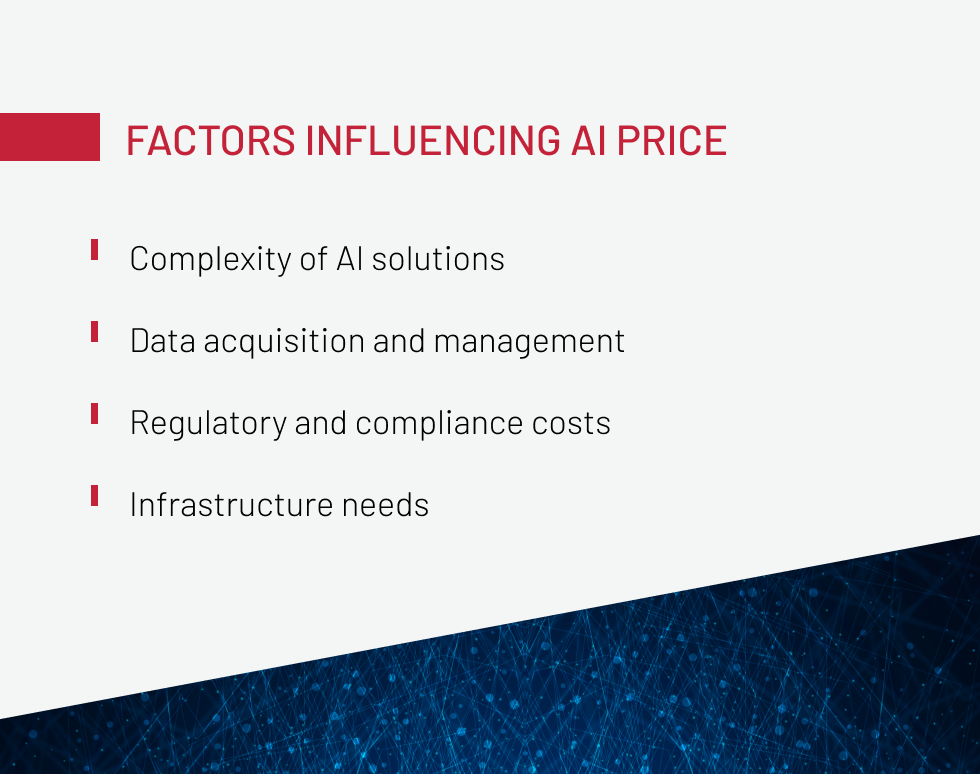
Complexity of AI solutions
Solution complexity affects AI cost through the amount of engineering, integration, coordination, and operational control the system requires. In many enterprise projects, that complexity comes less from the model than from the business processes and platforms around it.
The review summary project makes the relationship visible. Connecting review providers, SAP Commerce, the Azure Function, the review-count database, and the AI microservice required more implementation work than a direct model call. The system also needed logic to decide when review data had changed enough to justify a new summary and a reliable path for returning the final result to SAP Commerce.
Each boundary added a cost of its own, including integration, infrastructure, monitoring, and ownership. It also made those costs easier to manage: SAP Commerce stayed focused on commerce behavior and presentation, the AI microservice handled generation, and the Azure Function handled review-count tracking and refresh decisions.
Complexity is therefore not automatically wasteful. Deliberate complexity can fund control and reduce avoidable operating expenses. Accidental complexity, such as duplicated logic, unclear ownership, untracked model calls, unmanaged prompts, or poorly governed integrations, adds cost without providing the same return.
Data acquisition and management
Data cost is easy to underestimate because it often hides behind implementation tasks. Teams may think they are pricing an AI feature, while the real work is cleaning, structuring, and governing the data that AI will use.
Not every raw dataset can be passed directly to AI and expected to produce reliable business output. In our case, the input was customer review text. That kind of raw text can be appropriate for summarization when the system has enough guardrails around what is sent, how often it is processed, and how the result is displayed.
More complex AI scenarios are different. AI search, product assistants, recommendation logic, and AI analytics often need product data, taxonomy, attributes, stock signals, pricing context, and business rules to be normalized before AI can use them well. If this preparation is handled manually for each use case, the cost can quietly repeat across every new AI initiative.
Instead of preparing the same source data manually for each use case, a team can establish a reusable data-readiness layer once and use it across several initiatives. This is the principle behind medallion architecture: data moves through stages of cleaning, normalization, and enrichment before it becomes available to AI search, assistants, analytics, or content generation, while keeping the data sources untouched. Where this pattern fits the organization, solutions that follow it, such as an AI Search Readiness Kit, can help implement the layer without rebuilding the preparation logic feature by feature.
The cost implication is practical. Data preparation can be an implementation cost, a long-term operating cost, or a reusable platform investment. The architecture decides which one it becomes.
Explore Expert Soft’s whitepaper on AI-ready ecommerce data architecture for a practical way to prepare enterprise data for multiple AI use cases.
Regulatory and compliance costs
Regulatory and compliance costs depend on what data the AI system touches, where the business operates, and how much explainability or auditability the organization needs.
Enterprise ecommerce companies operating across multiple regions may need to consider data privacy, regional data-processing rules, customer consent, industry-specific regulations, vendor risk, security controls, and audit trails. If AI interacts with customer data, internal business rules, pricing logic, or regulated product information, the governance burden increases.
McKinsey found that 51 percent of respondents from organizations using AI had seen at least one negative consequence from AI, with inaccuracy being the most commonly reported issue. For AI cost planning, this is not just a risk statistic. It points to the budget companies need for validation, monitoring, escalation paths, and business controls.
Infrastructure needs
AI infrastructure is not limited to model hosting. Our client example illustrates that well.
In this project, the infrastructure included scheduled jobs in SAP Commerce, JSON feed generation, an Azure hot folder, an Azure Function triggered by file upload, a database for stored review counts, calls to external review providers, the AI microservice, and monitoring around the process. Each component carried some cost: compute, storage, integration work, operational monitoring, and support ownership.
Not every component added to this architecture was simply another source of long-term spend. The Azure Function and review-count database formed a cost-control mechanism: they compared the current number of reviews with the number used for the previous summary and requested a new generation only after the configured threshold was reached.
Although that mechanism introduced its own infrastructure and support cost, it controlled a more variable ongoing expense by preventing model calls for insignificant changes. This distinction leads directly to the long-term question: how architecture affects the cost of keeping AI useful after launch.
The Long-Term Financial Implications
Up to this point, the article has looked at where AI implementation cost comes from: development work, data readiness, compliance, infrastructure, and the architecture around the model. The long-term financial question starts when those decisions meet real usage. So now let’s take a look at how operating cost grows, how architecture affects ROI, and why reusable patterns matter when the first AI feature becomes the starting point for more.
Ongoing operations costs
This is where the review summary example shows its real strength: it demonstrates how ongoing AI costs can be managed through execution logic.
Reviews kept arriving after launch, and the summary had to stay useful without treating every new review as a reason to call the model again. If every data change becomes a model call, the operating cost follows data noise. If the architecture can distinguish meaningful change from ordinary movement, cost follows business value more closely. In this case, the system compared the current review count with the count used for the previous summary and called the model only when the configured difference was reached.
This applies beyond product reviews. AI-generated product descriptions, AI search indexes, personalization summaries, catalog enrichment, and customer-facing assistants all need execution policies. Should the system run on every update, on a schedule, after a threshold, after approval, or only for high-value products? Each answer creates a different cost profile.
Impact on ROI
AI ROI is often discussed as a model or use-case question. In practice, a small architectural decision can have a larger ROI impact than selecting a slightly cheaper model.
Let’s get back to the mechanism of our example. The feature still delivered AI-generated review summaries to PDP users. The user-facing capability did not shrink. What changed was the rule for when the company paid for regeneration.
If a product receives one new review, the previous summary may still be accurate enough. If the product receives a meaningful number of new reviews, regeneration becomes more valuable. By aligning AI execution with business significance, the architecture reduces unnecessary calls without reducing the usefulness of the feature.
This is the kind of decision that improves ROI quietly. It does not make a dramatic demo. It keeps production economics under control after the demo is over.
Cost of upgrades and expansion
AI costs evolve as organizations scale their initiatives. If every new AI capability requires a new one-off integration, the AI software development cost repeats. Teams rebuild orchestration, monitoring, data preparation, access rules, and cost controls again and again. The result is AI sprawl: multiple tools, multiple owners, multiple invoices, and inconsistent governance.
If you are planning AI inside SAP Commerce or another complex commerce ecosystem, our specialists are ready to help.
Contact UsReusable architecture patterns reduce that future cost. A separate AI orchestration layer, shared data-readiness approach, standard monitoring, and clear execution policies make expansion less expensive because the next use case can reuse proven decisions.
Best Practices for Managing AI Costs
We have returned to the review summary case several times because it shows the cost patterns clearly: AI spend is shaped by triggers, ownership, data movement, and where governance sits. Now it is worth turning those observations into a few practices enterprise teams can reuse.
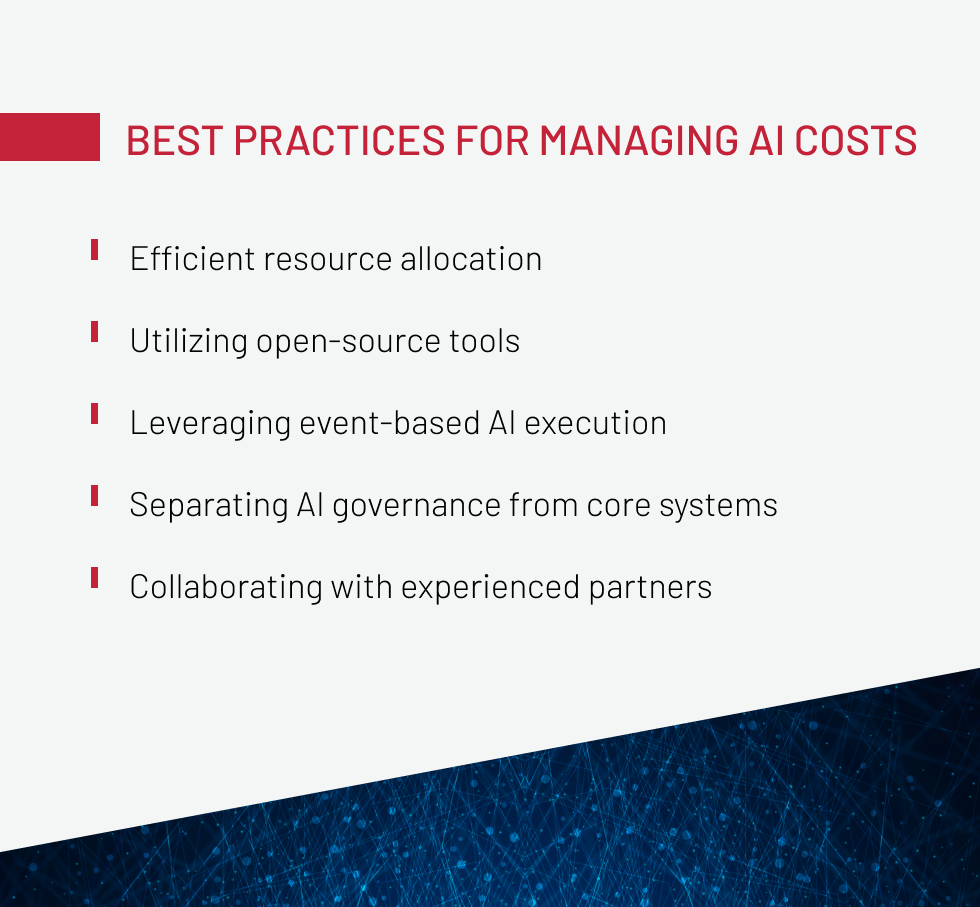
Efficient resource allocation
Efficient resource allocation starts with a simple rule: avoid processing everything automatically.
AI should be directed toward activities where the result justifies the cost. For review summaries, the team used a standard engineering filter: do not regenerate after every review event. For other ecommerce use cases, it may mean prioritizing high-traffic products, high-margin categories, markets with enough content volume, or workflows where manual effort is genuinely expensive.
Meaningful business triggers help teams avoid AI execution that looks technically correct but economically careless. A trigger might be a threshold of new reviews, a change in product status, a category-level update, a seasonal content refresh, a quality score, or a human approval event.
Utilizing open-source tools
Open-source technologies can reduce the cost of AI in selected areas, especially around orchestration, observability, data processing, testing, evaluation, and model experimentation.
They are not automatically cheaper. Open-source tools still require engineering time, security review, maintenance, hosting, and ownership. For enterprise teams, the real value is flexibility. Open-source components can help avoid unnecessary vendor lock-in, support custom evaluation workflows, and give architects more control over how AI services connect with the rest of the commerce platform.
The smart approach is selective. Use open-source when it improves control or reduces repeat cost. Use managed services where operational reliability, compliance, or speed justifies the price. The cheapest tool on paper is not always the cheapest tool after support, governance, and integration work are included.
Leveraging event-based AI execution
Not every data change requires a new AI request. Before launching the model, the system should decide whether something meaningful has happened.
This can be done through business thresholds, event triggers, refresh policies, or approval workflows. The design should connect AI execution to value instead of letting raw system activity dictate spend.
In the review summary case, review counts were the signal. The Azure Function compared the current count with the count used for the previous summary. If the delta did not meet the configured threshold, the system did not request a new generation. This pattern helps reduce token consumption without lowering output quality.
Separating AI governance from core systems
Do not put all AI logic inside the core ecommerce platform just because the feature appears there.
Core commerce systems should remain focused on transactional and customer-facing responsibilities. AI monitoring, orchestration, refresh decisions, token governance, and policy tuning often belong in separate services where they can evolve without adding unnecessary pressure to the main platform.
In the Expert Soft project, SAP Commerce did not send review data straight to the model. A scheduled job exported a product feed as JSON and uploaded it to an Azure hot folder. That upload triggered an Azure Function, which read the feed, requested current review data from external review providers, counted reviews for each product, and stored those counts in its own database. The function then compared the current count with the count used for the previous summary.
Only when the configured threshold was reached did the process request a new generation from the AI review-summary microservice. Otherwise, the existing summary remained in place.
This separation kept refresh decisions outside SAP Commerce, made the policy easier to tune, and helped control token spend without loading the core commerce platform with cost-governance logic.
Learn how to isolate the parts that need independent control, but do not fragment the platform just to look modern.
Download WhitepaperCollaborating with experienced partners
Many AI cost overruns come from architecture and implementation decisions rather than model selection.
An experienced implementation partner can help assess where costs will appear after go-live: integration depth, data readiness, invocation frequency, monitoring, refresh policies, governance, cloud services, and long-term ownership. This is especially important in SAP Commerce and enterprise ecommerce ecosystems, where AI rarely lives in isolation.
Expert Soft’s role in projects like the review summary implementation is not to make AI sound mysterious. It is to make the operating model concrete: which service owns generation, which service decides when generation is needed, how the commerce platform receives the result, and how the business keeps costs under control as usage grows. If you need to implement AI in your ecommerce system so it works with the existing ecosystem, not against it, feel free to contact us.
To Sum Up
The true cost of AI extends beyond development budgets and model pricing. Initial implementation matters, but long-term AI spending is shaped by architecture decisions, integration strategy, governance mechanisms, data readiness, support ownership, and how frequently AI is invoked.
The review summary case shows the pattern in practical terms. A seemingly simple PDP feature required a separate AI microservice, SAP Commerce integration, Azure-based review counting, refresh thresholds, and a decision layer that prevented unnecessary regeneration. The model generated the content, but the architecture controlled the economics.
That is the main lesson for enterprise ecommerce teams asking how much AI costs. The answer is not only a model price, a development estimate, or a cloud invoice. It is the cost of making AI work inside a real operating environment, then keeping that environment controlled as usage grows.
New articles

See more

See more

See more

See more

See more