
AI Microservices Architecture for Enterprise Ecommerce: Where Production AI Logic Can Live

An AI solution in an ecommerce platform is rarely just a model call. Like any capability introduced into a production commerce system, it brings its own rules, configuration, release rhythm, monitoring needs, and operating constraints. With AI, those constraints become sharper because model behavior can change, prompts need tuning, provider limits affect execution, and generated output may appear directly in catalog or storefront experiences.
If all of that logic is pushed into SAP Commerce or another stable commerce core, the platform starts carrying work it was not designed to own. So, the practical architecture question is where AI logic should live relative to that core, so the ecommerce system does not become overloaded by AI-side change.
McKinsey’s 2025 global AI survey reports that 88% of organizations regularly use AI in at least one business function, yet nearly two-thirds have not begun scaling AI across the enterprise. That gap matters because it shows where many teams get stuck: AI is already inside business functions, but the operating model for scaling it is still unfinished.
In practice, AI adoption often develops independently across teams, with each group using its own approaches instead of building on shared lessons, proven optimizations, and common controls. In ecommerce, this fragmentation can quickly become difficult to manage and can also increase exposure to emerging threats, including jailbreaks and data-wiping attacks. That is where architecture decisions about ownership, fallback, cost control, and traceability start to matter.
In this article, we use Expert Soft’s experience in microservices development and one of our projects as the practical ground for the discussion, so the architecture choices stay tied to real ecommerce constraints rather than abstract microservices advice. We will look at when an AI microservice boundary helps, what controls can live outside the commerce core, and when the same split can add risk instead of control.
Quick Tips for Busy People
If you only have a few minutes, keep these points from the article in mind:
- AI logic needs a defined home: production AI becomes manageable when model interaction, refresh policy, fallback, and cost rules have a boundary outside the stable commerce core.
- The microservice is only one part of the architecture: the AI capability may live in a microservice, while inference, gateway, and orchestration responsibilities can stay separate or combined depending on the system.
- Production pressure reveals the boundary: frequent prompt changes, provider volatility, and customer-facing latency usually show whether AI logic needs more room than the commerce core can safely give it.
- Governance should sit where teams can operate it: refresh policy, cost rules, audit context, and observability lose value when every adjustment has to wait for a core platform release.
- Ownership has to be visible after launch: generation behavior, storefront acceptance, operations, cost, and incident response need named owners before the first production issue appears.
- Microservices can add risk too: if the split only creates another deployment path, another latency point, or another unclear owner, the architecture has moved the problem rather than contained it.
The article starts with the boundary itself, because the strongest value of AI microservices is the operating control that boundary can make possible.
What AI-Native Microservices Integration Means in Enterprise Ecommerce
In enterprise ecommerce, AI-native microservices integration can mean an architectural approach where a specific AI capability can operate behind a separate service boundary instead of letting AI-side logic spread through the commerce core. The capability still serves the ecommerce experience, but the rules that govern generation, provider calls, refresh, policy, and fallback can evolve in a more focused layer.
That boundary matters because AI behavior is rarely one deterministic function. A production AI feature may have to take commerce data, prepare it for model use, evaluate generated output, store the result, and expose it back to the storefront with enough context for teams to trust it. If that logic sits directly inside SAP Commerce or another core platform, every prompt change, model switch, provider limit, or regeneration rule can become part of the platform release path.
The terms around this pattern often get mixed together, so the distinction is worth making in practical language.
An AI microservice usually owns a specific AI-enabled capability, such as review summarization, product description enrichment, catalog attribute generation, or support-response drafting. It may call an LLM or another model, but its responsibility is broader than raw inference.
AI inference microservices expose model execution. Their job is to run or call the model and return the result. They may not own the business rules around when generation should happen or whether the output is suitable for customer-facing use.
A gateway or control layer handles access, routing, rate limits, policies, provider selection, and sometimes audit controls. It can protect the rest of the system from provider behavior and make AI usage visible.
Orchestration coordinates workflow decisions. In a more complex setup, it may decide which steps run first, which input source to use, whether human review is needed, and what fallback path should apply.
These parts can be separate services, combined components, serverless functions, or adjacent platform layers depending on the system. The useful decision is whether the AI behavior has operating rules that would become harder to release, govern, or explain if they were buried in the core commerce platform.
Where an AI Microservice Boundary Becomes Useful in Production AI
The AI microservices boundary becomes useful when AI starts behaving by rules that differ from the platform around it. A pilot can tolerate manual review, one-off prompts, generous provider calls, and a few rough edges. Customer-facing ecommerce flows are less forgiving. They need predictable latency, clear fallback, controlled spend, and a way to explain how visible AI output was produced.
Several signals suggest that an AI microservice boundary may be worth considering.
-

AI changes faster than the commerce release cycle
A prompt adjustment, model version change, or provider configuration update should have its own validation boundaries and, where possible, be tested outside the main commerce workflows.
-

Provider behavior can affect the platform
When model APIs, rate limits, pricing, or response formats shift outside the platform team's control, a boundary gives the team somewhere to absorb the change before it leaks into commerce logic.
-

Prompt and policy rules keep evolving
Real traffic usually exposes edge cases that a pilot never sees, so review thresholds, governance limits, and escalation paths need a place to mature without making the commerce core absorb every policy adjustment.
-

AI cost has its own mechanics
Spend moves with model choice, retries, refresh rules, and reuse decisions, which means cost control has to be visible at the point where AI work is triggered, not reconstructed later from platform traffic.
-

Latency and fallback affect the customer experience
A storefront cannot wait indefinitely for a model call, and it should not fail a product page because generation is unavailable. Prepared output, cache strategy, reuse rules, and fallback behavior become architecture decisions.
-

Traceability becomes part of accountability
Teams may need to know which input, prompt version, provider, model, rule, and generation condition produced a visible result. Without that trail, the system may display AI output that no team can explain reliably.
An AI microservice boundary helps when these signals create real operating pressure. It adds less value when the AI feature is low-risk, rarely changes, does not affect customers, and can be governed safely through existing platform patterns.
Once those pressures are visible, the next question becomes more practical: which parts of AI behavior need their own control surface, and which can remain inside the existing commerce platform.
AI Microservices Architecture Controls That Can Sit Outside the Commerce Core
Production AI usually needs several areas of control around generation behavior, output quality, spend, latency, and recovery. These controls do not have to live in one universal layer. Depending on the architecture, they can sit in an AI service, gateway, orchestration layer, serverless function, event-driven worker, or another adjacent operating layer.
The point is to keep AI-side rules where teams can change, monitor, and govern them without turning each adjustment into a core platform release. Read the areas below as control surfaces: each one shows a type of AI behavior that may need its own operating logic once the feature reaches production.
Refresh frequency and regeneration thresholds
Production AI needs a rule for when new input deserves new output. In ecommerce, that input may be new reviews, changed product attributes, updated catalog content, altered compliance language, or market-specific data. Regenerating every time any input changes can waste money and create noise. Waiting too long can leave stale or weak AI output visible to customers.
When refresh logic starts deciding how much AI work is worth running, automation design becomes part of architecture. Explore a deeper framework on making enterprise automation proportionate, observable, and controlled.
A separate control layer can decide when change is meaningful enough to trigger regeneration. It can compare review counts, input quality, product importance, freshness expectations, and business priority before calling the AI service.
-
Pro tip:
Keep the trigger explainable. If a regenerated result costs money, changes visible content, or skips an update, the team should be able to tell which signal caused that decision.
Cost and provider usage
AI calls have their own economics. Teams need to control model choice, token usage, retries, provider limits, batching, and reuse rules. Those controls become more important when generated content appears across a large catalog or when multiple markets use the same platform foundation.
An AI service or gateway can route requests to different providers, cap usage, prioritize products, and avoid unnecessary regeneration. Caching intermediate steps and context merging are widely adopted for the AI services. It can also expose cost signals that ordinary platform monitoring may miss.
-
Pro tip:
Put cost controls close to the decision that creates spend. If SAP Commerce only sees the final summary, it should not also be the place where teams reverse-engineer why provider costs moved.
Latency and caching/reuse
Customer-facing commerce flows need stable response times. Synchronous AI calls can be useful in some internal workflows, but product pages and browse flows usually need prepared or reusable output. Caching, pre-generation, and refresh windows can protect the storefront from constant model calls.
A separate AI-side control layer can decide whether the storefront receives a prepared result, waits for a fresh one, or falls back to an existing version without making each freshness rule a commerce-core release.
If you plan to move from one AI capability toward a broader operating model, explore practical advice to design an AI backbone for enterprise commerce.
Download whitepaperKeeping fallback rules close to the AI capability gives teams a practical place to change degraded behavior as provider reliability, product expectations, or governance rules evolve. The commerce core should know how to consume the approved state, but it should not have to own every branch of AI recovery logic.
-
Pro tip:
Define fallback by customer impact, not only by exception type. A provider timeout, low-confidence output, and expensive regeneration may all need different visible behavior even if they look like ordinary service failures in logs.
Traceability and audit context
AI output should not appear as an unexplained artifact. Teams may need prompt version, source input, provider, timestamp, generation condition, output status, and review context. This audit trail helps engineering debug issues and gives governance teams a way to understand how visible content was produced.
Keeping that context in an AI-side service or control layer makes the trail part of the capability itself, instead of scattering it across commerce logs, provider dashboards, and manual review notes.
IBM’s 2025 Cost of a Data Breach Report shows why AI oversight cannot stay informal: 63% of breached organizations lacked AI governance policies or were still developing them, and 97% of organizations that reported an AI-related security incident lacked proper AI access controls. For ecommerce teams, that does not make every generated AI feature a security event. It does mean AI systems need visible control points before they become part of production operations.
-
Pro tip:
Capture not only prompt and model versions, but also the source data and generation path behind each output, so teams can determine whether a quality issue came from the model, insufficient or incorrect input data, or the prompt sequence. Product and governance teams should be able to see why an output was approved, skipped, refreshed, or blocked.
Observability for quality, skipped updates, failures, and spend
Ordinary uptime does not tell the full story of AI health. A platform can be up while AI output quality declines, provider errors rise, refresh jobs skip too many products, latency increases, or spend moves outside the expected range.
An AI-side observability layer can track the signals that describe the capability, not only the service, so teams can tune generation rules and provider behavior without waiting for general platform monitoring to explain a very AI-specific problem.
-
Pro tip:
Watch skipped work as closely as failed work. In AI flows, a quiet decision not to regenerate can be correct, but it can also hide stale content, weak inputs, or overly aggressive cost controls.
A boundary only proves its value when it changes how a production flow behaves: what the core platform owns, what the AI layer owns, and where teams can adjust the system without creating new release risk.
How AI Microservices Work in a Real SAP Commerce AI Flow
To make these patterns less abstract, let’s look at an example from Expert Soft’s project experience.
A large retail and health and beauty company worked with a high-load SAP Commerce platform to implement AI-generated pros-and-cons summaries from customer reviews on product detail pages.
A microservice boundary was a strong fit because the AI behavior had a different operating rhythm from the main ecommerce platform. Review summaries needed generation logic, provider interaction, refresh thresholds, and cost control, while SAP Commerce needed to stay focused on product context and storefront delivery.
We created an architecture in which review data was passed into a dedicated AI microservice for the pros-and-cons summary generation outside SAP Commerce Cloud. The core then received the prepared summary, connected it to the relevant product context, and made it available for storefront rendering. The platform did not need to own prompt mechanics, provider interaction, or the internal logic of generation.
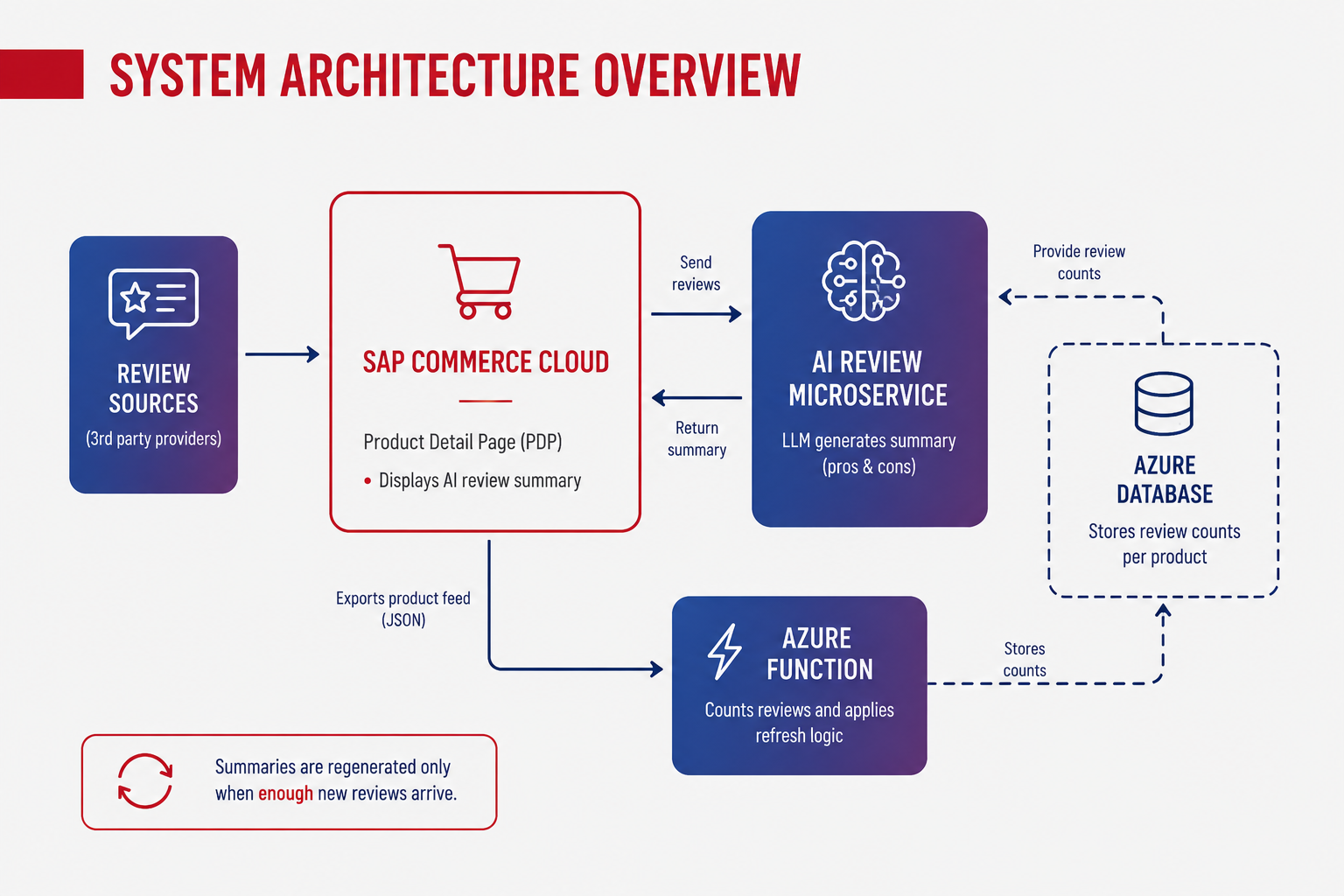
The team also separated the refresh-control logic. Review counting and regeneration thresholds moved into an Azure Function. That function tracked review counts from external providers and triggered regeneration only when the change was meaningful enough to justify a new AI call.
Expert Soft knows how to integrate AI in ecommerce systems so the solution fits platform constraints, release cycles, and ownership models.
Let's TalkThis illustrates several earlier points at once:
- Release cadence:
AI-side generation behavior could change without treating every prompt or provider adjustment as a core platform modification. - Cost control:
regeneration depended on a threshold, so the system did not react to every new review with another AI call. - Latency and fallback:
SAP Commerce worked with prepared output instead of depending on constant synchronous generation. - Responsibility boundaries:
SAP Commerce presented the product experience, while the AI service and Azure Function handled generation and refresh policy.
The practical implication is simple enough to be useful: the commerce core does not need to become the place where all AI behavior lives. It needs a stable way to consume AI output in the right product context, plus enough metadata and control to keep the feature operational after launch.
Responsibility Boundaries in AI Microservices After Launch
After launch, AI behavior touches several teams at once. Engineering may own the service, product may own customer-facing suitability, operations may own incidents, and governance may need evidence of how output was produced. If the architecture does not make those responsibilities visible, the AI feature can become everyone’s dependency and nobody’s logic.
The list below separates the responsibility layers that usually need to stay visible after launch.
-
Commerce core:
owns stable transactional logic, product context, platform integrity, catalog relationships, and customer-critical commerce flows. It should consume AI output through controlled contracts rather than owning every AI-side rule.
-
AI service:
owns generation behavior, prompt and model interaction, provider integration, output formatting, and AI-specific processing. It should make changes testable without creating unnecessary regression risk for the commerce core.
-
Control layer:
owns routing, thresholds, audit context, policy checks, review triggers, escalation paths, and operating rules. In some architectures, this may be a gateway, orchestration component, serverless function, or a combination of smaller controls.
-

Storefront and product ownership:
owns customer-facing acceptance, UX impact, freshness expectations, content suitability, and the decision about whether visible AI output helps the product experience.
-

Engineering and operations ownership:
owns monitoring, incident response, cost alerts, fallback recovery, provider-failure handling, and production support. This group needs dashboards and alerts that show AI-specific health, not only platform uptime.
Clear boundaries make collaboration easier because each team can see which decisions belong to the commerce core, the AI capability, the control layer, and the customer-facing product experience.
That ownership view also helps with the final architecture decision: whether an AI microservice boundary is solving a real operating problem or just adding another distributed component.
When AI Microservices Help and When They Add Risk
AI microservices help when they give teams a more controlled operating boundary for production AI. They add risk when the boundary creates distribution, latency, ownership, or operational complexity without a clear reason. The table below is a fit check for architecture discussions before the pattern becomes a default answer.
The healthiest use of an AI microservice boundary is selective. If the AI capability has a different rate of change, cost model, risk profile, or operating policy than the commerce core, a boundary can protect both sides. If the capability is small, stable, low-risk, and easy to govern within existing platform mechanisms, a separate service may become an architecture theater with invoices attached.
Final Word
AI microservices matter in enterprise ecommerce when they give production AI a controlled operating layer. The point is not to decompose every new capability. The point is to keep volatile AI decisions close enough to the AI workflow that teams can govern, tune, and observe without making the stable commerce core responsible for every provider, prompt, cost, and fallback change.
The SAP Commerce review-summary flow shows the practical version of the idea. SAP Commerce kept the product experience and platform integrity close to the core. The AI microservice handled generation. The Azure Function handled refresh thresholds. The boundary did not make the system magically simpler, but it put change, cost, and responsibility in places where teams could control them.
That is the real test for AI microservices architecture. If the boundary makes production behavior easier to govern, operate, and evolve, it can be a strong fit. If it only moves complexity into another service without clearer ownership, the architecture has not solved the AI problem. It has renamed it.
New articles

See more

See more

See more

See more

See more