
Data Integration Best Practices: How to Keep Enterprise Systems in Sync at Scale

Enterprise data integration starts to matter most when the task is no longer “connect these systems” but “keep them synchronized while data volume, update frequency, and downstream dependency keep growing.”
Most enterprise stacks already contain separate source databases, storage layers, analytics tools, internal applications, and customer-facing interfaces. Batch synchronization can work while updates are predictable and the business can wait.
Pressure builds as the dataset grows, updates arrive more often, and downstream systems depend on fresher data. A full reload that once looked harmless becomes slow, expensive, and harder to recover when it fails. At that point, the team is choosing an operating model for synchronization, not just another connector.
The same pressure appeared in an Expert Soft project for a Big Three credit rating company. The client ran an analytical portal that had to keep large index datasets ready for search and filtering, while the underlying data kept growing too fast for a simple scheduled flow to remain reliable.
That scenario becomes the article’s practical thread, showing how synchronization decisions change when data volume, freshness, recovery, and cost all start to matter at once.
Quick Tips for Busy People
If you are scanning first, these are the main takeaways.
- Platform choice follows the synchronization problem: a data integration platform helps only after the team understands what must stay current, where the source of truth lives, and how target systems use the data.
- Sync means more than moving records: enterprise systems are in sync when dependent applications receive usable updates within the required time window, and teams can detect drift or failure.
- Batch and real-time are operating choices: scheduled sync works for stable, low-urgency flows, while change-based or near-real-time patterns become more relevant when stale data affects users or operations.
- Capabilities need a production role: CDC, streaming, monitoring, recovery, and cost controls matter because they help the flow stay current without full reloads becoming the default answer.
- Best practices start before tooling: define freshness, reduce repeated work, separate pipeline responsibilities, and design recovery before the synchronization flow becomes critical.
- Platform shortlists come last: compare vendors only after latency, update volume, source and target roles, observability, and cost constraints are clear.
The full article starts with the platform category, then narrows into the synchronization problem that shaped the case.
What is a Data Integration Platform?
A data integration platform is software that helps move, transform, replicate, synchronize, and govern data across different systems. Depending on the platform, it may provide connectors, pipelines, transformation logic, orchestration, monitoring, data quality controls, governance features, and support for batch or streaming data movement. In practice, the platform sits between systems with different data models, ownership boundaries, and freshness expectations, so its value depends on how well it controls the flow between them.
The category is broad because enterprise data integration covers several different scenarios:
- loading data into data warehouses,
- connecting SaaS and enterprise applications,
- syncing operational databases,
- enabling reporting and analytics,
- supporting search, risk, customer-facing, or internal systems with fresh data.
Some teams use a packaged platform for most of this work. Others combine platform tools, cloud services, message brokers, databases, custom services, caches, and monitoring. In real enterprise systems, both patterns are common.
For this article, the focus is narrower than the whole data integration market. We are looking at one specific problem: keeping enterprise systems in sync when data volume, update frequency, and operational dependency make simple full reloads harder to trust.
That distinction matters. The best data integration platform for a warehouse-loading use case may not fit operational synchronization between a source database, a search layer, and a customer-facing portal. A platform with many connectors can still be the wrong choice if it cannot support the latency, transformation depth, error recovery, and cost profile the flow needs. To make that narrower problem concrete, the next section defines what keeping systems in sync actually means.
What It Means to Keep Enterprise Systems in Sync
A data integration platform is a product category. Enterprise synchronization is the operating condition that the architecture must maintain. The two overlap, but they are not the same thing.
This distinction is exactly why our practical example is useful here. Expert Soft worked with a Big Three credit rating company whose analytical portal depended on fresh index data for search, filtering, and dashboards. Postgres remained the source database for upstream analytical data, while MongoDB served prepared index documents to the portal.
The architecture had to keep those two models aligned. In Postgres, one index could be drawn from several related tables. In MongoDB, the portal needed a complete document ready for search and display. Redis also supported valid filter combinations, such as indicators, geographies, and time ranges, so users would not wait on repeated heavy lookups.
The data integration problem was synchronization, not data availability. Scheduled extraction could move selected data, but frequent updates and large uploads made the serving layer harder to keep current within a predictable window.
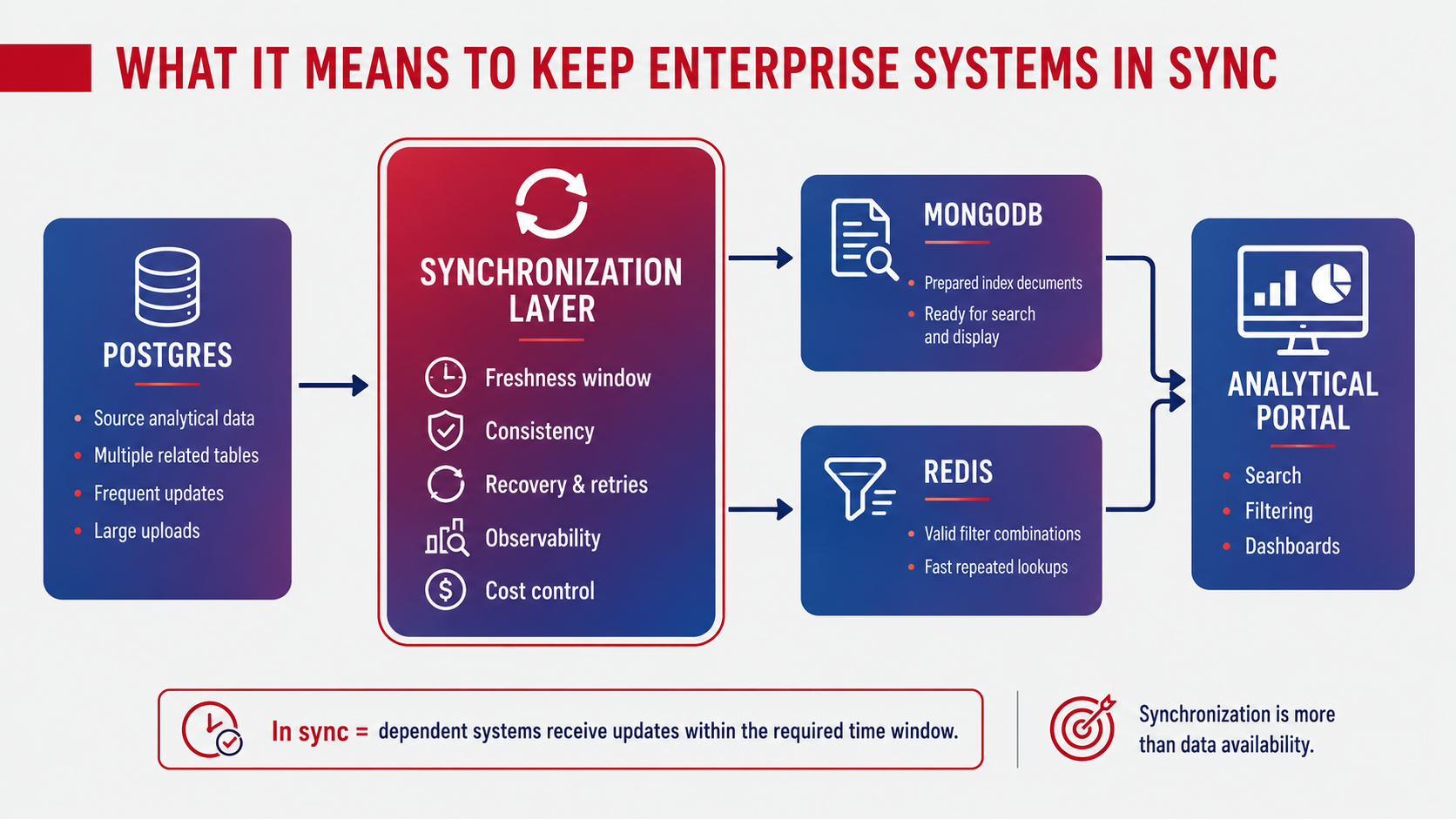
Systems are in sync when dependent systems receive the updates they need within the required time window. That definition is more useful than “the batch job finished” because it includes freshness, consistency, recovery, observability, and cost.
The pressure behind this is not going away. An IDC projection cited by ITPro expects global data volumes to more than double by 2028, with more than one billion new applications emerging. Whether or not a specific enterprise sees that exact curve, the direction is familiar: more data, more applications, more dependencies, and less tolerance for stale operational state.
This is why synchronization architecture needs more than connectors. If stale data can affect search, risk analysis, reporting, customer experience, or internal operations, the integration flow becomes part of the product.
The next choice is the operating model. Batch, near-real-time, and event-driven integration can all be valid, but only if they match the freshness and recovery requirements of the systems involved.
Batch vs Real-Time Data Integration: When Each Approach Works
Batch and real-time integration are not the bad and good options in a morality play. They are different operating models. The right choice depends on freshness, latency, update volume, reliability needs, and cost.
Batch integration works when data does not need to be updated immediately. It is often a practical fit when latency of several hours or a day is acceptable, volumes are stable, downstream systems do not depend on fresh operational updates, and failure recovery can happen before users or business processes are affected.
Batch also has strengths. It is easier to reason about, easier to schedule, and often simpler to operate when the dataset is manageable. For analytics and reporting, a nightly load may be entirely reasonable.
The risk appears when a batch job keeps doing more work than the business actually needs. Full reloads repeatedly move and process data that has not changed. As the dataset grows, the job becomes slower and more expensive. If the job fails, recovery may require another large run. If downstream systems depend on the result, the delay becomes visible.
Real-time or near-real-time integration becomes more relevant when data changes frequently, downstream systems need updates quickly, full reloads become too expensive, or stale data affects search, operations, risk, reporting, or customer experience. Many enterprise systems do not need absolute real-time. They need right-time integration: fast enough for the business process, stable enough for production, and controlled enough to recover.
The credit rating project followed that logic. The team did not move from scheduled ETL to Kafka because “real-time” sounded modern. The existing flow struggled because the source database held more than 60 million records, millions more were added daily, and the portal needed prepared index documents for search and filtering. The architecture had to shift from waiting for scheduled extraction to reacting to source changes through a message-driven pipeline.
Recent market signals point in the same direction. A Confluent study reported by TechRadar found that 72% of IT leaders saw real-time data processing challenges as a barrier to scaling AI systems, while 66% pointed to data lineage uncertainty. Even outside AI, the lesson is practical: when modern systems depend on fresh, traceable data, latency and lineage become architecture concerns.
This is also where real-time data integration tools need practical validation: a set of proven capabilities.
Core Capabilities to Look for in a Data Integration Platform
When evaluating a data integration platform, it is tempting to start with the connector list. Connectors matter, but they are only the opening move. For enterprise synchronization, the deeper question is whether the platform or architecture can keep data current, process changes efficiently, recover from failures, and scale without uncontrolled cost.
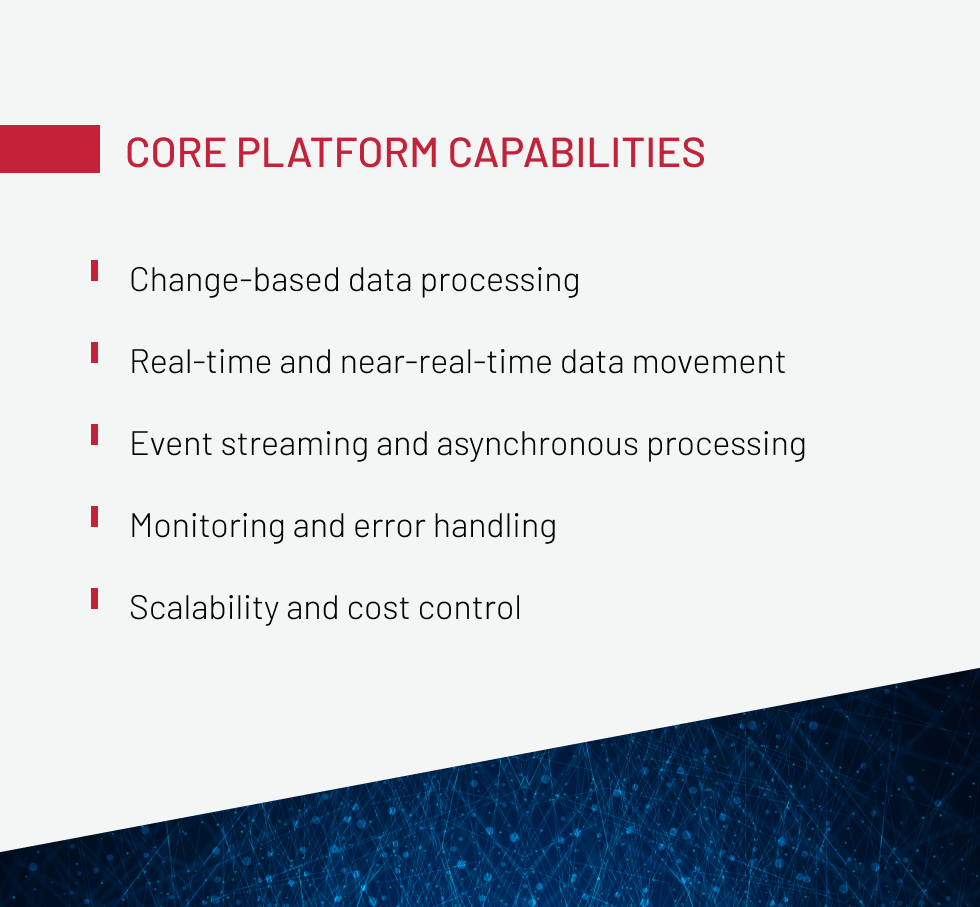
Change-based data processing
A strong synchronization flow should process changes rather than reload the full dataset by default. That may mean CDC, incremental extraction, log-based replication, event capture, or another change-based pattern.
For this capability, Expert Soft used AWS DMS to track selected Postgres table changes and publish them for further processing. The value was reducing dependency on long-running scheduled jobs and giving the pipeline a way to react to inserts, updates, and deletes closer to when they happened.
For enterprise teams, this capability changes the cost and latency profile. Instead of asking the system to move everything again, the architecture asks what changed, what downstream document or view is affected, and what needs to be updated.
If your synchronization flow is starting to carry production risk, Expert Soft can design an integration architecture that matches your data volume, latency, and recovery requirements.
Talk to Our TeamReal-time and near-real-time data movement
A data integration platform should support the level of latency the flow needs. Some flows can wait. Others cannot.
Near-real-time movement is especially useful when downstream systems support operational work: search indexes, risk screens, customer-facing portals, pricing views, inventory visibility, or internal decision tools. Lower latency matters when it keeps dependent systems trustworthy, not when it chases a theoretical zero-latency target.
In our project, the final architecture had to handle two different scales of work. Day to day, the pipeline absorbed the incremental Postgres changes — the millions of new and updated records arriving daily — continuously, through the CDC-based flow, without a full reload. The architecture also had to stay capable of a full reindex: when a bulk correction or a large historical load hit the source, the same Kafka-based flow could process hundreds of millions of records in approximately one hour, instead of the multi-day runs the old scheduled approach needed for the same volume.
That is not “instant,” and it did not need to be. It matched the system’s practical freshness requirement for both the everyday incremental case and the occasional full-volume run.
Event streaming and asynchronous processing
Scalable synchronization is easier to control when source and target systems are decoupled. If every source change directly triggers target writes through tight point-to-point logic, the architecture can become brittle under load.
Kafka gave source changes a controlled path into the processing layer, so the credit rating flow was no longer tied to one scheduled extraction window.
The important detail was payload design. Early Kafka events did not always include enough context to build a complete MongoDB document, so the back-end service sometimes had to query Postgres again under large updates. Enriching the events with the data needed for the target document made the consumer more self-sufficient and turned streaming into a useful processing pattern, not just a faster delivery channel.
For a deeper look at scalable retrieval patterns, read Speed Through the Mess: How to Build Scalable Retrieval in Complex Stacks.
Monitoring and error handling
Synchronization is invisible until it fails. Then everyone wants to know where the lag started, which events failed, whether retries are working, and whether the target system can be trusted.
A production-ready data integration platform should make failures, lag, retries, latency, and sync status visible. It should also support recovery without forcing teams into a full rerun whenever something goes wrong.
This is where data integrity practices become operational. Synchronization teams need to define correctness, expose problems, and create a path back to trusted data after failures. In production pipelines, monitoring belongs inside the integrity model because it shows whether the data can still be trusted.
Scalability and cost control
Scale is not only about throughput. It is also about how much unnecessary work the pipeline creates.
A platform may move data quickly, but still be expensive if it repeatedly moves unchanged records, creates redundant storage, or forces downstream services to perform avoidable lookups. A good enterprise synchronization design reduces redundant processing, unnecessary storage, and avoidable pressure on source systems.
The credit rating project shows why cost control starts with the flow itself. The team moved away from scheduled extraction and redundant movement toward change capture, event transport, enriched messages, custom processing, MongoDB serving documents, and Redis-backed filter metadata. The architecture reduced repeated work instead of simply adding more capacity around the old pattern.
Integrate AI solutions without overloading your ecommerce system.
Explore WhitepaperThose capabilities set up the practical question behind the next section: how should teams design a synchronization flow that remains fresh, recoverable, and cost-aware as data volume grows?
Data Integration Best Practices for Keeping Systems in Sync
The practices below come from the same focus: keeping enterprise systems in sync when a source model, a serving model, and user-facing expectations no longer fit a simple full-reload pattern. The credit rating project gives each practice a concrete reference point without turning them into a case study.
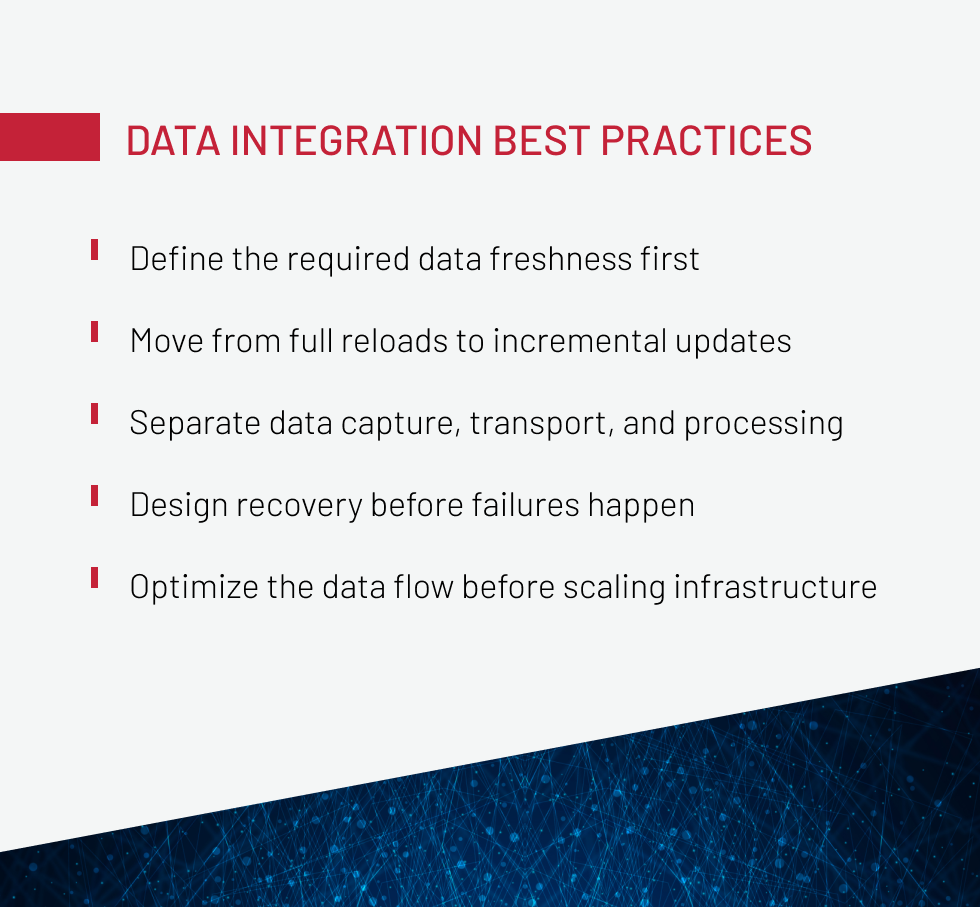
Define the required data freshness first
Do not start with the tool. Start with the acceptable delay.
Real-time data is not required everywhere. Reporting flows may tolerate daily updates, while operational screens or customer-facing actions may need updates within a much shorter window. The required freshness should be a business and architecture requirement before the team evaluates a data integration platform.
That freshness gap was visible in the portal flow. Scheduled synchronization stopped being enough because the portal depended on prepared index documents for search and filtering. When millions of new records arrive daily, users could be looking at stale filter options or outdated analytical views unless the serving layer reflects source changes within a controlled processing window.
-

Pro tip:
Write the freshness requirement as a time window and a consequence. "MongoDB must reflect index updates within the agreed processing window because stale filters affect portal search" is more actionable than "make it real-time."
Move from full reloads to incremental updates
Full reloads are simple until they become the bottleneck. They move too much data, repeat work unnecessarily, and make failure recovery heavier than it needs to be.
Incremental updates reduce the surface area. The system identifies inserts, updates, and deletes, then applies only the changes that matter to the target system. CDC is one common way to support this, but the broader principle is to stop treating the whole dataset as the unit of work.
For the credit rating portal, the main shift was from scheduled extraction toward CDC-based updates. Postgres stayed the source of truth, MongoDB stayed the serving model for the portal, and the pipeline’s job changed from moving selected batches to keeping affected target documents current as source changes arrived.
-
Pro tip:
Before replacing a full reload, map which target records are affected by each source change. Capture may be straightforward. Rebuilding the complete target object after a partial update is usually where the architecture needs the most care.
Separate data capture, transport, and processing
A scalable integration flow is easier to operate when responsibilities are separated: capture identifies changes, transport moves events, processing applies transformation logic, storage serves the target use case, and caching avoids repeated lookup work where fast filtering matters.
The project used that pattern in concrete terms. AWS DMS handled change capture from Postgres, Kafka carried events, a custom back-end consumer assembled MongoDB documents, MongoDB served the portal, and Redis accelerated valid filter combinations.
This separation improved control because each layer could evolve. When partial Kafka events slowed processing, the team adjusted the message structure rather than abandoning the architecture. Enriched events made the consumer more self-sufficient and reduced extra Postgres reads.
-
Pro tip:
If a consumer regularly calls the source database to complete its work, the event may be under-designed. Enriching the message can be cheaper than scaling the source database around avoidable lookups.
Design recovery before failures happen
High-volume data integration will meet failures. Service restarts, malformed events, target write errors, and downstream lag are normal production realities, so the architecture has to assume that individual updates may need attention.
Recovery cannot be a late addition once the pipeline becomes critical. Teams need retries, error handling, observability, and a way to recover without rerunning the entire dataset whenever one part fails.
The same concern showed up in our project flow. The pipeline had to keep Postgres and MongoDB aligned while large analytical updates kept arriving. Platform owners needed more than a completed job. They needed enough visibility to know whether the serving data could still be trusted.
-
Pro tip:
Define the smallest replayable unit before production. If teams know whether they can safely reprocess an event, a source range, or a target document, recovery becomes a controlled operation instead of a full synchronization rerun.
Optimize the data flow before scaling infrastructure
When a pipeline becomes slow, the first reflex is often more compute, more storage, or larger instances. Sometimes that is necessary. Often, it only makes an inefficient pattern more expensive.
A slow pipeline is not always an infrastructure shortage. It may be repeatedly reading unchanged data, storing redundant intermediate copies, or asking source systems to serve lookup work that the integration design should avoid. Inspect those movements before scaling capacity.
In our project, the improvement came from changing the movement pattern instead of scaling the old one. Scheduled extraction had to collect and transform index data for MongoDB in large runs. The final flow captured Postgres changes, enriched Kafka messages with the context needed to build complete index documents, processed them through a custom consumer, stored prepared documents in MongoDB, and used Redis for valid filter combinations. That made the flow more predictable and able to process the required volume of records within approximately one hour.
-
Pro tip:
Look for repeated work before adding capacity. If the pipeline keeps processing unchanged data, fetching missing context, or rebuilding complete targets too often, architecture optimization may beat infrastructure scaling.
Once those practices are clear, a platform list becomes more useful. The question is no longer which product sounds strongest in general, but which option supports the synchronization pattern the system actually needs.
Best Data Integration Platforms in 2026
There is no universal best data integration platform. The right option depends on source systems, destinations, latency, governance, data volume, budget, and the architecture around it.
For enterprise synchronization, use the list below as a shortlist starter. Then validate each option against the pattern you need: CDC or incremental processing, streaming support, monitoring, recovery, scalability, governance, and cost control.
The following platforms are options to consider, not a definitive ranking.
Confluent
Confluent is the commercial platform built around Apache Kafka, and it is a natural fit when the synchronization problem is event-driven by design rather than connector-driven, moving change events through a replayable stream that multiple downstream consumers can read from independently.
It is worth considering when the architecture already relies on Kafka-style decoupling between source and target, or when teams need managed stream processing, schema governance, and connector infrastructure without operating Kafka clusters themselves. For pure batch or warehouse-loading use cases, a lighter ELT tool is usually a better fit.
Debezium
Debezium is an open-source CDC framework that captures row-level changes from databases like Postgres, MySQL, and SQL Server and publishes them as event streams, typically through Kafka.
It is especially relevant for teams building a custom synchronization pipeline close to the source, where the team wants direct control over capture logic without a managed vendor layer. For teams that prefer a fully managed capture-to-target service instead of assembling the pipeline themselves, a packaged CDC platform may reduce operational overhead.
Qlik Replicate
Qlik Replicate (formerly HVR) is a log-based CDC and replication platform built for keeping heterogeneous databases and data warehouses continuously in sync at low latency.
It is often relevant when the integration problem is primarily database-to-database or database-to-warehouse replication at scale, with strong requirements around initial load plus ongoing change capture in a single managed tool. For flows that also need custom transformation logic or complex event enrichment before the target write, teams should validate how much of that Qlik Replicate handles natively versus what still needs a custom consumer layer.
Fivetran
Fivetran is well known for automated data movement, managed connectors, database replication, SaaS replication, and analytics-oriented pipelines. It is especially relevant when the target is a warehouse, lake, or analytics environment and the team wants to reduce custom pipeline maintenance.
Fivetran’s own platform materials describe automated high-performance pipelines across hundreds of sources and destinations, which makes it a practical shortlist candidate for ELT and centralized analytics use cases. For operational synchronization, review transformation requirements, target behavior, latency, and recovery model carefully.
Informatica
Informatica is a mature enterprise-grade option for cloud data integration, data engineering, governance-heavy environments, data quality, replication, and CDC-supported scenarios.
It is often relevant when the integration problem includes data governance, data quality, cloud cost visibility, and large-scale data management. For teams with complex compliance and governance needs, Informatica may be a stronger fit than lighter connector-first tools.
To Sum Up
Successful data integration at scale depends on more than choosing a platform with enough connectors. Connectors are useful, but they do not define freshness, consistency, recovery, observability, or cost.
Enterprise systems stay in sync when the integration architecture matches the role of each system, the volume of updates, the required latency, and the operational risk of stale data. Sometimes that means batch. Sometimes it means near-real-time movement. Sometimes it means CDC, Kafka, custom processing, dedicated serving databases, caching, and monitoring. Often, it is a hybrid.
The Expert Soft case shows the practical pattern. A scheduled ETL flow was enough at first, but high-volume analytical data and frequent updates changed the operating conditions. The final architecture did not simply move more data faster through the same old process. It changed the way data moved, how messages carried context, how target documents were assembled, and how the portal served search and filtering.
That is the best practice. Start with the synchronization requirement, then choose the platform, pipeline, and processing model that can keep the system trustworthy under scale.
FAQ
-
How do I decide between batch and near-real-time integration?
Choose the operating model that matches your freshness and recovery needs. Batch fits when several hours or a day of latency is acceptable, volumes are stable, and failures can be fixed before users notice. Near-real-time fits when frequent changes, user-facing dependencies, and the cost of full reloads make staleness visible.
-

Which core capabilities matter most for operational synchronization at scale?
Look beyond connector lists and validate that the stack can stay current, recover, and control cost: change-based processing, real-time/near-real-time movement, event streaming and async decoupling, monitoring and error handling, scalability and cost control.
-

How should I pick a data integration platform?
source/target roles, transformation depth, monitoring, recovery, governance, and cost constraints. Then match strengths with tool capabilities.
Andreas Kozachenko focuses on enterprise architecture, integrations, performance, cloud, data, deployment, and technical risk. His perspective fits the practical decisions behind keeping enterprise systems synchronized at scale without turning platform choice into a generic tooling exercise.
New articles

See more

See more

See more

See more

See more