AI Search for Ecommerce: 14 Tools to Improve Product Discovery

AI search tools are opening up new ways for ecommerce retailers to help shoppers find the right products. From understanding natural language queries to finding products through images, there’s a growing range of capabilities to explore. That variety is useful, but AI search for ecommerce in an enterprise store often takes more than choosing a search engine.
Imagine a shopper looking for a replacement part. The search returns several promising options, yet the shopper still can’t tell which one will fit. Even a great search engine can’t help much if the catalog is missing the compatibility information needed to make that decision. The same goes for supplier synonyms the catalog doesn’t recognize or search queries that consistently leave shoppers without a useful result.
That’s why our roundup of 14 AI search tools for ecommerce goes beyond search engines. Alongside search platforms, we’ll explore tools that enrich product data, improve query handling, and help teams evaluate search relevance. We’ll also look at AI assistants and visual search tools that give shoppers new ways to find what they need.
Quick Tips for Busy People
Here is the short route through the comparison.
- Match the bottleneck to the role: The 14 tools cover search, readiness, catalog production, and optional shopper interfaces rather than one interchangeable feature set.
- Choose the results foundation deliberately: Algolia, Constructor, Coveo, Bloomreach, and Athos differ in API control, behavioral ranking, commerce models, and merchandising fit.
- Inspect inputs and query behavior: AI Search Readiness Kit exposes data gaps, while searchHub works on underperforming queries over an existing engine.
- Improve the records shoppers search: Catalog AI Studio, Akeneo, and Salsify help produce or manage useful product attributes, each at a different point in catalog operations.
- Add guidance for difficult choices: Zoovu Zoe and Rezolve let shoppers explain a need through conversation when a results list is too blunt.
- Let images carry intent where appropriate: ViSenze and Syte help shoppers find catalog matches from pictures, provided the imagery and assortment support them.
- Test the combination on your store: Real queries, variants, latency, controls, and ownership reveal more than an AI feature label.
The details below show where those distinctions become operational.
The 14 Tools at a Glance
What makes this shortlist useful is the role each tool can play in an enterprise store. We checked official product documentation for on-site discovery capabilities, the data each tool needs, integration and control options, and the shopping task it supports. That is why the overview separates search engines from the tools that improve their inputs and the interfaces that give customers another way to find products.
| Tool | Category | Search role | Best-fit situation |
|---|---|---|---|
| Algolia AI Search | Core search | AI search engine with API-led retrieval | Custom storefront search build |
| Constructor Search | Core search | AI search engine with behavior-led ranking | Large retail or B2B assortment |
| Coveo for Commerce | Core search | AI search engine with ML relevance tuning | Enterprise interaction data |
| Bloomreach Search | Core search | AI search engine for search and merchandising | Search plus merchandising |
| Athos Commerce Site Search | Core search | AI search engine for intent-led site search | Combined discovery platform |
| AI Search Readiness Kit | Search readiness | Data diagnostics preparation for AI search | Unready data before AI launch |
| searchHub | Optimization | AI search and product discovery optimization | Existing engine with weak queries |
| Catalog AI Studio | Catalog preparation | Product-card production | Supplier-heavy catalog operations |
| Akeneo PIM AI Enrichment | Catalog preparation | PIM attribute generation | Akeneo-centered data workflow |
| Salsify Intelligence Suite | Catalog preparation | PXM content enrichment | Multi-channel content operations |
| Zoovu Zoe | Shopping assistant | Guided product advice | Complex product selection |
| Rezolve Conversational AI | Shopping assistant | Conversational shopping | Natural-language shopping journey |
| ViSenze AI Visual Search | Visual search | Image product lookup | Visual retail and marketplaces |
| Syte Visual Discovery | Visual search | Visual similar-item discovery | Fashion, decor, and jewelry |
Start with the core search platforms if the results page itself is the bottleneck. If an existing engine is sound but the inputs or query handling are weak, the supporting categories may be the more relevant first move. A useful place to begin is the layer that decides which products appear when a shopper searches.
AI Search Platforms for Ecommerce
These products retrieve and rank items from an on-site catalog. Teams comparing the best AI-powered search and personalization platforms for ecommerce should ask who shapes relevance: developers through APIs, models learning from shopper behavior, merchandisers through controls, or some combination. All still need a dependable feed of products, availability, and events.
Algolia AI Search
-

Best fit
Teams wanting an API-led search implementation.
-

What sets it apart
Configurable AI-assisted retrieval.
Algolia AI Search gives a team an API-led way to assemble its own results experience. Hybrid keyword and semantic retrieval can handle a query whose wording does not match the product title exactly. Developers can shape the index and front-end, while merchandisers can promote or demote products for particular queries, inspect why an item appears, and compare changes with A/B tests. The useful distinction is how much of the experience the merchant can compose and tune.
Consider a query for a jacket in a specific color and size. Algolia can retrieve likely matches, but the merchant decides whether a color variant is indexed as a separate result, how availability affects ranking, and when a merchandising rule should outrank the model. Those decisions make Algolia attractive to teams with a defined search design and engineering capacity. Its separate recommendations product is outside this comparison.
Constructor Search
-
Best fit
Large retail or B2B catalogs where shopper behavior matters.
-
What sets it apart
Behavior-informed search ranking.
Constructor Search uses shopper behavior to influence search and autosuggest while customers are still expressing a query. Its clickstream-informed models can connect typos and long-tail wording to intended products, update synonyms and reformulations, and use interaction signals to refine the ranking. This matters in a broad assortment where dozens of items match the text but shopper choices reveal that some are much more useful than others.
The shift is visible before the results page: autosuggest can show products, prices, and inventory as the shopper types, rather than only completing a phrase. Constructor also gives merchandisers reporting on popular terms, no-result searches, and room to experiment with changes. For an enterprise or B2B store, that loop is only as representative as the events and catalog context it receives. Account-specific assortment and business rules still need an explicit place in the implementation.
Coveo for Commerce
-
Best fit
Enterprise teams seeking ML-based commerce relevance.
-
What sets it apart
Intent-aware product ranking.
Coveo for Commerce is built for an enterprise search path in which the index, shopper events, and ranking models work together. Its documentation describes intent-aware product ranking and automatic relevance tuning. A team can feed product and interaction data into the system, then let the ranking respond to what shoppers engage with instead of maintaining one static order for every query.
The concrete fit is a catalog with parts, variants, or customer-specific terms that must be indexed correctly before ML relevance can help. Coveo’s unified index can bring product and related content into one search experience, while commerce events inform ranking and merchandisers can manage campaigns. Map the event and catalog fields first, then decide where model-led ordering may yield to stock, promotions, or other commercial rules. This is AI/ML search, not a generative shopping chat by default.
Bloomreach Search
-
Best fit
Retailers wanting search within a broader commerce-discovery suite.
-
What sets it apart
Loomi-powered understanding and ranking.
Bloomreach Search puts Loomi-powered search in the same operating environment as category and merchandising work. Search can interpret shopper wording, while the team can adjust the weight of data signals in ranking and use interaction data to personalize product grids. For a retailer whose search and category pages repeatedly diverge, that shared workflow is more consequential than the AI label.
A merchandiser can boost or bury a product, lock its place, preview the result, and run an A/B test before making a rule permanent. That is a tangible reason to consider the broader suite when campaign placement and algorithmic relevance must coexist. The retailer still has to decide which team owns those controls and whether its catalog and behavioral data can support the shared model. Bloomreach’s shopping agent is a separate product, not this search profile.
Athos Commerce Site Search
-
Best fit
Teams combining search with merchandising and personalization.
-
What sets it apart
Intent-focused on-site discovery within the Athos platform.
Athos Commerce Site Search addresses the gap between the words in a query and the terms on a product card. It handles natural language, typos, and synonyms, and can extract searchable terms from descriptions and other product fields. A shopper asking for a product by its everyday name can therefore reach items cataloged under a supplier’s terminology. Athos also exposes why products rank through Search Preview, giving the commerce team a place to investigate a surprising result.
Its hybrid search can preserve pinned positions while finding intent-based matches, and its merchandising application lets a team curate and test product placement alongside search. That combination is useful when the same team must answer both “why did this rank?” and “which products should this campaign show?” Catalog enrichment and ranking diagnostics need to be configured around the merchant’s assortment, availability, and market rules. Athos’s conversational assistant remains a separate extension.
Expert Soft helps you give shoppers relevant results as your catalog, availability, and search language change.
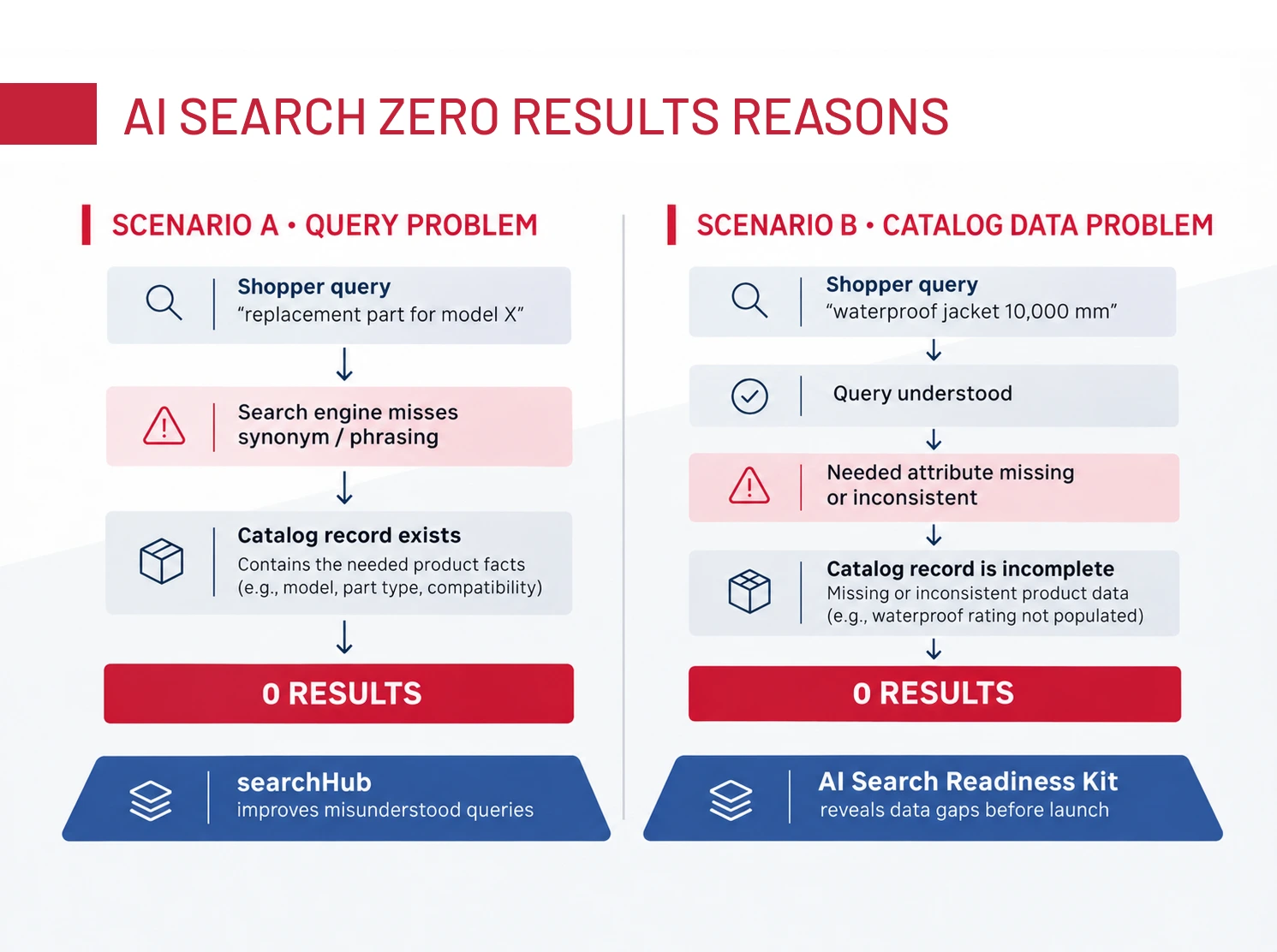
Contact UsEven with the right AI search engine, shoppers can still get zero results for a product you have in stock. Sometimes, the search engine doesn’t understand what the shopper is looking for. Other times, the catalog is missing the information needed to find the product. The next two tools can help you figure out where the problem lies before you start looking for a new search platform.
Tools for AI Search Data Readiness and Query Optimization
AI ecommerce search depends on both the product information an engine receives and the shopper language it can interpret. Inconsistent attributes can make the right item invisible, while an unrecognized query can fail even with a good catalog. These two tools address different sides of that problem. They also give teams a more useful starting point for diagnosing search performance and relevance gaps than a generic claim that search needs more AI.
AI Search Readiness Kit
-

Problem addressed
Unready product and search data.
-

How it helps
Read-only visibility into data gaps and a prepared layer for AI use.
AI Search Readiness Kit is a read-only readiness layer for an existing search environment. It can expose a category where supplier feeds call the same attribute by different names, variants do not line up, or click and add-to-cart events never reach the ranking system. Its diagnostics connect those input gaps to measures such as attribute completeness, duplicate rate, and zero-result queries, so the team can see what needs correction before changing customer-facing search.
The AI Search Readiness Kit prepares normalized data and signal outputs for the engine or assistant a merchant already uses. It does not replace production search or rewrite source systems. A catalog owner can review a proposed attribute contract and guardrails while engineering decides how approved outputs enter the live path. That division of responsibility is exactly what an AI readiness assessment should settle before a pilot becomes an operating dependency.
searchHub
-
Problem addressed
Misunderstood or underperforming search queries.
-
How it helps
An optimization layer over an existing engine.
searchHub works in front of a merchant’s current engine. It looks for journeys where shoppers give up, groups related search intent, and cleans up a query before the engine ranks products. A typo, unusual phrasing, or ambiguous term can therefore be addressed in the request path rather than left as a recurring report in an analytics dashboard. The underlying engine continues to retrieve and rank the products.
The feedback loop is central: searchHub measures a change against a baseline, so the team can tell whether a reformulation helped. That makes it a fit for an established engine whose query handling needs work. The added request-path layer needs a latency and ownership budget, and a cleaned-up query still cannot retrieve a product whose catalog record lacks the relevant attribute.
When search failures keep resurfacing, someone has to own the investigation and verify that a fix held. Read the whitepaper for a practical way to close that loop.
Suppose shoppers search for a jacket by its waterproof rating, but the supplier feed puts that rating in an unstructured description or leaves it out. Better query interpretation may recognize the request perfectly and still miss the item. Now the work moves upstream, to how product cards are produced.
Tools to Prepare Catalog Data for AI Search
Search relevance is partly a content production problem. Titles, descriptions, variant relationships, and structured attributes determine what an index can retrieve and what an assistant can safely say.
Salsify’s 2025 consumer research found that 54% of surveyed shoppers had abandoned a purchase because product information conflicted across channels. It shows why producing consistent records is consequential beyond the search team.
The three tools below work at different points in that production path, from SKU creation to PIM enrichment and cross-channel publishing.
Catalog AI Studio
When search failures keep resurfacing, someone has to own the investigation and verify that a fix held. Read the whitepaper for a practical way to close that loop.
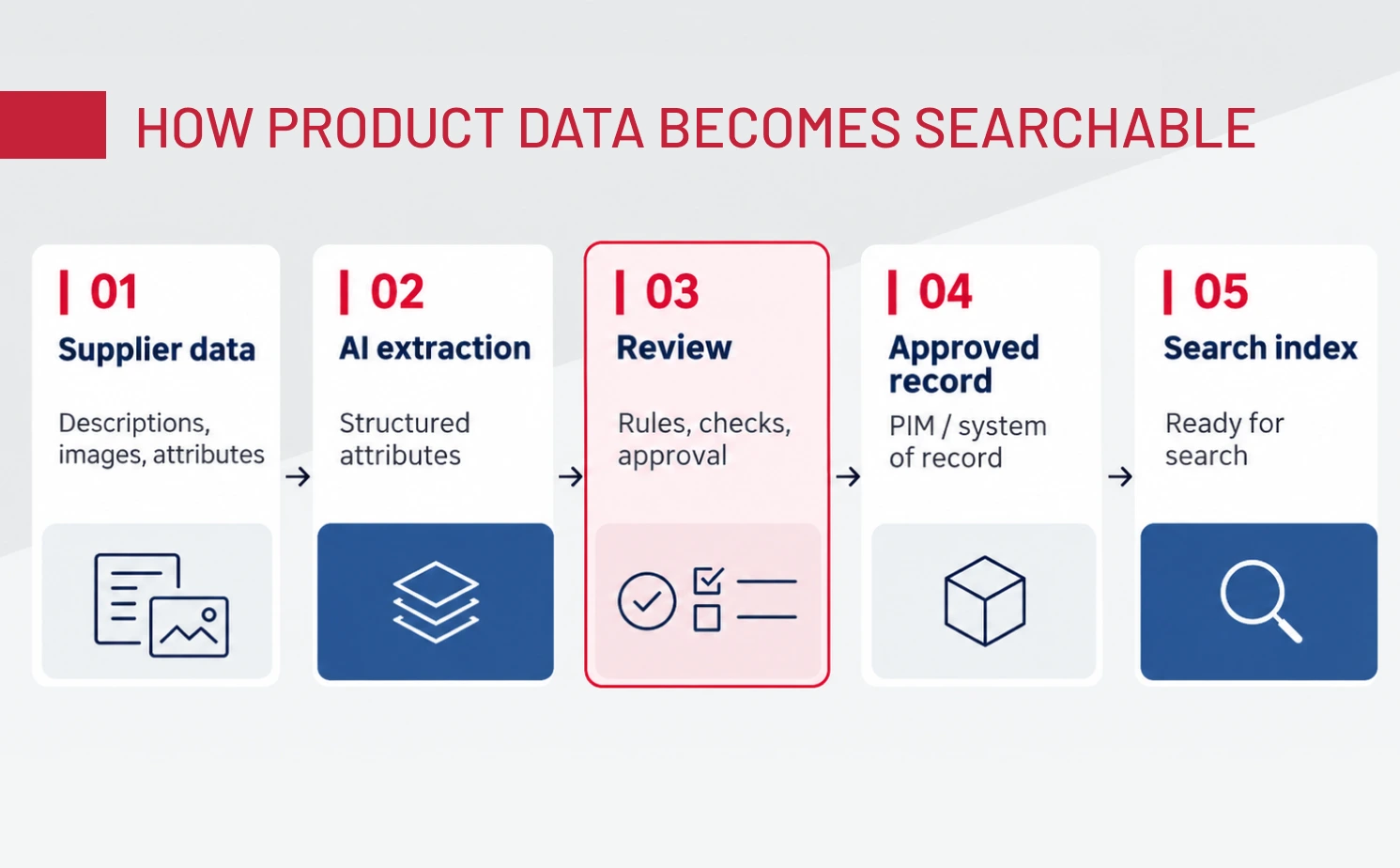
Catalog AI Studio is a production workflow between raw supplier input and a publish-ready product card. Supplier text and images enter an extraction and normalization step, proposed attributes are checked against category rules, and uncertain fields go to a reviewer. Titles and descriptions are generated from approved attributes, so the search index receives a more useful record without treating generated prose as its own source of truth.
A catalog operator can see a draft and its diff before an approved update reaches the PIM, which remains the system of record. Confidence thresholds, review routing, and an audit trail make that production path governable across suppliers. Use that approved output to populate the fields the search index actually receives, so a newly published SKU can be found by its verified attributes, not only its title.
Akeneo PIM AI Enrichment
-

Catalog task
Govern supplier-content ingestion and product-card production.
-

Contribution to search
Normalized, reviewable product data.
Akeneo PIM AI Enrichment brings AI-assisted enrichment into the PIM where product attributes are already managed. Its AI Configurations let a team set reusable prompt-based enrichment, asset generation, and translation behavior, then apply it through rules or from the product edit form. A catalog manager can therefore work on missing or inconsistent fields without moving the decision to a separate search application.
That proximity is most useful when an enrichment rule is tied to an eligible attribute and a review step. A generated specification that the source record never supplied can make a card look complete while making it less trustworthy. The PIM team has to validate the value and ensure the approved field reaches the search index.
That is where a controlled catalog workflow matters for large B2B assortments: an attribute approved in the PIM should carry the same meaning across product families before it becomes a search filter.
Salsify Intelligence Suite
-
Catalog task
Generate or complete product attributes inside PIM.
-
Contribution to search
More structured product information for indexing.
Salsify Intelligence Suite places AI tasks inside a product experience management workflow. A team can set up intelligent task types in the workflow builder for content generation, extraction, or guideline checks, then route work through human review before the product information goes to its destinations. That is useful when the same item needs consistent descriptions and attributes across a store and other selling channels.
For on-site search, the decisive step comes after enrichment: which approved fields reach the commerce platform, and how quickly are they reindexed? If a new material attribute is published to a marketplace but omitted from the store’s search feed, shoppers still cannot find the product by material. Salsify fits teams coordinating product content across destinations. It does not rank on-site results itself.
The question then shifts from improving individual product cards to getting approved product facts into every experience that depends on them.
-
Catalog task
AI-assisted product-content work within PXM.
-
Contribution to search
More complete, consistent product information for discovery.
Salsify Intelligence Suite places AI tasks inside a product experience management workflow. A team can set up intelligent task types in the workflow builder for content generation, extraction, or guideline checks, then route work through human review before the product information goes to its destinations. That is useful when the same item needs consistent descriptions and attributes across a store and other selling channels.
For on-site search, the decisive step comes after enrichment: which approved fields reach the commerce platform, and how quickly are they reindexed? If a new material attribute is published to a marketplace but omitted from the store’s search feed, shoppers still cannot find the product by material. Salsify fits teams coordinating product content across destinations. It does not rank on-site results itself.
The question then shifts from improving individual product cards to getting approved product facts into every experience that depends on them.
If product data feeds several search and AI experiences, give those teams a shared foundation. Read the whitepaper to plan a reusable data layer without replacing source systems.
A well-structured product card helps the search engine return the right information. But what if shoppers don’t know exactly what they’re looking for? When choosing between products with different specifications, answering a few questions may be easier than scrolling through another page of search results.
AI Shopping Assistant Tools for Product Discovery
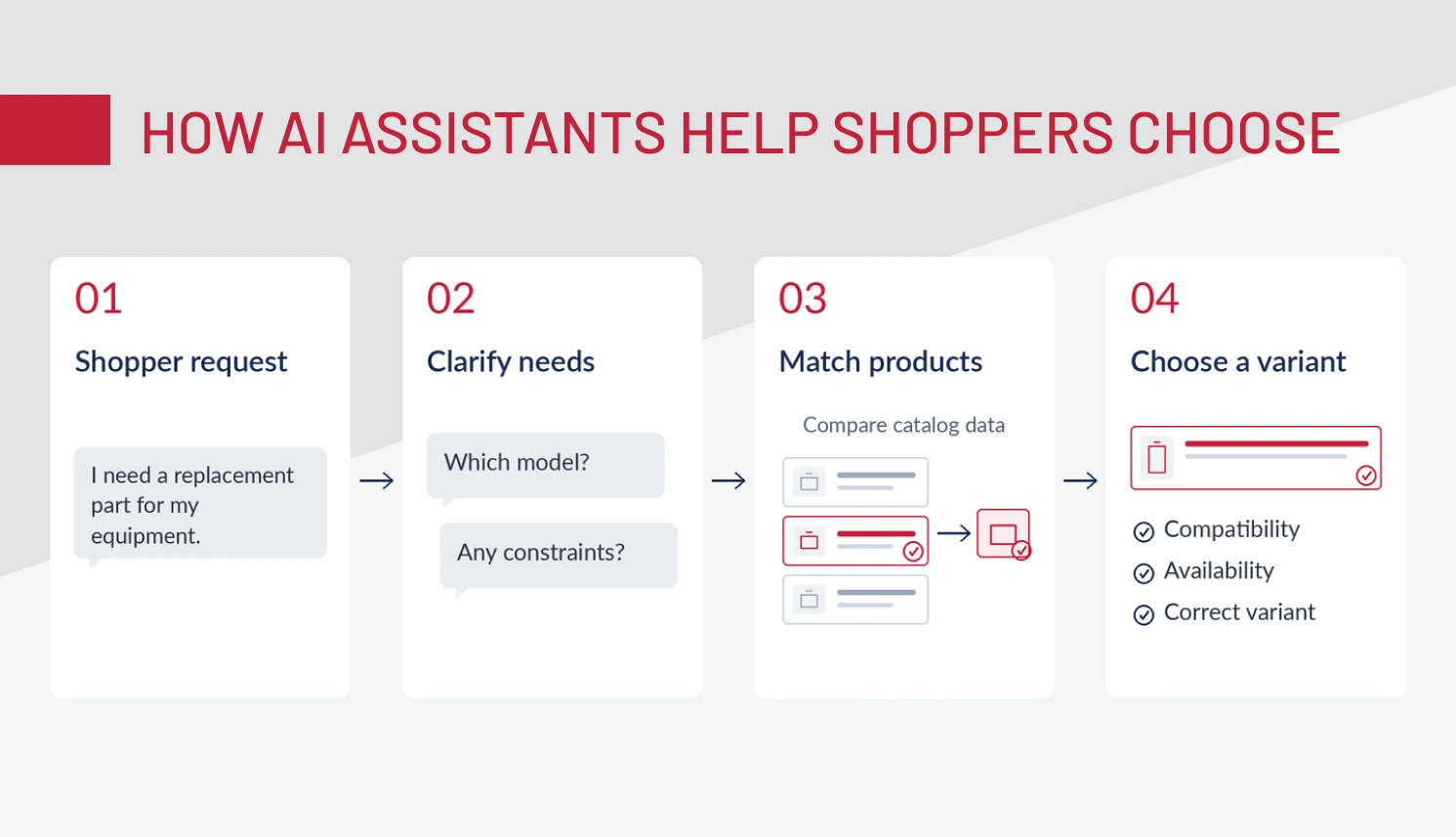
Consider what the assistant has to do after that first question: narrow the assortment, explain why a product fits, and carry the right variant toward the cart. That is where these tools differ from a friendly chatbot.
Zoovu Zoe
-

Shopping scenario
Guided selection from a complex assortment.
-

Interaction model
Conversational product advice grounded in catalog data.
Zoovu Zoe acts as a product advisor for an assortment where the shopper’s intended use matters more than a single search term. A question about requirements can narrow the set, and follow-up answers can lead toward suitable catalog products. That guided path is useful for technical or high-consideration goods whose differences are hard to express in one query. Ordinary results remain the faster route for a shopper with a precise SKU.
The assistant’s value is in the questions it asks and the product knowledge behind the advice. A catalog team needs to maintain relationships, exclusions, and availability as the assortment changes. In a pilot, the revealing moment is an uncertain requirement: does Zoe ask for the missing detail or confidently suggest a product that fails it? That answer will tell the team more than a polished demo conversation.
Rezolve Conversational AI
-
Shopping scenario
Shoppers expressing intent in ordinary language or other supported inputs.
-
Interaction model
Multi-turn product guidance linked to commerce data.
Rezolve Conversational AI accepts text, voice, or image input and carries a shopper through a product-oriented conversation. Someone can show a reference image, explain a constraint in ordinary language, and refine the request across turns before moving toward checkout. The distinctive promise is that these inputs become one commerce journey rather than separate search modes.
That handoff is where enterprise fit becomes visible. A recommended item must still respect live availability and any eligibility rules, and the chosen variant has to reach the cart correctly. The team should establish which catalog facts ground each recommendation and what the assistant does when the answer is uncertain. Otherwise, a fluid conversation can end at the wrong product.
A shopping assistant can help customers find the right product by talking through what they need. But what if your shoppers don’t know how to describe the product they’re looking for and have a photo instead? That’s where visual search can make product discovery much easier.
Visual Search Tools for Ecommerce Product Discovery
Visual tools are useful when the store can turn an image match into a buyable product, with the right variant and current availability. In this category, compare how each product handles a busy reference image, similar items, and the step from a visual match to a catalog result.
ViSenze AI Visual Search
-
Search input
Image-based product lookup.
-

Where it fits best
Visual retail catalogs and marketplaces.
ViSenze AI Visual Search centers on Smart Image Search: the shopper supplies a picture and receives visually related products from the retailer’s assortment. A fashion marketplace can use that route when a customer knows the silhouette or pattern they want but has no useful keyword for it. The result needs to lead to a live product card, which makes commerce integration part of the discovery experience rather than an afterthought.
The quality of that match depends on the images the merchant can supply. A set with inconsistent angles, missing color variants, or outdated marketplace imagery will expose different problems from a curated demo set. Visual similarity also needs the catalog’s size, material, and availability rules before it becomes a useful buying result. ViSenze’s published performance figures remain vendor claims, so the merchant’s own image set should decide the case.
Syte Visual Discovery
-
Search input
Customer or product imagery.
-
Where it fits best
Visually led product discovery and similar-item exploration.
Syte Visual Discovery offers image-led product matching with capabilities such as detecting more than one object in a picture and letting a shopper crop the item of interest. That workflow can turn a room scene or outfit image into a more specific search target. Its visual attribute handling is aimed at categories such as fashion, home decor, and jewelry, where an item can be recognizable before it is easy to name.
The shopper’s crop is a meaningful signal: it distinguishes the lamp from the sofa in the same room image before matching begins. The merchant then has to decide whether a result should prioritize shape, color, category, or current assortment. Syte is compelling when that visual selection shortens a real shopping journey. Its value is less clear when the catalog imagery or product mapping cannot support a useful similar-item result.
How to Choose the Right Tool Combination
The best AI search for ecommerce depends on the problem your shoppers face. Start with the failure you can observe, not the longest feature list. If shoppers get zero results for legitimate terms, inspect query logs and attribute coverage. If the right products appear but rank poorly, evaluate relevance controls and behavioral signals. If product cards are incomplete or inconsistent across suppliers, fix the catalog workflow that feeds every downstream experience. Only then ask whether conversation or imagery gives shoppers a better input mode.
When evaluating AI search for ecommerce, use the same test set across candidates. A useful sequence is:
-

Define the failure
Collect real queries, zero-result and low-click paths, variant errors, and examples where shoppers cannot describe an item well.
-

Verify the data path
Trace source attributes, PIM decisions, index fields, availability updates, and behavioral events to the result the customer sees.
-
Test relevance and control
Compare the same queries and catalog slices, including ambiguous language, B2B identifiers, variants, out-of-stock products, and merchandising overrides.
-
Check enterprise operations
Measure latency at expected load, integration effort, observability, data ownership, change approval, and who responds when relevance drifts.
-

Add an interface only with evidence
Pilot assistant or image-led journeys on categories where customers have a real selection problem, then compare them with the existing search path.
For high-traffic stores, search performance under load is part of relevance in practice: a useful result that arrives too late does not help the shopper. The ownership of production AI logic also matters when a query layer, catalog pipeline, and assistant touch different systems. Decide who can change each layer and how a bad change is reversed. That keeps the combination operable after the pilot team has moved on.
The wider uses of AI across ecommerce can draw on the same catalog foundation, but this comparison tests what helps customers find a suitable product.
Final Word
Retailers rarely get better product discovery by simply installing a smarter search box. In an enterprise store, the catalog changes, suppliers describe products differently, and customers rarely follow the vocabulary in the product feed.
The search platform matters, but so do the systems that prepare product facts, reveal failed queries, and let shoppers express a need in words or images. The strongest choice is a search experience your team can understand, maintain, and improve as the business changes.
Frequently Asked Questions
-

Which AI search tool is best for an enterprise ecommerce store?
The best choice depends on the job. Algolia, Constructor, and Coveo are options for the core search experience; AI Search Readiness Kit helps expose gaps in the data and queries feeding it, while Catalog AI Studio prepares product information for publication and indexing. Compare candidates with your own catalog, queries, and operating workflow.
-
Can AI search understand natural-language product queries?
Many AI search platforms can interpret intent beyond exact keywords, but the quality varies by implementation and catalog data. Test genuine customer phrasing, including ambiguous requirements and synonyms, then inspect whether the returned products actually satisfy the intended need.
-
What should an ecommerce team check before launching AI search?
Check attribute completeness, variant structure, data freshness, query logs, and relevance test cases. Confirm who owns integrations, merchandising overrides, monitoring, and fallback behavior before customer-facing launch. A fluent answer or attractive results page is not enough if the product facts are unreliable.
Alex Bolshakova is Chief Strategist for Ecommerce Platforms at Expert Soft. Her perspective focuses on the platform decisions that help enterprise retailers improve product discovery while keeping catalog data, integrations, and search operations manageable at scale.
New articles

See more

See more

See more

See more

See more