
Technical Documentation as a Business Asset: Why Mature Teams Treat It as a Process

Mature engineering teams rarely treat technical documentation as an afterthought. Instead, they invest in it systematically, not just because it is “nice to have” for developers, but because over time it proves to be an operational asset for the business itself. When systems grow, teams change, and platforms evolve, documentation becomes one of the few things that preserves continuity, reduces friction, and keeps work predictable.
From our experience at Expert Soft delivering services for enterprise ecommerce platforms, tech documentation affects business outcomes: how fast teams can scale, how costly changes become, how dependent a platform is on specific individuals, and how often the same mistakes are repeated. A well-structured spec example can save more time and money than hours of meetings, ad hoc explanations, or reverse engineering in the worst case.
In this article, we look at technical documentation through that operational lens. We’ll share concrete cases from our projects where documentation made a measurable difference, and just as importantly, examples where its absence created real friction and cost. We’ll clearly outline where documentation genuinely works as a business asset and where expectations around it can be overstated.
Quick Tips for Busy People
If you’re short on time, below is a brief overview you need to keep in mind when treating technical documentation as a business asset:
- Documentation shapes change adoption: a technical documentation example helps platforms handle team rotation, legacy evolution, and scaling pressure without repeated rediscovery.
- Documentation preserves system intent: when data flows, technical requirements, and constraints are explicitly recorded, teams spend less time rediscovering the past and more time delivering new value.
- Documentation reduces AI misalignment: when constraints and intentional design choices are recorded, AI assistance accelerates delivery instead of creating rework.
- Documentation makes risk visible, not avoidable: by capturing architectural decisions, constraints, and ownership boundaries, it turns hidden operational risks into a manageable context, supporting stability as systems and teams grow without pretending to replace sound engineering judgment.
- Documentation supports decisions, it doesn’t make them: while it preserves context and constraints, it cannot replace architectural judgment or forecast business direction beyond the realities of today’s system.
- Outcomes depend on treatment: documentation matters only if it’s current, structured, and used in daily operations.
What follows looks at how these dynamics play out in real systems.
Technical Documentation Business Value
Let’s start with the business value of technical documentation and how it shows up in real project work. The points below are based on practical use cases we regularly encounter, where documentation directly influences delivery speed, costs, and overall predictability.
Lower onboarding costs and faster team scaling
In the projects we work on, teams rarely remain static. Specialists join for specific initiatives, responsibility shifts between units, and capacity changes as priorities evolve. In that setup, documentation becomes the mechanism that preserves context across transitions, so the business doesn’t pay for change with lost time or repeated decisions. This is particularly relevant in SAP outsourcing setups, where delivery often spans multiple vendors, internal teams, and long-running platform lifecycles.
In that operating model, documentation directly shapes how expensive and time-consuming specialist transitions become. When we join a project, either to reinforce an existing team or to take ownership of a new business unit, the quality of documentation largely determines how quickly we can contribute. Clear architecture decisions, documented data flows, and visible integration points reduce reliance on ad-hoc explanations and repeated involvement from senior engineers.
Documentation also helps new team members align faster with how the system is expected to work: security requirements, coding standards, testing practices, and known constraints are already explicit rather than rediscovered mid-delivery.
From a business perspective, the impact is practical and measurable: less senior time spent on one-off knowledge transfers, faster ramp-up for new contributors, and the ability to scale teams without coordination costs increasing at the same pace as headcount.
Reduced bus factor
The “bus factor” is how many people need to get hit by a bus before your project grinds to a halt. It’s dark humor, but it represents a real operational risk: critical knowledge concentrated in too few heads.
When someone who understands your payment processing flow or inventory sync logic leaves, that knowledge shouldn’t leave with them. For business stakeholders, this reduces dependency on specific individuals and keeps delivery and maintenance moving despite team changes. This is particularly important for enterprise platforms where systems outlive teams.
We work with enterprise teams on systems that must evolve under load, change, and scale without losing reliability. Let’s discuss your needs!
Talk to UsStreamlined development
Here’s an example that explains this better than any theory. We were working on a large-scale data platform migration, moving a legacy system to a new architecture built on microservices. Part of the job involved recreating functionality that existed in the old system.
Specifically, we needed to build a new microservice that handled feed generation, taking data from multiple sources, transforming it into a specific format, and delivering it to client-specific directories. The legacy system did this through a scheduled background job. Simple enough in concept. But the problem was zero documentation on the customer’s side on how it actually worked.
We had to reverse-engineer the entire process: trace data flows, identify transformation logic, map dependencies, and ensure nothing got dropped or corrupted along the way. Because this was a data-heavy platform where accuracy was non-negotiable, we couldn’t just wing it. Every detail mattered.
Time spent investigating the legacy system roughly equaled time spent building the new service. When we finished, we made sure to document it properly: flow diagrams, data transformations, dependencies, edge cases. The next team touching that service won’t waste weeks decoding what we built.
In situations like this, a clear product and technical specification for apps would have preserved both functional intent and technical constraints, removing weeks of investigative work.
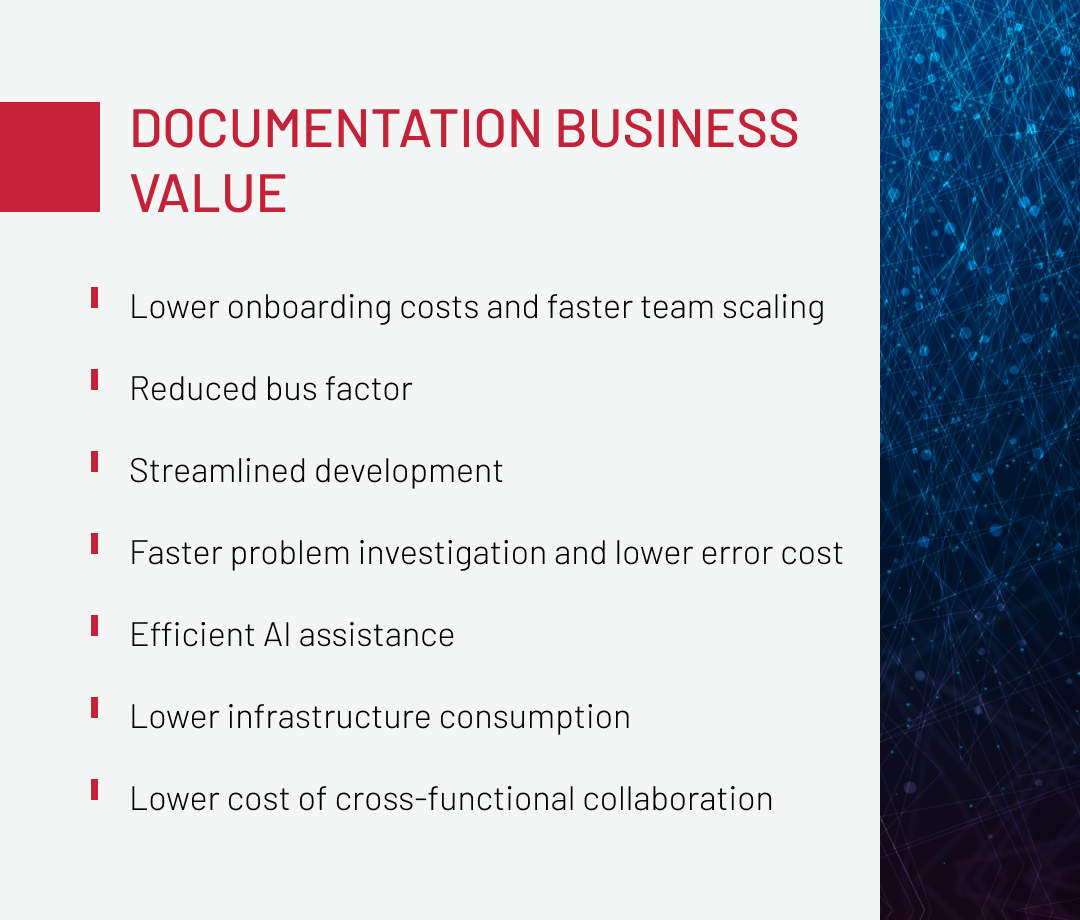
Faster problem investigation and lower cost of errors
Incidents are costly at any stage of a system’s lifecycle. They consume engineering time, slow decision-making, and create uncertainty around whether an issue is a defect or expected behavior. Documentation reduces that investigation time by preserving system intent and context: what should happen, what can fail, and why.
Above all, this is critical during production incidents, especially during peak events, where delays translate into lost revenue and emergency work. When something breaks, you need answers fast: What does this component do? What depends on it? What are the known failure modes? If those answers live in documentation, your incident response starts immediately.
But documentation’s value goes beyond just fixing the immediate fire. After resolving an incident, mature teams ask: why didn’t we catch this earlier? They update test cases, clarify edge cases, document the failure mode. This turns a one-time incident into institutional knowledge that prevents recurrence.
Without this practice, context evaporates. Good documentation creates a feedback loop: incidents inform documentation, documentation prevents future incidents. That’s how you actually reduce the cost of errors over time.
Efficient AI assistance
AI coding assistants have become embedded in many engineering organizations. Their impact on productivity depends largely on the quality of context they operate on.
Quality documentation makes AI tools exponentially more useful. You can point an AI at your architecture docs, coding standards, and integration specs, and it’ll generate code that fits your system. It can help investigate bugs, suggest refactors, and catch issues during code review, all based on documented patterns and constraints.
Without documentation, you’re either spending huge amounts of time explaining context, defeating the productivity gain, or you’re getting generic solutions that don’t account for your specific architecture decisions. In practice, this introduces the risk of AI-generated output that appears valid but is misaligned with real system constraints.
Here’s a concrete example: if your documentation clearly states that a particular behavior is intentional, not a bug but a deliberate design choice, an AI reviewing code won’t flag it for “fixing.” Without that context documented, you waste time investigating non-issues or, worse, “fix” something that was working exactly as intended.
AI is becoming a permanent capability in enterprise platforms. Download a whitepaper on architectural approaches for embedding AI into your system in a way that lets your team own outcomes.
Lower infrastructure consumption through code practices
When technical documentation includes guidelines for writing performant, resource-conscious code, it helps reduce infrastructure costs and usage at scale. This matters especially in Europe, where environmental impact is increasingly prioritized. Carbon footprint from server infrastructure is a real consideration. Code that runs efficiently consumes less power, generates less CO2, and costs less to operate.
We’re not talking about premature optimization. We’re talking about documented best practices that prevent wasteful patterns from spreading through your codebase. When these standards are clear and accessible, engineers naturally write more efficient code. The compounding effect across thousands of services and millions of requests adds up to real infrastructure savings.
Lower cost of cross-functional collaboration
Documentation shapes how costly it is for non-engineering teams to work with the platform. When system constraints and architectural context are documented, product managers and business analysts can self-serve information instead of relying on repeated explanations from engineers.
As a result, each initiative requires fewer syncs, fewer clarification cycles, and less time spent on alignment, making delivery cheaper and faster. Managers also spend less time acting as intermediaries and more time on coordination that actually moves work forward.
Over time, this reduces coordination overhead across the organization and changes how risk and change are absorbed as the platform scales.
Role of Documentation in Risk and Scalability
Documentation reduces certain operational risks and supports stability as systems grow, but it isn’t a cure-all or a substitute for sound architecture. Understanding how to write a technical specification in this context means treating documentation as an operational tool, not a promise it can’t realistically keep. What documentation does:
-
 Makes operational risks visible and manageable
by turning individual knowledge into shared context, enabling active risk management instead of discovery during outages.
-
 Acts as a stabilizer for scaling
rather than a growth driver by reducing the cost and risk of changes as systems and teams grow.
-
 Clarifies architectural decisions and constraints
so both new and existing engineers understand why patterns exist and which assumptions must be preserved.
-
 Maintains coherence as teams scale
by establishing boundaries, clarifying ownership, and preventing conflicting assumptions across business units, allowing evolution to happen deliberately rather than accidentally.
What documentation can’t do
- Predicting business needs several years in advance.
- Translating technical constraints into business strategy automatically.
- Replacing the judgment of experienced engineers in complex architectural decisions.
- Serving as a strategic forecasting or decision-making tool rather than an operational asset.
Documentation performs best when expectations align with its actual role, reducing coordination costs, preserving institutional knowledge, and making system evolution safer and faster. In many cases, a technical documentation example is what makes that alignment explicit. Whether it delivers value ultimately depends on how it’s written and maintained.
Key Characteristics of High-Quality Technical Documentation
For documentation to function as a business asset, it must meet specific quality standards. These characteristics determine whether documentation is relied on in day-to-day operations or gradually loses credibility and usage.
Structure and consistent format
High-quality documentation follows a predictable structure and a consistent format. As projects grow, this consistency becomes critical. When every component’s docs follow the same pattern, such as architecture overview, integration points, dependencies, known issues, engineers know exactly where to find information. A clear technical specification example, covering inputs, outputs, dependencies, constraints, and failure modes, gives engineers a concrete reference instead of abstract guidance.
Random, freeform documentation doesn’t scale. It might work for small projects where everyone already knows the context. For enterprise platforms with dozens of services and rotating team members, a lack of structure means documentation becomes part of the problem instead of the solution.
Actuality and regular updates
When documentation falls out of date, it can mislead teams by presenting assumptions that no longer reflect the system. Engineers make decisions based on incorrect assumptions, waste time investigating discrepancies, and eventually stop trusting any documentation at all.
Mature teams treat documentation freshness as a managed attribute. They track when information was last verified, revisit documentation during planning, and evaluate its accuracy alongside other quality signals such as test coverage and code review standards.
Clarity across different roles
Technical documentation primarily serves engineers, but it should not rely on implicit knowledge held by individual authors. Clear structure, explicit assumptions, and the absence of hidden context ensure documentation remains usable for anyone who needs to understand the system.
This includes QA engineers who need to understand failure modes for testing, operations teams who need to troubleshoot production issues, and even technical product managers who need to understand constraints for planning.
The goal is to write clearly enough that anyone with a relevant technical background can understand what’s documented without needing the original author to explain it.
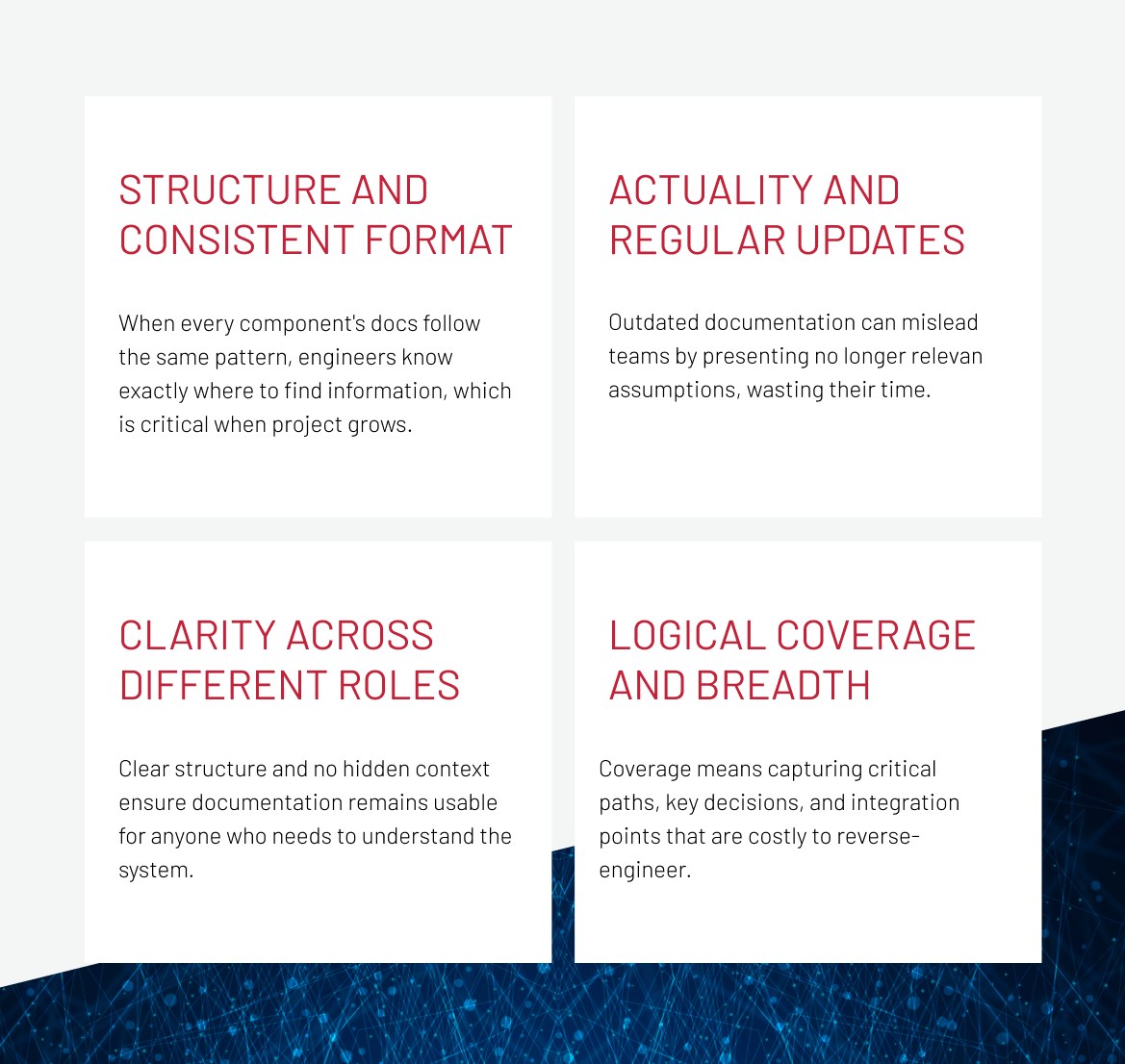
Logical coverage and breadth
As systems grow, value comes from comprehensive coverage rather than isolated documents. New contributors should be able to locate any major component, understand integration points, and follow deployment processes without guesswork.
For larger platforms, this often means having a TSD document that explains component responsibilities, data flows, dependencies, and constraints at a system level. When this context is available, teams don’t need to reconstruct architecture from code or tribal knowledge before making changes.
Effective documentation scales with the system. It is structured for navigation and search, reflects relationships between components, and is actively maintained through periodic review, reorganization, and retirement of outdated content.
Coverage does not mean documenting every line of code. It means capturing critical paths, key decisions, and integration points that are costly to reverse-engineer.
At Expert Soft, we maintain documentation because we see the operational impact directly: faster delivery, quicker incident resolution, and shorter ramp-up time. It remains useful because it is treated as a working asset that reduces operational overhead and risk.
Let’s Summarize
Technical documentation belongs to the operational fabric of a system, alongside processes, tooling, and ownership. Its impact depends less on volume and more on how it’s treated in day-to-day work: whether it’s maintained as part of operations or left as a byproduct of delivery.
When documentation is structured, current, and trusted, it becomes part of daily operations. When it isn’t, the cost reveals itself through delays, rework, and growing coordination overhead. Over time, examples of specifications often become the reference points teams rely on to preserve intent and avoid rebuilding context from scratch.
Across enterprise ecommerce platforms, teams that treat documentation as an operational asset spend less time rebuilding context and more time moving systems forward.
If you want to speak about the peculiarities of long-running enterprise platforms, we’re open to a conversation about managing complexity without losing operational stability.
Alex Bolshakova, Chief Strategist for E-Commerce Solutions at Expert Soft, views technical documentation through a strategic lens. Drawing on enterprise transformation initiatives, she explains why mature teams treat documentation as an ongoing process and a long-term business asset.
New articles

See more

See more

See more
See more

See more