
How to Outsource Software Development to Reduce Risks in High-Load Systems in 2026

Today’s software development outsourcing discussions are shaped less by execution mechanics and more by constraint. Budgets are under pressure, vendor landscapes are being consolidated, and teams are expected to maintain and modernize complex ecommerce platforms with fewer people and fewer external partners. In this environment, ecommerce development services are evaluated through the lens of cost control, risk exposure, and long-term maintainability.
At the same time, businesses are actively exploring how AI can be embedded into both customer-facing and internal operations. That push often runs into the realities of existing platforms: large, legacy, or tightly coupled systems that weren’t designed for experimentation. Enabling AI in such environments may require refactoring, selective migration, or structural workarounds, each carrying technical and business risks.
Being in the outsourcing field since 2013, we’ve seen how these conditions reshape what enterprises expect from external teams. The requirements today are less about delivery capacity and more about judgment: understanding where modernization is feasible, where legacy constraints must be respected, and how risk accumulates when systems evolve under pressure.
This article focuses on those shifts, outlining how outsourcing strategies, engagement models, and risk management practices are evolving to support long-term platform stability rather than short-term delivery gains.
Quick Tips for Busy People
Here’s the article in a nutshell, summarizing the main ideas of how to successfully outsource software development:
- Outsourcing priorities have shifted: cost still matters, but companies now look just as closely at whether a partner can keep systems stable, manage risk, and support predictable operations as complexity grows.
- Build, operate, and optimize happen in parallel: enterprise systems don’t pause for transformation. Development, maintenance, and optimization run simultaneously to avoid downtime and uncontrolled technical debt.
- Ownership matters more than structure: hybrid teams succeed or fail based on how clearly decision authority and accountability are defined, not on geography or team composition.
- AI raises the bar, not the ceiling: AI speeds up execution but amplifies both good and bad decisions. Strong engineering judgment, review discipline, and architectural oversight become more critical, especially in ecommerce systems.
- Strategic outsourcing differs by responsibility, not contract type: the key distinction lies in who owns architectural decisions, long-term consequences, and system-wide risk, not in how work is priced.
The sections below explain each of these ideas in practical terms and why they matter for enterprise teams.
Key Shift in Requirements for Modern Outsourcing
The way companies approach the idea of how to successfully outsource IT development has shifted in a fundamental way. According to a 2024 survey by Deloitte, cost savings drove 70% of outsourcing decisions in 2020. By 2024, that figure dropped to 34%. It shows a shift from treating cost as the primary selection factor to looking at value-added capabilities, prioritizing system stability and operational predictability.
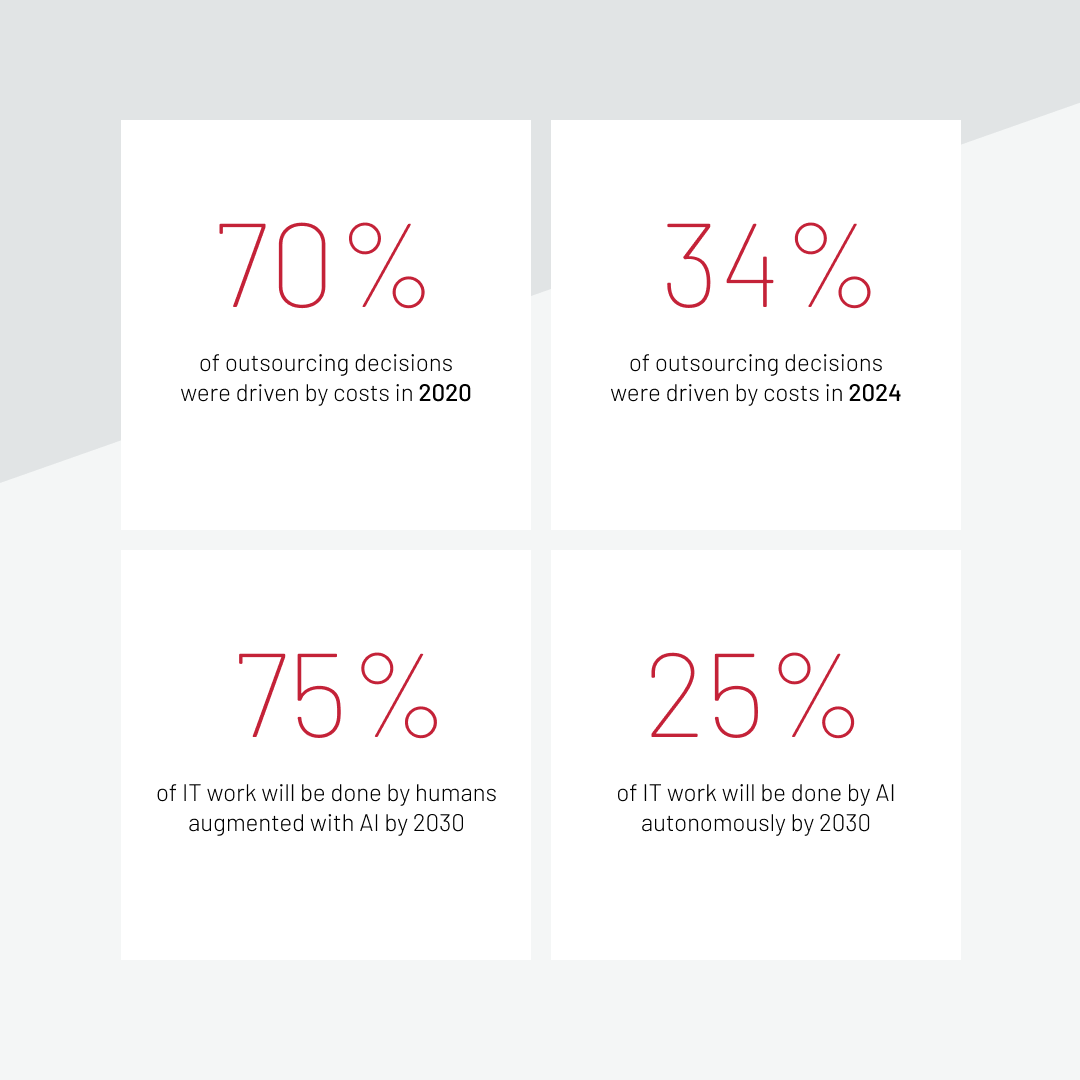
Expectations around skills have also changed. Organizations increasingly expect outsourcing partners to leverage AI in service delivery. Gartner projects that by 2030, 75% of IT work will be done by humans augmented with AI rather than replaced by it, with only 25% fully autonomous. This means knowing how to use AI to simplify and speed up processes, especially manual ones, while still focusing on fundamental aspects like strategy and architecture.
As a result, companies look for teams that can reason about legacy platforms, high-volume data flows, and failure modes under load. The focus has shifted from completing tasks to owning outcomes, where understanding business risk matters as much as writing code. The question is no longer how many developers are needed, but whether a partner can carry a system through change without disrupting the business.
Working with high-load systems, we at Expert Soft understand enterprise ecommerce architecture and know how to keep platforms stable.
Let’s TalkComponents of Modern Outsourcing Strategy
Modern outsourcing works when its components reinforce each other. The value of each component isn’t in how it looks on paper, but in how it supports long-term reliability, ownership, and controlled evolution of the platform.
Build–Operate–Optimize approach
Build–operate–optimize is best understood not as a delivery sequence, but as a way to manage uncertainty over time. In enterprise environments, systems don’t pause while architectures change. Treating build, operate, and optimize as separate phases creates artificial boundaries that rarely survive first contact with production. That’s why these activities tend to run in parallel.
What helps enterprises evaluate a partner is how the partner works within this integrated mindset: whether they understand the underlying principles, can operate new components within existing systems, and can balance competing constraints as conditions change.
Hybrid team responsibility
Hybrid teams are often discussed in terms of geography and time zones, but in modern enterprise setups, those factors rarely determine success now. More often than not, outsourcing partners join projects that are already live, with established systems and a long operational history, to reinforce existing teams. In this context, hybrid teams describe how internal specialists and outsourcing partners work side by side, sharing responsibility for decisions, outcomes, and the long-term behavior of the system.
In effective hybrid models, responsibility is explicit. Teams know which parts of the system they own, where architectural authority sits, and who is accountable when something breaks. Without that clarity, hybrid setups tend to slow down instead of scaling.
Skillset in AI solutions
AI changes how engineering work is performed, but it doesn’t change who owns the outcome. In modern outsourcing strategies, AI is used to increase efficiency, not to replace engineering judgment.
For example, all our clients actively encourage the usage of Copilot and other similar solutions among developers. These tools help accelerate routine work: assisting with refactoring and tests, improving navigation and documentation, etc. Used this way, AI increases throughput without taking ownership of decisions.
The strategic risk appears when AI output isn’t governed by system-level understanding. In enterprise projects, code that “works” can still introduce unnecessary complexity or hidden coupling. That’s why AI adoption strengthens an outsourcing team only when developers have the maturity to guide it. Engineers need to know what result they’re aiming for, iterate on AI output, and evaluate impact beyond immediate correctness.
Scaling opportunities
Scaling is where the combined effect of all previous components becomes visible. In enterprise ecommerce, outsourcing rarely breaks because of headcount alone. Problems tend to appear when the scope grows faster than ownership structures, decision models, and quality controls.
At a smaller scale, informal coordination and shared context often work. As the scope expands, integrations multiply, release cycles overlap, and more people touch critical paths. Ambiguity around ownership becomes more visible, decision-making naturally shifts closer to execution teams, and quality thresholds rise as traffic and transaction volume increase. Documentation, previously optional, starts functioning as operational infrastructure.
From a strategic perspective, scaling works when expansion follows demonstrated stability. Teams that consistently operate well at one level of scope earn more autonomy. Capacity grows after the system shows it can absorb change. When this alignment is missing, output may increase, but clarity declines, incidents rise, and additional engineers amplify existing weaknesses instead of resolving them.
Traditional vs. strategic outsourcing
Here’s a table that compares the elements that actually differentiate approaches in modern enterprise contexts:
The distinction between traditional and strategic outsourcing shows up less in formal structure and more in day-to-day behavior. As systems grow more interconnected, the decisive factors become how risk is handled in practice, how architectural context is maintained across workstreams, and how effectively a partner operates within existing constraints, such as legacy platforms, evolving requirements, and production realities.
Download a guide that explains what actually changes in the cloud and how to prepare legacy systems so the transition holds under real load.
Engagement Models for Modern Strategy
Rather than repeating the same ideas about common engagement models, in this section, we’ll examine how each one behaves under modern enterprise needs.
| Model | Primary purpose | Degree of outcome controllability | Risk distribution | Suitability for legacy systems | Documentation and governance requirements | Failure modes |
| Dedicated team | Long-term capacity augmentation and sustained platform knowledge | High–medium — depends on team quality and integration with client processes | Shared operational risk, client retains strategic risk | High — team learns system complexity over time and builds institutional knowledge | Moderate to high, essential for knowledge continuity and effective handoffs | Dependency on key individuals, knowledge loss if team changes, can become siloed from business context |
| Fixed Price | Defined scope with budget predictability for well-understood features | Low — rigid scope limits adaptation to discovered complexity | Vendor assumes delivery risk within agreed scope, client assumes risk of scope definition accuracy | Low — legacy unknowns break fixed assumptions, hidden complexity causes scope battles | Low initially; creates friction during inevitable scope changes | Scope creep conflicts, quality shortcuts to meet budget, change order overhead, adversarial dynamics |
| Time & material | Maximum flexibility for evolving requirements and discovery-driven work | High — continuous adjustment possible as understanding deepens | Client assumes cost and timeline risk, vendor assumes execution risk | Very high — accommodates discovery, adaptation, and emerging complexity | Variable, can become minimal without discipline and active governance | Cost overruns without governance, lack of accountability for efficiency, can drift without clear objectives |
| Staff augmentation | Fill specific skill gaps within existing internal teams | Medium — individual contributor effectiveness varies, depends on integration quality | Day-to-day risk is carried by the client, while contractual frameworks typically create shared accountability for delivery and incidents | Medium — depends on how augmented staff integrate and knowledge transfer effectiveness | Low — relies on client’s existing documentation and processes | Shallow integration, contractors lack full system context; limited ownership, becomes expensive contract labor |
| Outcome-based | Align vendor incentives with business results | Low in enterprise context — too many variables outside vendor control affect outcomes | Theoretically vendor, practically shared due to attribution complexity | Very low — requires measurable business outcomes cleanly decoupled from external factors | High — must define, instrument, and track business metrics with clear attribution | Misaligned attribution (business results rarely map to technical delivery); metric gaming, vendor reluctance due to uncontrollable variables |
Enterprise platforms rarely operate under a single delivery model because different parts of the system carry different levels of risk and uncertainty. Core platform development, exploratory work, and standardized integrations behave differently and benefit from different engagement structures.
However, the outcome-based approach isn’t the one shining in enterprise setups, as enterprise environments’ delivery teams rarely control business results directly. Their influence usually sits with technical execution, system stability, and infrastructure behavior rather than sales or marketing outcomes. Because of that, outcome-based elements tend to work best as a complement, layered onto a stable base, such as a dedicated team, with incentives tied to technical signals like uptime, deployment reliability, or incident reduction rather than high-level business KPIs.
In practice, Expert Soft often relies on dedicated teams for complex SAP Hybris development and long-term platform evolution, combining with staff augmentation flexibility for focused modernization or new capabilities.
Risk Management in Enterprise Outsourcing
In enterprise outsourcing, risk management relies on how responsibility, assumptions, and visibility are handled once multiple teams start working on the same system.
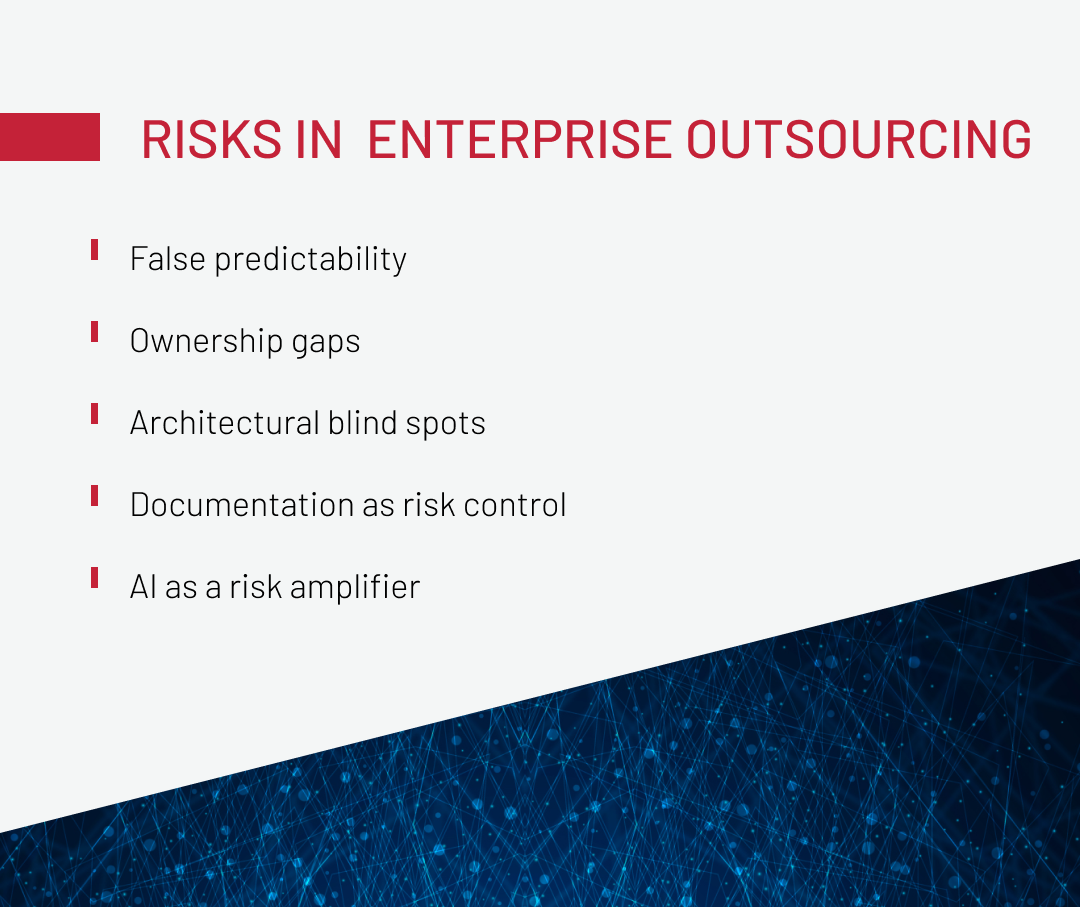
False predictability
Outsourcing often starts with an incomplete system view: legacy data behaves differently than expected, integrations break under load, and undocumented business rules surface late. This is typical for mature platforms.
Risk grows when early assumptions are treated as complete and then locked into delivery structures and long-term roadmaps. In outsourcing, predictability improves not by freezing plans but by allowing scope, architecture, and resourcing to adapt as understanding deepens.
Ownership gaps
Ownership gaps often emerge not because responsibility is explicitly rejected, but because it is implicitly diluted. When an external team is engaged to deliver a clearly bounded initiative, such as a system migration, accountability for the outcome is usually assumed and rarely questioned. The risk profile changes when outsourcing takes a more embedded form, for example, when external engineers join an internal team to extend capacity rather than lead delivery.
In these setups, responsibility is often assumed to shift back to internal teams by default. From our experience, this is where risk starts to accumulate. When our engineers join a client team to extend capacity, we do not treat responsibility as limited to the assigned tasks.
That’s why we make sure Expert Soft’s specialists know how to consider decisions in the context of the whole system, including its impact on architecture, integrations, and future change. For example, when a simpler implementation can meet the same requirements, we propose and justify it, instead of silently spending hours on more cumbersome options. This ownership of outcomes, rather than task execution alone, is what prevents responsibility from being fragmented across teams.
Architectural blind spots
Outsourcing increases the risk of fragmented system understanding. One team knows checkout, another handles inventory, a third owns payments, but no one sees how these parts interact under failure or scale.
These blind spots usually sit around integrations, data flows, and background processes. In outsourcing relationships, this risk is reduced when architectural thinking exists alongside task execution, when teams can trace data across boundaries and recognize when local changes affect global behavior.
Documentation as risk control
Without shared documentation, responsibility doesn’t scale across vendors because knowledge concentrates in individuals, onboarding slows, and decisions are revisited without context, making transitions increasingly risky.
In outsourcing, documentation is risk containment. Architectural decisions, integration contracts, deployment dependencies, and known limitations preserve context so teams can operate autonomously without reintroducing past mistakes.
With this long-term view of documentation as a risk-control mechanism, we at Expert Soft treat documentation as a working process, not a box to check. We do not create documentation for its own sake. Instead, we focus on capturing context in a way that allows any developer, from the current team or a future one, to understand decisions that were made and confidently build on them.
AI as a risk amplifier
AI accelerates outsourcing execution, but it also amplifies decision quality. Teams with strong architectural judgment move faster with better results. Teams without it scale mistakes at a higher velocity.
AI-generated code may pass tests while introducing performance, maintainability, or coupling issues that surface only in production. In outsourcing setups, this shifts risk from execution speed to review discipline and architectural oversight.
From our experience being responsible for code reviews on client projects, this shift is already visible in practice. The volume of AI-generated code has increased, and while much of it functions correctly, it often introduces subtle performance, maintainability, or coupling issues. In such cases, the critical point is not to accept code simply because it works today, but to assess whether it can become a problem under load, during future changes, or in adjacent parts of the system.
AI reduces risk only when it’s governed: reviewed against system-wide impact, performance-critical paths, data integrity, and security, not treated as a shortcut around understanding.
To sum up
Understanding how to outsource software development at enterprise scale means aligning responsibility, architectural ownership, and risk management with real system complexity. Delivery models matter, but they only succeed when teams can make decisions, manage uncertainty, and adapt without disrupting production.
Strong outsourcing setups combine engagement models based on risk, govern AI usage carefully, and treat documentation and ownership as operational requirements rather than process overhead. These choices determine whether platforms remain stable as scope and complexity increase.
If you’re working through modernization, integrations, or scaling challenges, we’re always open to a conversation. Expert Soft partners with enterprise teams on complex ecommerce platforms and is happy to share perspectives from similar delivery situations. Let’s talk.
New articles

See more

See more

See more

See more

See more