
Advanced Order Management Optimization: How to Adapt Your OMS for High-Load Ecommerce

Even well-designed ecommerce platforms can stumble when the ecommerce order management system (OMS) becomes a blocking dependency. Checkouts slow down, inventory drifts out of sync, and a single overloaded integration path starts behaving like the system’s hidden single point of failure. In terms of stability, the real challenge is creating an OMS-ecommerce relationship that can absorb stress without pulling the entire customer journey down with it.
This article breaks down how, under ecommerce development services, we at Expert Soft approach ecommerce-OMS interaction for high-load platforms. Instead of analyzing how OMS systems are built internally, we focus on what the ecommerce platform can control: its responsibility boundaries, failure-handling patterns, and design choices that reduce exposure to unpredictable OMS behavior under load.
Quick Tips for Busy People
Here are the core ideas of the article at a glance.
- OMS failures are predictable: under load, synchronous ecommerce-OMS dependencies trigger cascading breakdowns rather than isolated errors.
- There are early warning signs: growing queues, increasing synchronization lag, manual interventions, and repeated escalations indicate that the order management system the ecommerce uses is approaching its operational limits. They provide an opportunity to adjust integration patterns before customer-facing flows are affected.
- OMS failures under load are rarely isolated issues: they emerge when ecommerce relies on synchronous OMS behavior across critical paths, causing latency, retries, and partial failures to cascade through checkout, inventory, and fulfillment flows.
- Effective resilience follows two strategic directions: some practices reduce the operational burden placed on the OMS, while others reduce ecommerce’s dependence on OMS availability during critical moments.
- Resilience starts with protecting the customer flow: from the ecommerce perspective, the primary goal is preventing that delay from breaking checkout, confirmation, or customer expectations.
- Stable systems assume degradation, not linear scaling: architectures that hold up under pressure are designed around delayed processing, eventual consistency, and explicit back-pressure rather than optimistic assumptions about real-time OMS responsiveness.
- Clear responsibility boundaries reduce blast radius: ecommerce owns customer-facing decisions and expectations, the OMS executes fulfillment asynchronously.
Here’s how these concepts unfold across the key areas of ecommerce-OMS integration.
What Breaks with OMS Under Load
The first thing that breaks when traffic increases is the tight and synchronous dependency on the OMS. Checkout starts waiting on slow OMS responses, validations become unreliable, and inventory checks fall behind. These issues show up in the same ways every time, and knowing these patterns makes it much easier to design systems that stay stable when traffic suddenly spikes.
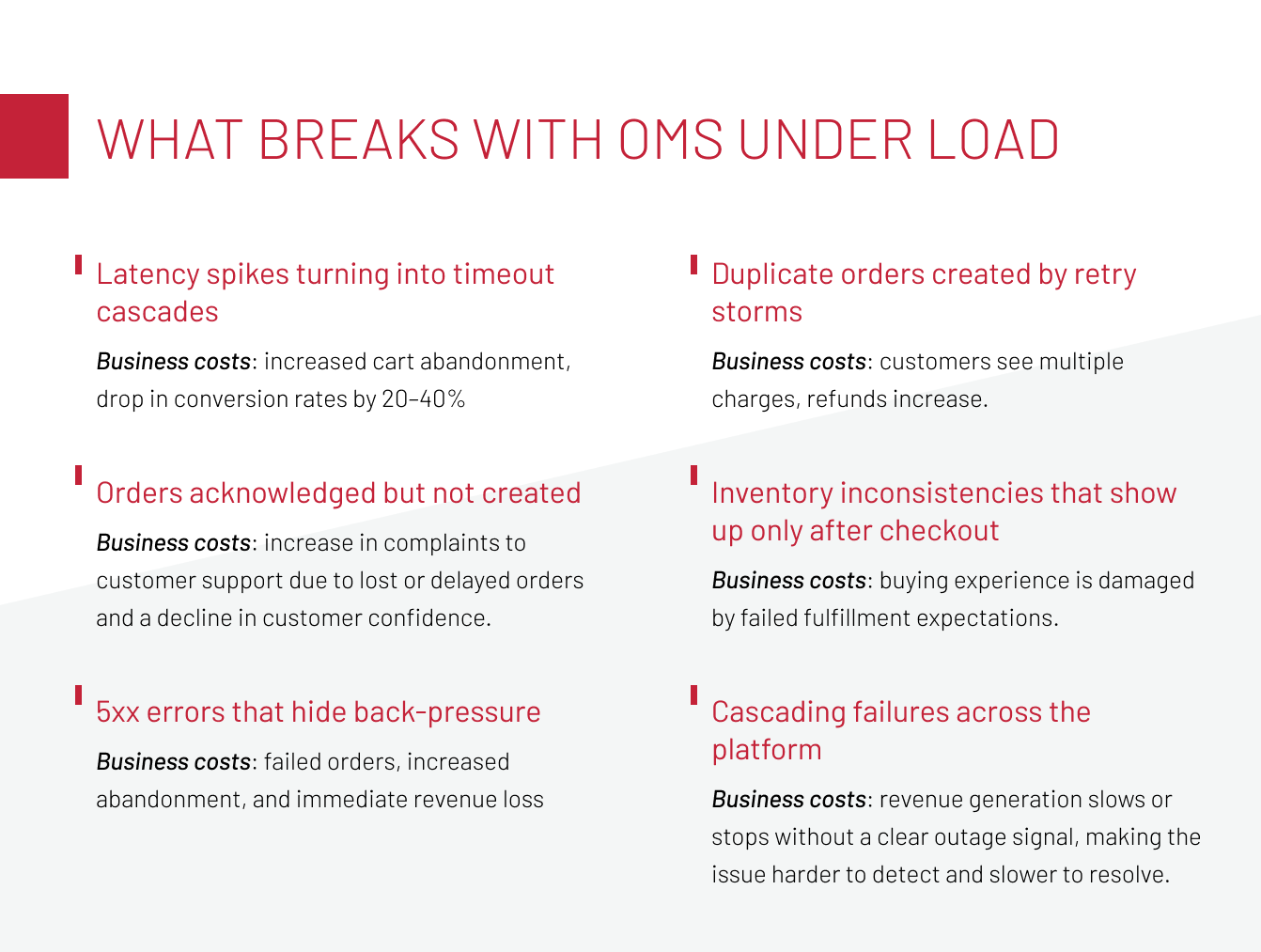
Latency spikes turning into timeout cascades
In high-load scenarios, the failure originates from synchronous coupling between the ecommerce platform and the ecommerce order management software. As load increases, OMS processing slows down, and p95/p99 latencies degrade from normal operating levels to multi-second delays. Because the interaction is synchronous, these delays propagate upstream. Worker threads remain blocked while waiting for OMS responses, reducing available capacity for new checkout requests.
-

Impact:
Synchronous checkout calls begin to time out, leading to prolonged loading states or errors during order placement and payment processing.
-

Business costs:
Checkout issues increase cart abandonment, drop conversion rates by 20–40% (based on practical experience), and load support teams with a surge in customer complaints during peak revenue periods.
Orders acknowledged but not created
Under heavy load, the OMS may acknowledge an order before it is fully persisted or processed internally. When internal processing fails after the response is sent, the ecommerce platform receives a success signal despite the order not existing in fulfillment systems.
-
Impact:
The ecommerce platform treats the order as successful, while fulfillment never receives the order.
-
Business costs:
Increase in complaints to customer support due to lost or delayed orders, and a decline in customer confidence and trust.
5xx errors that hide back-pressure
Under heavy load, the OMS may respond with generic 5xx errors or timeouts instead of clearly indicating that it has reached its capacity. From the ecommerce platform’s perspective, these responses don’t explain what’s actually going wrong.
-
Impact:
The ecommerce platform keeps retrying requests without understanding the cause of the failure, adding more load and causing order placement failure.
-
Business costs:
Unstable checkout behavior during peak traffic leads to failed orders, increased abandonment, and immediate revenue loss.
Duplicate orders created by retry storms
After an initial OMS error or timeout, the ecommerce platform may retry submitting the order. Depending on how retry logic and idempotency are set up, the OMS can later process both the original request and the retry as separate orders.
-
Impact:
Retries may be treated as new orders, resulting in duplicate charges and duplicate shipments.
-
Business costs:
Customers see multiple charges, fulfillment teams ship the same order more than once, refunds increase, and trust is damaged while operational costs rise.
Inventory inconsistencies that show up only after checkout
Under heavy load, OMS inventory updates may lag behind real-time sales. When synchronization slows, the availability data can become outdated during checkout.
-
Impact:
Customers place orders for items that appear to be in stock but are already sold out, resulting in cancellations after checkout.
-
Business costs:
Orders must be canceled post-purchase, customer support volume increases, and the buying experience is damaged by failed fulfillment expectations.
Unpredictable business validations
As the load increases, the OMS may apply validation rules inconsistently. Under these conditions, valid orders can be rejected while invalid ones are approved.
-
Impact:
Customers receive unclear rejection messages and failures when trying to place an order.
-
Business costs:
Conversion is reduced, trust in checkout reliability declines, and operational workflows become harder to manage due to inconsistent validation outcomes.
Cascading failures across the platform
When OMS responses slow down, ecommerce worker threads can remain occupied long enough for queues to build up across dependent services. As pressure accumulates, delays spread beyond the initial integration point, causing severe financial losses.
-
Impact:
Checkout gradually becomes unresponsive even though individual systems appear to be running.
-
Business costs:
Revenue generation slows or stops without a clear outage signal, making the issue harder to detect, slower to resolve, and more expensive during critical sales periods.
As these issues repeat, the real problem is that the system is operating too close to its limits. The sooner you can spot the signals of growing strain, the more options you have to reduce impact before checkout becomes unstable.
Early Warning Signs That Your OMS Can’t Handle Scale
An OMS rarely fails without warning. A system usually doesn’t fail suddenly during a traffic spike. It shows stress first: small, easy-to-ignore signals that add up to a clear sign it’s already operating near its limits.
- Signal 1: Processing queues that never fully drain.
When orders slow down overnight but the processing queue never quite empties, it’s a sign the OMS is already struggling to keep up with normal traffic. If the system can’t catch its breath during quiet hours, it won’t survive peak load, making this one of the clearest early warning signs of capacity strain. - Signal 2: Inventory discrepancies becoming routine.
Occasional mismatches are normal, but weekly reconciliation sessions are not. If inventory often requires manual correction, the OMS integration isn’t keeping up with transaction velocity, and operational fixes are masking a deeper architectural issue. - Signal 3: Synchronization lag exceeding business-defined thresholds.
Real-time updates aren’t always required, but once status changes take more than the approved time to appear in the platform, the system is running without a safety buffer. Under peak conditions, that delay easily becomes several minutes, leaving ecommerce effectively blind. - Signal 4: Growing reliance on manual operations.
When ops teams start “quickly fixing” orders every day or rely on outdated manual workflows to route exceptions, manual intervention is compensating for systemic limitations. Each workaround becomes a structural crack, and those cracks widen under load. - Signal 5: Developer escalations becoming standard procedure.
When normal traffic swings force engineers to intervene specifically to keep OMS processing stable, like through restarts, config changes, or hotfixes, it’s a sign the OMS isn’t operating reliably. It behaves more like a prototype that needs constant support, and peak events allow no room for reactive patches. - Signal 6: Returns and cancellations creating operational drag.
Processing returns should not require manual effort, yet it increasingly does. Cancellations take hours to reflect in inventory. These edge cases become major operational bottlenecks during peaks, when return volumes rise and accuracy becomes critical.
If three or more of these signals appear simultaneously, configuration tweaks won’t solve the problem. The OMS integration is signaling the need for architectural change, not incremental tuning.
Ensure your systems communicate reliably. Let’s talk about how to introduce reliability by design in your ecommerce operational flows.
Talk to Our TeamHealthy Contract Between Ecommerce and OMS
Across the high-load systems we support, ecommerce-OMS failures almost always trace back to blurred responsibility lines. Ecommerce sometimes depends on the OMS for decisions that cannot be delivered reliably in real time, while ecommerce order management systems occasionally influence aspects of the customer journey it has no visibility into.
In architectures that operate predictably at scale, responsibilities settle into a stable pattern: ecommerce handles everything customer-facing, and the OMS drives fulfillment execution. When these areas drift, the system becomes fragile under peak load.
-
Boundary: availability and browsing must not rely on live OMS calls
Real-time OMS lookups during product browsing or availability checks create synchronous dependencies that become bottlenecks under load. A more resilient approach is for ecommerce to rely on cached or projected availability updated asynchronously, with the OMS validating and reconciling inventory after checkout rather than during page rendering.
-
Boundary: ecommerce defines delivery promises, OMS evaluates them after the fact
Customer-facing delivery windows and shipping expectations are generated by ecommerce logic based on available data and business rules. The OMS verifies feasibility once the order is created, but it does not participate in generating those windows in real time. This division prevents OMS latency from entering the customer experience.
-

Boundary: ecommerce absorbs OMS slowdowns without interrupting checkout.
When the OMS degrades, the stable setups we’ve implemented switch ecommerce into a limited mode, disabling express shipping, narrowing delivery zones, or widening SLA ranges. While the experience is simplified, the purchase flow remains intact. Customers generally tolerate a marginally broader delivery window far better than a failed checkout.
-

Boundary: OMS fulfills the promise, while ecommerce communicates outcomes
The OMS fulfills the order within the SLA defined by ecommerce and monitors execution against that commitment. If the SLA is at risk, the OMS raises events and initiates corrective actions such as re-routing, partial fulfillment, or cancellation. Ecommerce consumes these signals to communicate updated delivery status or changes to the customer.
-

Boundary: OMS holds an authoritative state but cannot block ecommerce
While the OMS is the source of truth for order status, stable systems avoid synchronous reads on critical paths. Interaction is asynchronous, idempotent, and retry-safe, with synchronous calls limited to optional features that include explicit timeouts and fallbacks.
These boundaries are not prescriptive rules. They reflect patterns that consistently support resilience under peak load. Their purpose is to prevent failures from propagating. When the OMS slows down or becomes temporarily unavailable, ecommerce must continue accepting orders and setting expectations based on its own data. Any remaining dependencies on real-time OMS validation, availability checks, or SLA computation typically emerge as operational bottlenecks during high-traffic events.
Make sure your checkout flow doesn’t become the next struggling area. Download the whitepaper to explore common mistakes that appear when customizing checkout flows.
Building Resilience Around OMS Constraints in Peak Load
From the ecommerce side, the core expectation is that the OMS should not break the customer flow. That’s why ecommerce platforms should assume the OMS will not scale linearly. The objective is not perfect performance but controlled degradation that keeps customer-facing flows intact. A confirmation that takes two seconds instead of 200ms is acceptable, a checkout that times out is not.
To protect the customer experience, the ecommerce order management platform should continue accepting orders even when it can’t process them immediately. Timeouts, ambiguous 5xx responses, or silently dropped messages leave ecommerce unsure whether an order was received, whether a retry is safe, or whether the customer was charged. Clear back-pressure signals, for example, indicating that a request has been accepted but will be processed with a delay, make it possible to set realistic expectations instead of forcing customers to guess.
Ambiguity causes more damage than delay because unclear system responses force retries, duplicate actions, and customer confusion, while a known delay allows ecommerce to behave predictably and communicate clearly.
Resilience also depends on predictability. Ecommerce cannot design reliable retries or timeouts when latency is inconsistent. These behavioral constraints drive four concrete architectural requirements:
- Asynchronous integration on critical paths.
During traffic spikes, any synchronous call to the OMS becomes a liability. One slow response ties up a thread, and thousands of slow responses paralyze checkout. The critical path must be fully asynchronous. Ecommerce emits an event, and the OMS processes it when ready without blocking, waiting, or timeouts cascading into user-visible failures. - Event-driven order lifecycle communication.
Order events, such as order submitted, payment confirmed, fulfillment started, and shipment created, create a clear sequence that the system can follow and retry safely. When something fails mid-process, the system avoids half-created orders and instead provides a visible event trail showing what happened and what must be compensated. - Idempotency as a survival mechanism.
Timeouts, retries, network interruptions, and impatient users double-clicking inevitably resend the same order intent. Without idempotent handling, the OMS creates duplicates, leading to double charges, fulfillment errors, customer frustration, and extensive manual cleanup. With idempotency in place, ecommerce can safely retry the request because the OMS always returns the same outcome, no matter how many times the intent is submitted. - Back-pressure and buffering as standard design assumptions.
During major campaigns, OMS lag is expected. Architecture must assume queues will grow and processing times will fluctuate. Ecommerce needs queueing infrastructure that absorbs spikes, circuit breakers that prevent cascading failures, and monitoring that provides visibility into queue depth, processing lag, and recovery rates. Once the order management software for ecommerce falls behind, the platform must understand how far behind it is and how quickly it is catching up to maintain a controlled customer experience.
Once these constraints are clear, stability becomes a question of interaction. What matters is how ecommerce and OMS behave together when pressure builds.
Practices for Ecommerce and OMS to Stay Stable at Scale
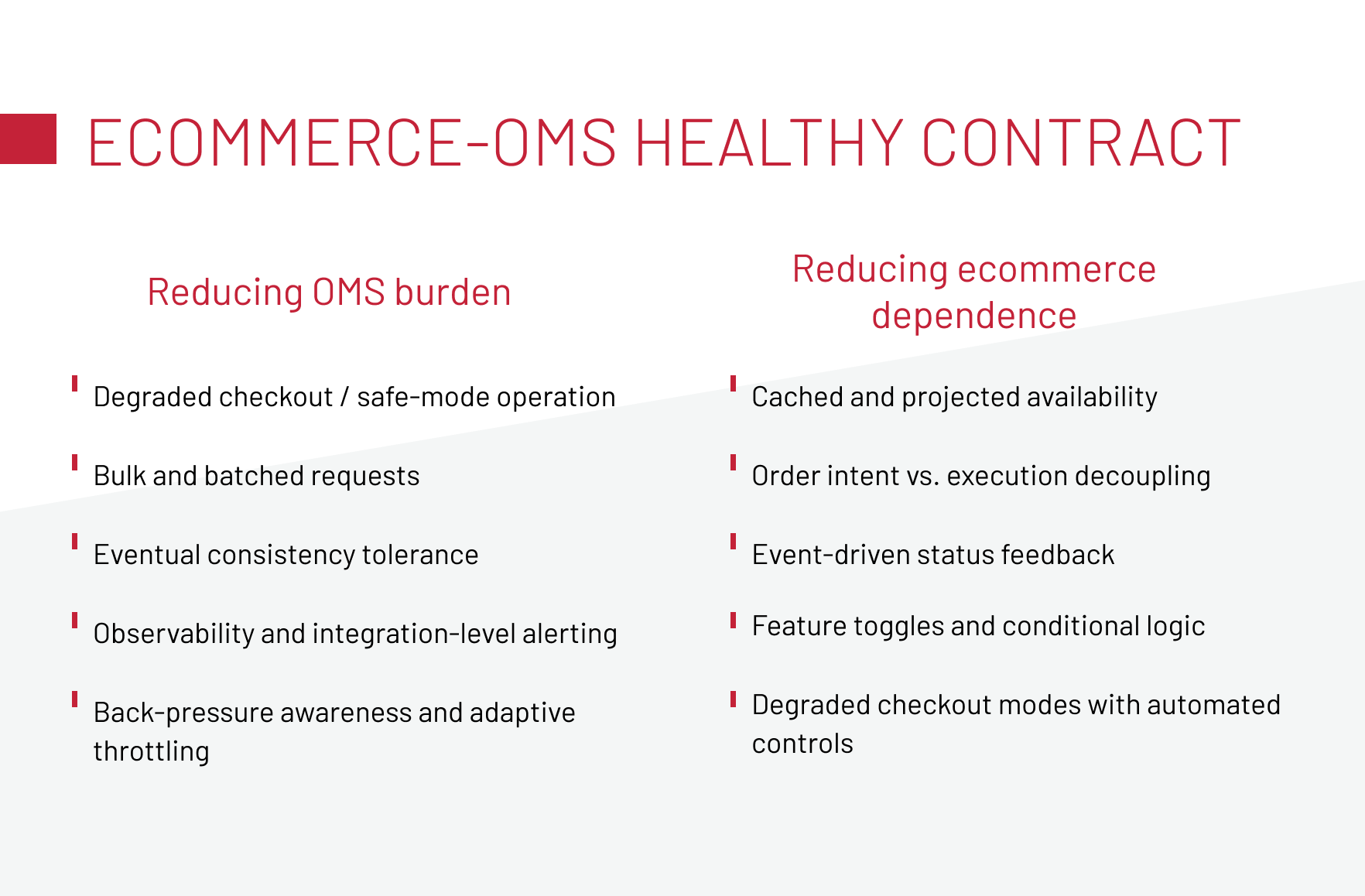
High-load environments remain stable not because individual components perform flawlessly, but because interactions across the system, including between the ecommerce platform and the OMS, follow patterns that absorb stress. In practice, two groups of strategies consistently support resilience:
- those that reduce the load placed on the OMS,
- those that reduce ecommerce’s operational dependence on the OMS during peak traffic.
Both groups work together to ensure that spikes in volume degrade gracefully rather than disrupt the purchase path.
Strategies that reduce OMS burden
These patterns lighten the operational load on the OMS so it can continue processing orders under peak conditions.
-
Degraded checkout / safe-mode operation
When the OMS signals pressure, ecommerce narrows the range of complex options, like express shipping, multi-address delivery, and intricate sourcing logic, to reduce downstream load. Feature flags and conditional flows control these adjustments. Under normal conditions, all capabilities remain available; during peaks, the flow contracts just enough to stay responsive. In a global beauty and luxury retail implementation, enabling this mode during unexpected spikes helped preserve most of the baseline conversion, compared to a full checkout stall when no degradation strategy was in place.
-
Bulk and batched requests
Order status checks, inventory updates, and cancellation operations create significant overhead when executed individually at scale. Combining many of these into batch operations reduces round-trips and evens out OMS load. Batch processors queue changes and dispatch them periodically, slightly increasing latency, while expanding total system throughput by orders of magnitude.
-
Back-pressure awareness and adaptive throttling
When the OMS communicates overload through slowed throughput or delayed acceptance, ecommerce reduces its request rate accordingly. Circuit breakers prevent retry storms, and adaptive throttling scales down non-critical operations automatically. This prevents cascade failures, where an overloaded OMS propagates instability across dependent services.
-
Eventual consistency tolerance
User experience and operational flows are designed with an understanding that OMS status updates may arrive with a delay during peaks. The UI applies optimistic updates, uses clear intermediate states, and avoids features that require real-time precision. Treating synchronization as naturally delayed enables stable customer communication without blocking the flow.
-
Observability and integration-level alerting
Monitoring OMS–ecommerce integration for throughput, latency, queue depth, and event gaps provides a controlled way to react before customers encounter issues. For example, if p95 response time moves from 200ms toward 800ms, that trend becomes an activation point for degraded-mode logic rather than a post-outage insight.
Inventory isn’t the only data that needs to be handled reliably at scale. Product data also requires clear ownership and resilient integration patterns. Download the whitepaper to see how to build product information management that remains stable as complexity grows.
Strategies that reduce ecommerce dependence on OMS
These patterns allow ecommerce to remain operational even when the OMS slows down or becomes temporarily unavailable.
-
Cached and projected availability
Instead of real-time OMS queries during browsing or cart interaction, ecommerce maintains its own view of availability using event-driven or scheduled synchronization. Pages load without OMS dependency, and the purchase path remains functional even if the OMS is responding slowly. Stale data is acceptable within controlled bounds and vastly preferable to a non-functional catalog.
-
Order intent vs. execution decoupling
Ecommerce confirms order acceptance immediately and records the order intent, while OMS processing continues asynchronously. This removes synchronous OMS calls from the checkout path. Under heavy load, the OMS may process its queue with delay, while customers already have order confirmation and remain unaffected by back-end processing lag.
-
Degraded checkout modes with automated controls
Feature toggles selectively disable capabilities that depend heavily on OMS performance. Instead of human intervention, automation triggers when OMS latency or queue depth crosses thresholds. The result is a stable checkout experience that adapts dynamically to system health.
-
Event-driven status feedback
OMS publishes order-status events, and ecommerce consumes them asynchronously rather than polling. This inversion of dependency removes blocking reads and prevents user-visible delays, even when OMS processing is slow.
-
Feature toggles and conditional logic
Ecommerce isolates complex OMS-dependent behavior behind configurable logic. During peaks, the system automatically limits or suspends the features that generate the heaviest OMS traffic. The core checkout remains fast and predictable.
Let’s Summarize
OMS failures under load follow predictable patterns, usually driven by synchronous dependencies and blurred system boundaries. The platforms that stay stable during peak events aren’t the ones relying on the best ecommerce order management software alone, but the ones designed to absorb delay, apply back-pressure, and keep checkout running even when downstream systems slow down.
Resilience comes from architecture, not reaction. Designing the ecommerce-OMS interaction to prevent performance bottlenecks before they appear is what protects revenue, operations, and customer trust. If you’re noticing early stress signals, it’s often worth reviewing those boundaries before traffic forces the issue.
Focused on scaling complex ecommerce platforms, Andreas Kozachenko, Head of Technology Strategy and Solutions at Expert Soft, brings strategic insight into optimizing order management systems to support high-load operations and evolving business demands.
New articles

See more

See more

See more

See more

See more