
MPA to SPA Migration: What Changes Architecturally and Operationally

One of the most common reasons companies move from a multi-page application (MPA) to a single-page application (SPA) is the expectation of faster front-end performance and more flexible UI development. That expectation is supported by performance data: research across more than 27,000 landing pages shows that sites loading in 1 second achieve conversion rates up to three times higher than those loading in 5 seconds, and up to five times higher compared with 10-second load times.
The issue is that an SPA does not deliver these gains by default. Poorly planned migrations can slow first load, complicate SEO, and introduce new operational risks. What changes in an MPA-to-SPA migration is responsibility, as performance, routing, SEO, and error handling shift toward the front-end, reshaping both architecture and daily operations.
That is why it is critical to understand this shift not only from the technical side but structurally as well: responsibilities move, architectural assumptions change, and operational processes develop. Drawing on Expert Soft’s enterprise modernization experience, in this article, we’ll focus on those changes and what they mean for teams and platform stability.
Quick Tips for Busy People
Here are the main takeaways if you want the short version.
- SPA vs. MPA reshapes responsibility: Routing, state, performance, SEO, and error handling shift toward the front-end.
- Performance gains come with complexity: SPAs improve responsiveness but introduce first-load and operational challenges.
- Headless architecture and SPAs are related but separate choices: headless works with MPAs, while SPAs typically require headless separation to manage routing, rendering, and data flow.
- User behavior should guide architecture: SPAs suit long, stateful, highly interactive flows, while MPAs often fit content-heavy, SEO-driven entry points, though many systems blend both.
- Hybrid models distribute responsibility: SPAs own rich, stateful interactions and client-side logic, while server-rendered pages handle first load, SEO, entry points, and core reliability concerns.
- State and debugging become harder: multiple client-side states and navigation paths require end-to-end visibility across routing, data flow, and user actions.
- Migration resembles reimplementation: SPA transitions often break legacy assumptions around rendering and data flow, requiring early architectural decisions, much like broader legacy system migrations.
Below is a closer look at where these differences show up.
SPA vs. MPA: Brief Overview
Before comparing how responsibilities shift between SPA and MPA architectures, it helps to quickly recall what SPA software is and how it differs from traditional multi-page applications.
In a multi-page application, the responsibility is clear and centralized. The server handles routing, decides what each URL represents, renders the view, and returns complete HTML. Every navigation starts a new request-response cycle. It’s a familiar model, with the presentation layer firmly on the server and shaped by traditional MVC patterns.
Single-page applications shift that balance. The first request delivers a JavaScript application that initializes in the browser and takes over navigation. From that point on, the front-end interprets URL state, assembles views, and fetches data through APIs.
Once that shift happens, the effects tend to ripple outward. Logic that previously lived entirely on the server: session state, error context, user journey tracking, ends up shared across client and server. Over time, this influences not just code structure, but also how teams collaborate, how deployments are organized, and how systems are monitored in practice.
Here’s how SPA vs MPA architectures compare across key technical dimensions:
Single-page and headless combination
It’s worth pausing here, because SPA is often mistakenly assumed to imply headless architecture. Both approaches rely on APIs, so at first glance they can look tightly coupled. In reality, they solve different problems and should be considered separately. Headless doesn’t inherently require an SPA, and choosing an SPA doesn’t automatically imply headless architecture.
Headless MPAs are entirely viable. In this setup, the back-end exposes functionality through APIs, while the front-end remains page-based and server-rendered. The two layers are decoupled at the architectural level and can be developed and deployed independently. This is still a headless approach, just paired with traditional server-side rendering rather than client-side routing.
However, from our practice, SPAs are most often paired with headless separation. In our cosmetics retailer implementation, this combination enabled independent front-end deployments, faster iteration, and clearer team boundaries.
Our team has guided enterprises through complex migrations from legacy systems to modern SPA architectures. We understand the risks, the gotchas, and how to get it right the first time.
Talk to Our TeamMPA vs. SPA: When to Choose
The architectural decision here isn’t about preference or trend. It’s driven by how users interact with the product and the constraints the business operates under.
Low time-on-site scenarios, like news portals, documentation sites, and content blogs, rarely benefit from SPA overhead. Users arrive, consume content, and leave. Interaction depth is shallow, so the advantages of client-side routing and state management never fully materialize.
Ecommerce enterprise platforms behave differently. A customer configuring a laptop may spend 20–30 minutes filtering SKUs, comparing specs, adjusting options, managing cart state, and moving through checkout. In those sessions, responsiveness matters because interaction doesn’t pause between page loads. That interaction pattern typically involves repeated filtering and comparison, ongoing state changes, and continuous navigation without leaving the flow.
However, interaction depth is only one dimension of the decision. Traffic models and operational constraints can shift the equation. Content-heavy platforms with strong SEO dependencies face tighter trade-offs. If organic search drives a significant share of traffic and budgets don’t support pre-rendering infrastructure or SSR, MPA often becomes the pragmatic choice.
That alignment also affects cost structure. SPAs typically come with a higher upfront investment:
- Routing architecture
- SEO readiness and preparation
- Performance optimization
- State management patterns
These foundations require deliberate planning and stronger front-end ownership. Over time, operational costs may trend lower. Once the foundation stabilizes, release cycles compress as front-end deployments decouple from back-end changes, allowing teams to move faster with less coordination overhead.
From a UX perspective, that investment pays off primarily in products where users stay and interact rather than consume and exit. When session continuity, maintained state, and uninterrupted flows matter, a well-implemented SPA delivers measurably better perceived performance once first-load challenges are addressed.
Hybrid approach
Adopting SPA patterns doesn’t require rebuilding the entire front-end as a single-page application. In practice, teams often introduce SPA-style components within an MPA, applying client-side rendering only to specific, highly interactive areas where it delivers clear value. This allows teams to improve user experience selectively without committing the whole application to a full SPA architecture. This selective approach often shows up as:
- SPA for highly interactive, stateful features
- Traditional rendering for content and static pages
- Clear separation at the routing level
Another common pattern is embedding SPA widgets inside an MPA. Interactive filters, real-time dashboards, or configuration tools can live as isolated SPA components, while the surrounding page keeps a traditional structure. This works best when functional boundaries are well defined, and the stateful parts can be cleanly contained.
As architectures evolve this way, the implications aren’t limited to rendering or routing decisions.
New Front-End Ownership Areas in SPA Architectures
The operational challenge here is the expansion of front-end team responsibilities into domains that previously lived elsewhere in the stack.
Routing and API communication
In MPAs, routing is largely implicit from the front-end perspective. The server owns URL mapping, rendering, and response construction, and each navigation is a discrete request-response cycle. From the browser’s point of view, pages arrive fully formed.
SPAs make routing explicit and virtual. It lives in browser memory, managed through the History API or hash-based navigation. The front-end defines URL-to-view mappings, handles transitions without document reloads, and keeps rendered UI consistent with URL state.
Once routing moves client-side, a set of responsibilities naturally follows:
- Deep links must resolve correctly
- Browser history has to behave predictably
- Route guards and redirects shift to the front-end
- Page reloads must reconstruct the correct application state
- Bookmarked filtered views need to open as expected
- Refreshing mid-flow shouldn’t drop the user or transaction context
At that point, state reconstruction belongs entirely to the front-end.
Back-end communication changes in parallel. Instead of implicit data flow through server-side rendering, interactions become explicit and contract-based. View updates, data mutations, and state changes are expressed as API calls with defined request and response shapes. Those contracts require versioning, backward compatibility planning, and coordination between front-end and back-end teams. When they change unexpectedly, front-end functionality breaks immediately and visibly in production.
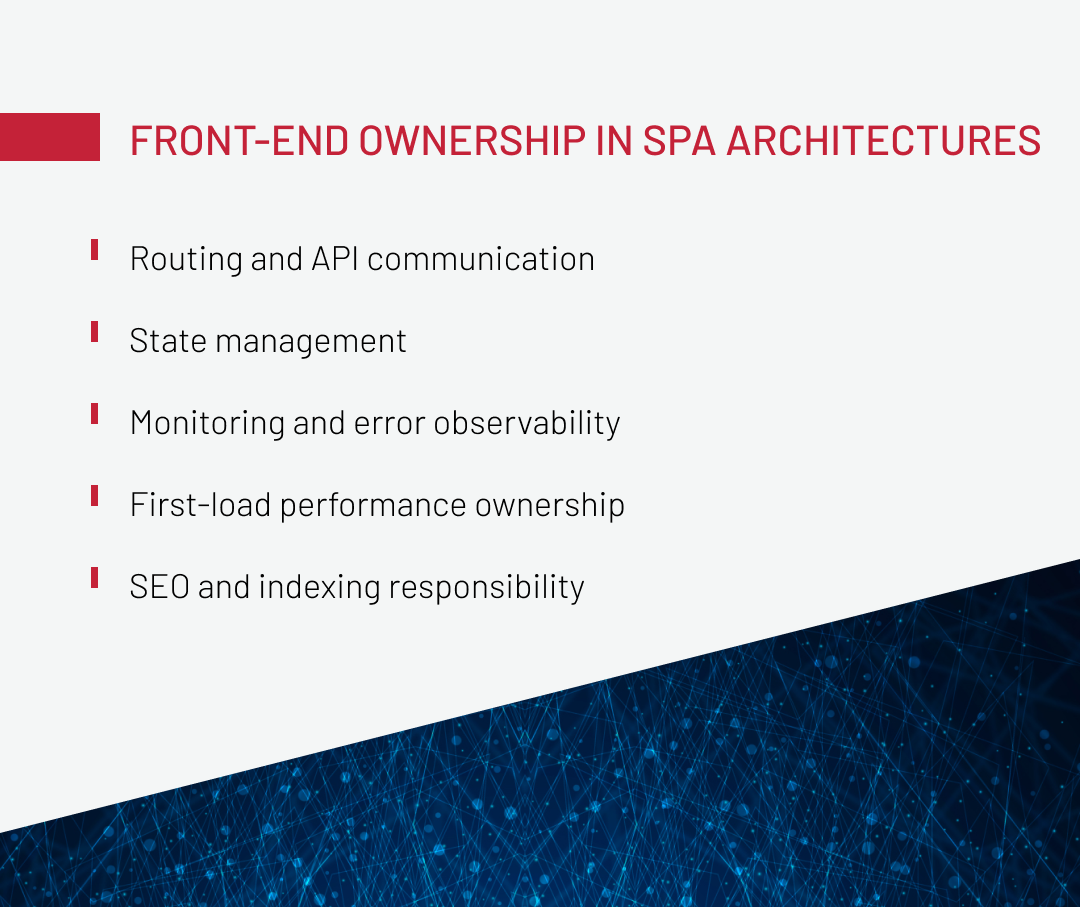
State management
In MPAs, state ownership is centralized. The server remains authoritative, with user actions triggering request-response cycles that carry the required context and maintain session continuity.
SPAs distribute state across client and server boundaries. The browser holds UI state, interaction context, navigation history, and cached data, while the server remains responsible for durable changes. Deciding what synchronizes with the back-end and what stays client-side becomes an architectural decision with implications for performance and consistency.
Some states fit naturally on the client. Accordion expansion, search input before submission, and modal visibility don’t require server awareness. Other changes, such as cart updates, saved preferences, or form submissions, need server synchronization and introduce optimistic updates and rollback handling.
As state interdependencies grow, complexity follows. A filter change on a product listing can affect visible results, active filters, product counts, facet values, and sometimes the URL itself. Keeping those pieces consistent depends on clear ownership boundaries and predictable update flows, regardless of the state management approach in use.
Monitoring and error observability
In MPAs, error investigation usually starts at a clear request–response boundary. A failed request appears in server logs, the execution path is traceable, and the issue can be isolated. SPAs remove that single entry point. Failures can emerge after multi-step user interactions that span multiple client-side states and API calls.
As a result, reproducing issues depends on reconstructing the full user journey. A report like “checkout doesn’t work” can represent dozens of different paths, each exercising different client logic and back-end endpoints. Without visibility into event sequences, state transitions, and API timing, teams are left guessing.
This is where proactive monitoring becomes mandatory. Session replay, structured user event tracking, contextual error capture, and client–server tracing allow teams to detect breakage patterns early and diagnose issues before they escalate.
First-load performance ownership
Once an SPA is loaded, interactions feel immediate, but that responsiveness comes at the cost of the initial page load. The first request must deliver the application framework, unlike MPAs, which spread that cost across routes and load only what each view requires.
SPAs front-load more responsibility. Routing, state management, component frameworks, and baseline UI code all ship up front, and when the initial bundle grows to 3–5MB of JavaScript, users on slower connections wait while the application bootstraps. Framework research shows wide variance here: compile-time optimized approaches can ship baseline bundles as small as 22KB, while runtime-heavy frameworks often start at several hundred kilobytes before application code is added.
At that point, lazy loading, code splitting, and performance budgets stop being optional optimizations and become ongoing responsibilities of the front-end development team, requiring continuous enforcement throughout the development cycle, not a one-time pass at launch.
Understand which AI foundation fits your enterprise today, what it will cost tomorrow, and how to move toward a scalable AI core with a clear execution plan. Download the whitepaper.
SEO and indexing responsibility
Client-side rendering changes when content becomes visible to search engines. With server-rendered pages, indexing happens immediately. With SPAs, meaningful content exists only after JavaScript executes, and crawlers may delay, partially render, or skip that step altogether.
For platforms that rely on organic traffic, this creates measurable risk. Pages can appear later in search results, ranking signals may weaken, and visibility becomes uneven across large content sets. Teams often address this with pre-rendering, which restores HTML for crawlers but introduces operational work around builds, cache invalidation, and content refresh.
Core Web Vitals and metadata management add further pressure. Large JavaScript bundles complicate performance targets, while titles, descriptions, and structured data must be actively managed on navigation and kept in sync with any pre-rendered output. SEO becomes an ongoing engineering concern rather than a passive benefit of the architecture.
MPA-to-SPA Migration
Migrating a production platform forces teams to balance architectural change with the realities of an already running system.
Team readiness and skill requirements
SPA development calls for a different skill set than traditional server-side rendering with light client-side scripting.
Teams with strong server-side backgrounds and jQuery-era JavaScript experience don’t automatically have the patterns needed for large client-side applications. State management, routing, performance optimization, and SSR introduce architectural decisions that may not be part of the team’s current practice.
Without clear ownership and architectural direction, these decisions tend to be made implicitly during feature development, which leads to inconsistencies and technical debt that are difficult to unwind later.
-

Pro tip:
Before building features, appoint a front-end architecture owner and formalize core decisions around state flow, routing model, and build strategy — these foundations determine the long-term stability of the SPA more than any individual component.
Upfront architecture assessment and documentation
Many SPA migration issues start before any production code is written. Teams begin implementation without clearly defining how the system is supposed to behave under real usage and failure conditions. Before moving forward, there needs to be shared clarity on a core set of architectural decisions:
-
Routing structure and URL patterns
how user scenarios map to routes, how parameters are handled, and which routes represent indexable pages versus internal states.
-

State management and data flow
what state must persist across navigation, what can be ephemeral, and how client, server, and cached data stay consistent over time.
-

SEO strategy by page type
how SEO is handled for pre-rendered pages, SSR routes, and client-only views, including metadata ownership and crawl expectations.
-

API contracts and versioning
how APIs are defined, how breaking changes are introduced, and how multiple client versions are supported during migrations.
-

Error handling and observability
how errors propagate across client and server, what gets logged, and how user-impacting failures are detected and diagnosed.
-

Performance budgets and enforcement
what limits exist for bundle size and load time, and how those limits are enforced during development and CI.
-

Security model
how authentication, authorization, and sensitive data handling work across client-side routing and APIs.
-
Cache invalidation for pre-rendered content
how and when cached pages are regenerated as data changes, and how stale content is prevented.
These decisions shape the system long before features do. In SPAs, early architectural gaps don’t stay isolated. As the codebase grows, they accumulate, and every new feature inherits the same constraints, making later corrections increasingly costly.
-
Pro tip:
Maintain a shared architectural decision log throughout the migration, as without a single reference point, SPA conventions around routing, state, and APIs begin to diverge quickly and create avoidable technical debt.
Back-end preparation for API-first interaction
Many MPA back-ends aren’t designed for SPA consumption. Server-side rendering pushes data directly into templates and returns HTML, while SPAs expect structured JSON from well-defined endpoints. Supporting that shift usually means adding a clear API layer and treating the back-end more like a service than a rendering engine.
Most core logic can stay as is. Data processing, validation, and domain models typically carry over. What changes is the interface that the front-end depends on. That brings a set of API-level concerns that need to be addressed explicitly:
- Clear request and response schemas with consistent HTTP semantics
- Standardized error formats and status codes
- Authentication and authorization at the API layer
- CORS handling for cross-domain front-ends
- Rate limiting and versioning expectations
Endpoint granularity also matters. Overly coarse endpoints waste bandwidth, while overly fine-grained ones create long request chains. The right balance depends on real front-end usage patterns, not internal back-end structure.
-
Pro tip:
Define formal API contracts early, as a shared specification reduces integration friction and exposes mismatches before they reach production.
Front-end migration
Front-end migration rarely means reusing existing code as-is. Moving from a page-based model to an SPA changes how interactions, state, and navigation are handled, so many parts of the UI have to be redesigned rather than simply adapted.
To see how this works in practice, consider a French cosmetics retailer with multiple business units sharing a common front-end codebase. Each unit had its own roadmap and priorities, so the migration moved incrementally, unit by unit, within a live system.
Early phases focused on defining shared components. Some became reusable building blocks for later units, while others were too tightly coupled to legacy assumptions and had to be rebuilt. Bundle size quickly became a gating factor, forcing teams to evaluate whether reuse justified the added weight.
Learn how to prepare mature ecommerce systems for reliable third-party integrations. Download the whitepaper to see how to eliminate fragile connections and make integrations scale without breaking your platform.
As SPA patterns expanded, the definition of a “feature” changed. Interactions now required coordinated client-side behavior: managing state across views, sequencing API calls, handling partial failures, and controlling loading and error states. Structural concerns like dependency cycles became more visible and required deliberate module boundaries.
Across the migration, one pattern stayed consistent. Progress depended less on coding speed and more on the clarity of architectural decisions made upfront. SPA complexity doesn’t come from individual features, but from how legacy patterns and modern approaches are reconciled over time.
-
Pro tip:
Treat each migrated unit as an architectural pilot — validate component reuse, bundle impact, and state complexity in isolation before scaling patterns across the shared codebase.
All points mentioned set the context for what front-end teams run into during real migrations.
SPA Migration Advice from Front-End Developer
Based on hands-on migration experience across multiple enterprise platforms:
-

Tip 1: Check back-end API readiness earlier than you think
Even modern back-ends aren’t always prepared for API-first interaction. It’s worth confirming early that all required states can be serialized to JSON, endpoints are well defined, and authentication lives at the API layer.
-

Tip 2: Treat pre-rendering as an architectural decision, not a patch
Pre-rendering works best when it’s designed from the start. That means understanding how static HTML will be generated, which pages need it, how updates are triggered, and how cache invalidation works. Adding it to an SPA that wasn’t built for it usually leads to deeper rework than expected.
-
Tip 3: Decide on lazy loading up front
Which components load immediately and which load on demand affect bundling, code organization, and loading state handling across the app. When lazy loading is postponed as an optimization step, it often forces broader structural changes later.
-

Tip 4: Make architectural ownership explicit
Having someone who can hold the full system model, anticipate failure modes, and make consistent decisions helps establish patterns the rest of the team can follow. In SPA work, small ad-hoc decisions tend to cascade, so early coherence pays off.
-

Tip 5: Invest in monitoring before the first production issue
Adding visibility “later” often means encountering bugs you can’t reproduce because the user journey context is missing. Session replay, error tracking with full context, and user action logging work best when they’re part of the baseline, not retrofitted under pressure.
-

Tip 6: Set performance expectations early and keep them visible
Defining acceptable bundle sizes, time-to-interactive targets, and LCP thresholds upfront makes regressions easier to catch. Teams usually find it far simpler to prevent performance drift than to recover from it after launch.
Across all of these lessons, the same pattern emerges as in the rest of this article: SPA migration is not a sequence of technical improvements, but a redistribution of responsibility. The earlier that shift is acknowledged and structured, the fewer hidden risks surface later in production.
Final Word
SPA and MPA architectures differ primarily in where responsibility lives across the system. Shifting routing, state, performance, SEO, and error handling to the client changes how applications are built and operated.
SPAs offer clear advantages, such as smoother interactions, faster release cycles, and stronger long-term flexibility, but these benefits are realized only when architectural nuances are addressed early, and a solid foundation is built from the start. Otherwise, the added complexity can erase the gains and introduce more problems than solve.
That shift demands explicit ownership and disciplined architectural execution across the front-end and supporting APIs. If you’re already operating in this model or moving toward it, our team is open to a practical discussion grounded in your current platform and constraints. Let’s talk.
New articles

See more

See more

See more

See more
See more