
How to Improve B2B Experience with Self-Service Features

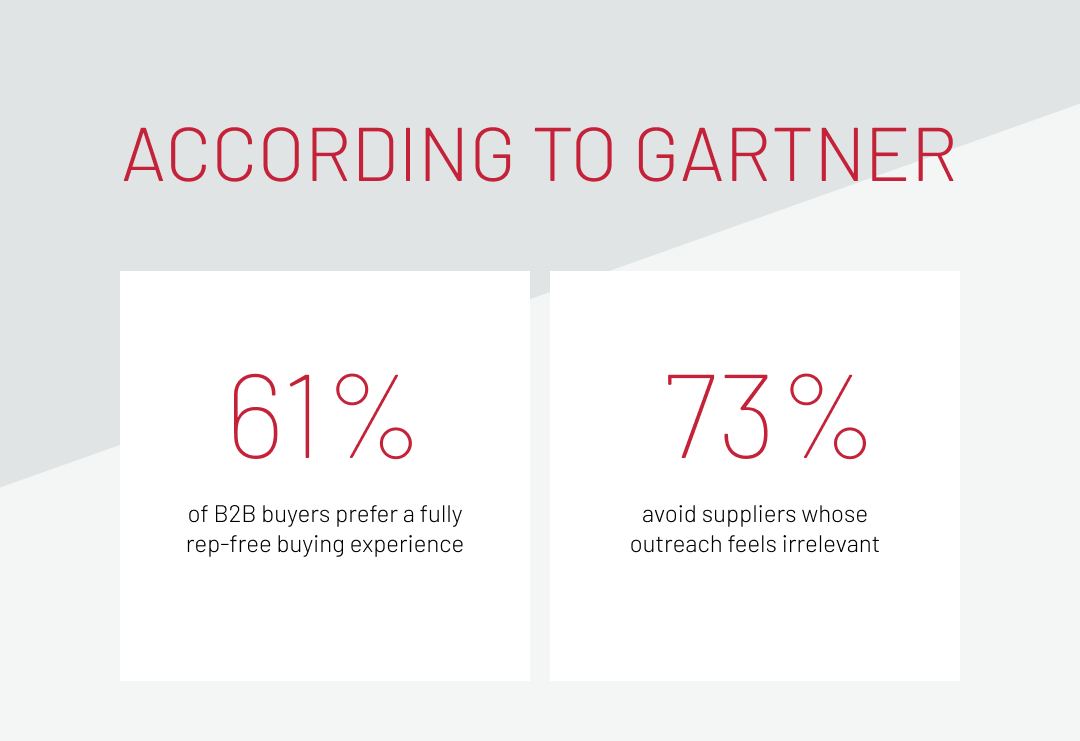
B2B buyers now expect the same digital fluency they get as consumers: real-time visibility, instant confirmation, and no middlemen. That expectation is measurable. According to Gartner, 61% of B2B buyers prefer a fully rep-free buying experience, and 73% actively avoid suppliers whose outreach feels irrelevant. When more than half of buyers want to avoid sales conversations altogether, platforms start to be judged on how easily someone can evaluate, purchase, and move forward on their own.
But B2B self-service has another role beyond buyer convenience. Done right, it’s an architectural mechanism that standardizes internal workflows, eliminates manual handoffs, and reduces operational overhead at scale. Alongside making the buying process easier for customers, companies also need to consider how their internal operations are structured so buyers can move forward without creating unnecessary operational noise.
This article looks at self-service through an operational lens: what it changes inside B2B platforms, which capabilities are non-negotiable, and where implementations typically break under scale. The article is grounded in practical delivery experience from Expert Soft’s ecommerce website development services, including projects where self-service capabilities had to support complex workflows, integrations, and operational control.
Quick Tips for Busy People
These are the core operational effects of B2B self-service when it’s designed to scale.
- Self-service solutions change internal operations: structured digital workflows standardize how quotes, approvals, and transactions move through the business.
- Better customer autonomy needs business control: in B2B, buyer independence only works when governance, traceability, and approval logic are built into the process from the start.
- Operational efficiency comes from removing routine coordination: the real value of self-service appears when repetitive manual actions stop consuming sales and operations time.
- Core capabilities define whether self-service is usable: role control, workflow logic, reporting, and automation are what turn a portal from a front-end layer into a working commercial system.
- Architecture determines whether self-service survives complexity: once B2B workflows involve multiple systems, user contexts, and transaction states, technical design becomes a business requirement.
- Scalability is about stability under real conditions: load spikes, integration failures, and silent workflow bottlenecks expose weak architecture long before they show up as obvious technical incidents.
- Reliability requires observability and resilience: business-logic monitoring detects degradation and stalls before they become commercial failures.
At the system level, these effects translate into changes in workflow design and execution.
Key Impact of B2B Self-Service
B2B ecommerce customer self-service is often discussed as a buyer-facing feature, but as part of broader B2B commerce trends, its real impact shows up inside the business. When commercial interactions move into structured digital workflows, they change how processes are defined, enforced, and scaled. Here we’re going to break down the most important operational effects of B2B self-service in terms of how it reshapes day-to-day commercial execution across teams, systems, and decision cycles.
Process standardization across commercial workflows
Historically, many steps in B2B commercial processes are handled through manual coordination: email threads, spreadsheets, or internal approvals routed through sales or operations teams. Each quote request may follow a slightly different path. Discount approvals can depend on informal rules or individual judgment. When companies scale, this variability often turns into operational friction, which in enterprise commerce can be even more problematic than simple inefficiency.
Self-service forces standardization. When customers interact with a defined digital workflow, the business has to codify its commercial logic:
- What triggers a discount request?
- Who reviews it?
- What states can a quote have?
- What happens on expiration?
That’s a prerequisite for repeatable, auditable operations.
Let’s look at the case of one of our clients, a B2B manufacturer and distributor of medical equipment. They had an entirely offline discount request process. Customers called or emailed their sales reps, who handled each request manually and inconsistently.
We digitized the full flow: customers can now submit discount requests directly through the platform, sales reps review and finalize quotes in an integrated system, and customers receive automated email notifications with finalized pricing. Updates to quotes are reflected in real time, and every original quote is archived for traceability. The outcome was a structured, reproducible process that the business could manage, monitor, and measure reliably.
Improved commercial accuracy and traceability
In B2B, it’s not enough to know that an order was placed. You need to know what quote it came from, what approval authorized the pricing, which account the order belongs to, and what changed between version one and version three of the quote. That audit trail is a compliance and dispute-resolution requirement.
Manual processes make consistency difficult to maintain. Pricing updates may happen in spreadsheets without version history, while orders are sometimes created with details that differ from the approved quote. When records no longer match, teams have to investigate what was agreed with the customer and reconcile the discrepancy across systems.
Self-service architectures can help introduce consistency by design. When implemented around quoting or ordering workflows, for example, quote states may be tracked programmatically, order creation can be tied to an approved quote record, and key changes such as pricing updates, status transitions, or ownership updates may be logged automatically.
As a result, commercial agreements remain fully traceable over time, with a clear record of how pricing, approvals, and quote versions evolved.
Faster decision cycles in complex B2B transactions
In B2B procurement, speed is determined by how quickly requests progress through approval and ordering without unnecessary delays. Structured digital workflows help streamline approval steps that are often coordinated through calendar invites, forwarded emails, or ad-hoc calls.
The value becomes especially clear in high-pressure scenarios. During the pandemic, a global medical technology provider faced a critical procurement challenge: hospitals urgently needed ventilators, but the existing purchasing process with a full suite of standard validation steps wasn’t built for emergency conditions. We were brought in to design and implement an accelerated approval and purchasing flow, implementing the technical logic that allowed urgency to override standard gatekeeping rules while preserving control.
This wasn’t a fully self-service implementation, and in many complex B2B contexts, it doesn’t need to be. The lesson here is architectural: introducing self-service features for buyers usually requires the underlying workflows to be formalized, allowing approval steps to be configured based on context, urgency, or buyer tier. The buyers get the independence they need while the business keeps the governance it requires.
Expert Soft offers professional ecommerce development services for B2B self-service platforms, helping teams design scalable architectures that support complex workflows without compromising control. Reach out for a technical conversation.
Let’s TalkTransparent procurement lifecycle for customers
One of the most expensive operations in a self-service B2B ecommerce team is answering status questions. “Where’s my quote?”, “Has my order been approved?”, “Why hasn’t anything happened in five days?” These questions cost time on both sides, and they’re entirely avoidable.
Self-service gives buyers visibility into the full procurement lifecycle, from quote submission through approval, order creation, and fulfillment. Approval progress is visible in real time, with status transitions triggering automatic notifications, so buyers can track progress directly without relying on sales representatives for updates.
The reduction in status-related inquiries goes beyond support efficiency, easing the informal burden on sales reps and account managers and allowing them to focus on higher-value commercial work. Predictability in the process builds trust in the platform, and trust in the platform means buyers use it more consistently.
Controlled buyer autonomy within governance boundaries
In B2B, autonomy only works within a governance framework: role hierarchies, spending thresholds, approval rules, negotiated pricing tiers. Without that structure, you have an ungoverned order entry system waiting to create problems.
A leading industrial supplier we worked with needed exactly this balance. Their clients ranged from small procurement teams to enterprise accounts with complex approval hierarchies.
The solution, built on SAP Commerce Cloud with Spring Boot and integrated with Microsoft Dynamics and HubSpot, included:
- Role-based access control across buyer, approver, and admin tiers
- Bulk ordering with workflow-driven approvals
- Negotiated pricing per client segment
- Self-service portal for order tracking and history
As a result, they got a platform where buyers could operate independently at the transactional level, but every action happened within predefined commercial and organizational parameters.
That’s what controlled autonomy looks like in practice: the buyer moves faster, but the business retains full visibility and control over what they can do.
Operational efficiency through automation of repetitive processes
The most labor-intensive parts of B2B commerce operations tend to be repetitive, low-value touchpoints, such as quote expiration reminders, pending approval notifications, and status updates as orders move through each stage. These tasks require human time, which is exactly what you don’t want to spend on them.
Automation handles the lifecycle. In the quote management system we built for the medical equipment client mentioned earlier, we implemented a notification engine that triggered automated reminders at defined intervals in the quote lifecycle: after seven days of inactivity, seven days before expiration, and on the expiration date itself. The system kept the process moving without anyone having to manually track quote states or chase customers.
When the automation works, operations teams stop babysitting transactions and start managing exceptions, which is where their time actually creates value.
These outcomes depend on the underlying system being designed to carry operational load at scale.
Core Capabilities of a B2B Self-Service System
Building self-service for enterprise B2B isn’t a feature list exercise. It’s an infrastructure design problem. Here are the capabilities that separate a scalable system from one that creates new operational problems while solving old ones.
-

Role-based access control (RBAC)
B2B customer self-service has hierarchies, like buyers, approvers, admins, procurement managers, and self-service without role enforcement is just chaos with a nicer interface. RBAC defines what each user type can see, initiate, approve, or modify. In the industrial supplier portal we talked about above, RBAC was foundational: different user types had distinct permissions at every stage of the ordering and approval process, ensuring the system reflected organizational structure.
-

Integration with core business systems
A self-service portal is only as accurate as the systems it talks to. Inventory levels, pricing rules, invoicing status should be synchronized in real time with your ERP, CRM, and pricing engine. When pricing or inventory data in the self-service interface is out of sync with core systems, buyers may make decisions based on incorrect information, creating discrepancies that teams must later resolve manually.
-

Visibility and reporting infrastructure
Operations teams need to see what's happening in the system, not just transactionally, but at the aggregate level. In the quote management system, we built specific reporting views for carts with quotes to provide visibility into the pipeline split between quoted and unquoted orders. In this case, the self-service layer functions not only as an operational interface but also as a source of structured commercial insight.
-

Automation and notification engine
The system needs to sustain its own process. Quotes move through defined states, approvals have deadlines, and both customers and internal teams need timely notifications when action is required. Without an embedded notification engine, the operational load moves back to the team manually monitoring statuses. The notification engine is what keeps the automation actually running without human intervention
-

Workflow and approval management
The self-service system needs configurable workflow management that supports commercial thresholds, sequential or parallel approvals, escalation rules, and exception handling. When a quote exceeds a spending limit, the system should know what to do next.
-

Audit trail and transaction logging
Enterprise environments have compliance requirements. Every status change, approval action, pricing adjustment, and user interaction needs to be logged, timestamped, and attributable. This makes the foundation for dispute resolution, financial reporting, and regulatory compliance.
Capabilities define intent, and architecture determines whether that intent survives real-world load, integration, and complexity.
Technical Considerations for a B2B Self-Service Architecture
Next, you need to make sure the architecture can sustain it under real-world conditions: varying load, complex integrations, and multiple user contexts operating simultaneously.
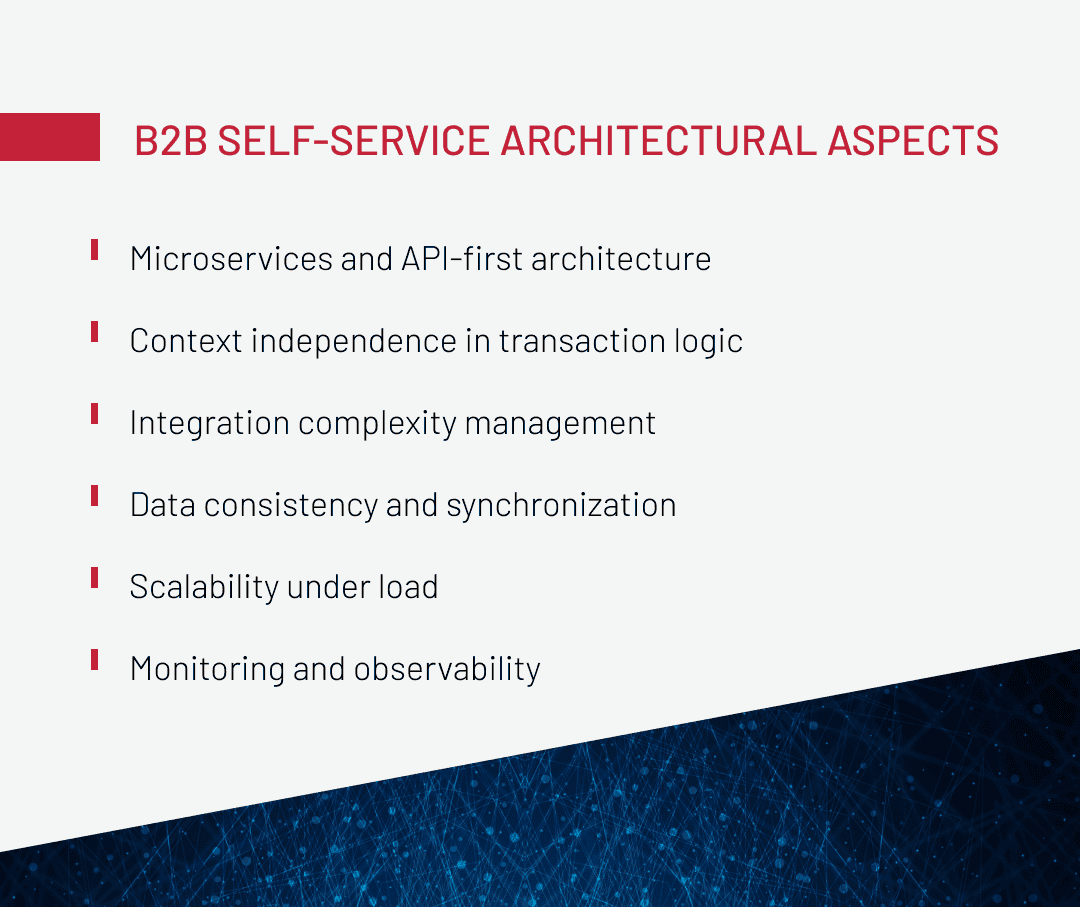
Microservices and API-first architecture
B2B self-service scenarios span pricing, approvals, ERP integrations, role management, and reporting. These components evolve on different timelines and have different scaling requirements. In a monolithic architecture, changes or scaling in one part of the system often require adjustments across the entire application, which can limit flexibility as the platform grows.
Building microservices with an API-first design gives you independent scalability per component, safer deployments with an isolated blast radius, and cleaner integration contracts with external systems. When a new workflow is needed, let’s say, a new buyer tier or a custom approval path, you can build and deploy it without restructuring the entire platform.
Context independence in transaction logic
In B2B environments, transactions, particularly quotes, may be processed by users other than the one who initiated them. For example, buyers opening quote links from email while logged into a different account context, sales representatives accessing quotes on behalf of clients, or B2B unit administrators reviewing transactions created by subordinates.
If your quote-to-order conversion logic depends on the active session context, you’ll get failures at the conversion step whenever the logged-in user doesn’t match the B2B unit associated with the quote. We hit this exact issue in the medical equipment quote management system: when a quote link was opened while the active session belonged to a different B2B unit than the one associated with the quote, the system produced conversion failures and invisible order states.
The fix was architectural, involving the complete removal of session dependency so that the quote itself became the authoritative source of buyer identity and B2B unit ownership, allowing quote links to be processed regardless of login state and stabilizing conversion.
What this comes down to is that B2B transactions can’t depend on user sessions. They need to carry their own context, like ownership, unit, pricing, and state, instead of borrowing it from those who are logged in.
Integration complexity management
A B2B self-service platform rarely operates in isolation. It integrates with ERP for inventory and order management, CRM for account data and communication history, pricing engines for contract-based rates, invoicing systems for financial reconciliation, and payment gateways for transaction processing. Each integration is a potential point of failure, desynchronization, or conflicting state.
Managing this complexity requires deliberate design: clearly defined integration boundaries, event-driven synchronization where real-time polling is too expensive, resilient retry logic, and circuit breakers that prevent a failing external system from cascading into the self-service layer. The goal here isn’t just connectivity, it’s more like reliability.
Integration fragility is usually an architectural side effect. Download the whitepaper on building integration-ready ecommerce systems.
Data consistency and synchronization
In B2B commerce, the cost of a data discrepancy is a pricing conflict, a disputed invoice, or a customer who placed an order based on inventory that was allocated elsewhere. Maintaining a single source of truth across pricing, inventory, quote ownership, and order status is a core architectural responsibility.
Practical priorities:
- Data integrity mechanisms that prevent conflicts between systems.
- Synchronization protocols that keep order and invoice states aligned.
- Clear ownership rules that define which system is authoritative for each data type.
If something goes wrong, auditability means you can trace the discrepancy back to its source rather than having to reconstruct it from memory.
Scalability under load
B2B portals face non-uniform load patterns. Seasonal procurement cycles, bulk quote requests during contract renewal periods, or emergency purchasing scenarios can create traffic spikes that expose weaknesses in your approval logic, integration layer, or database layer. A system that works perfectly at average load and breaks at peak load is not a production-ready self-service system.
Architecture decisions that matter here include:
- Asynchronous processing for non-blocking approval workflows
- Queue-based integration with external systems to prevent synchronous failures from blocking orders
- Read replicas for catalog and pricing queries
- Load-tested deployments that validate performance under realistic peak conditions.
Monitoring and observability
In complex B2B systems, integrations can degrade without failing outright, workflows can stall at specific approval steps without obvious errors, and pricing synchronization can lag for hours before incorrect rates are noticed. Without proper observability, these issues often become commercial failures long before they surface as technical problems.
Observability means structured logging of transaction states, integration health metrics, approval queue depths, and notification delivery rates, along with alerting on anomalies in business logic, not focusing only on infrastructure metrics. When a quote enters an unexpected state, or an order sits in “pending approval” for 48 hours without moving, the system should tell someone.
If AI is becoming part of your commerce architecture, this whitepaper breaks down how to design a scalable AI backbone instead of layering disconnected tools.
Download the WhitepaperFinal Word
B2B self-service solutions are usually evaluated through the lens of customer experience first, and that makes sense. But the value of self-service becomes visible when it is approached not as a feature layer, but as a way to restructure how the platform supports commercial interactions overall.
At that point, self-service starts improving more than the customer-facing side of the process. It helps turn fragmented actions into a more consistent operating model, where approvals move in a clearer way, decisions are easier to track, and the platform can support growth without pulling more routine work back to people. What looks like a convenience feature on the surface often becomes a mechanism for making the system itself more manageable.
And that is exactly what makes the customer experience stronger in the long run. When the underlying workflows are designed well, buyers get a process that feels simpler, faster, and more reliable, not because the interface looks better, but because the platform behind it is doing its job properly.
If a deeper discussion around system design, workflow structure, or architectural trade-offs would be useful, we’re open to a technical conversation grounded in real implementations.
New articles

See more

See more

See more

See more

See more